

Giving up parental rights in Florida is a profound legal step, one that permanently severs the parent-child relationship. This isn't a simple 'sign-away' process; it's a final, irreversible court order with immense legal and emotional weight. Under Florida law, this termination can happen either because a parent agrees to it or because a judge orders it. At Foley Family Law, we serve clients in Pasco, Pinellas, and Hillsborough Counties, handling all family and divorce issues, including for LGBTQ+ individuals and couples, with the sensitivity these matters require.
What Giving Up Parental Rights Truly Means

The decision to relinquish parental rights is one of the most serious considerations in all of family law. It’s far more than ending a legal connection; it’s a complete erasure of your status as a parent in the eyes of the law. This action creates lasting consequences that ripple across custody, financial obligations, and even inheritance.
At Foley Family Law, we understand the incredibly difficult situations that lead people in Pasco, Pinellas, and Hillsborough Counties to explore this option. We provide clear, compassionate guidance to all families, including LGBTQ+ individuals, to ensure you understand every single facet of this life-altering decision. We do not discriminate and handle all family and divorce issues with professionalism.
The Two Paths to Termination
In Florida, giving up parental rights falls into two distinct categories, each driven by very different circumstances.
- Voluntary Termination: This is when a parent consents to ending their rights. However, a parent generally cannot do this simply to avoid child support or other responsibilities. It must be in the child's best interest.
- Involuntary Termination: This is the most severe action a family court can take. It happens when a judge terminates a parent's rights without their consent. This is reserved for extreme situations where a parent's conduct poses a clear and present danger to the child, such as abandonment, severe abuse, or chronic neglect.
It’s crucial to understand that the court’s primary—and frankly, only—focus is the child’s best interests. A judge will not approve a termination, even a voluntary one, if it would leave the child without proper support or in an unstable home.
The legal system does not take severing parental rights lightly. It is a last resort, reserved for situations where it is absolutely necessary for the child's long-term stability and safety. It marks a permanent, unchangeable end to the legal parent-child relationship.
Understanding the Stakes
For many, particularly unmarried fathers, the journey to either assert or relinquish parental rights often begins with a more fundamental question. Before any rights can be addressed, legal fatherhood must be officially recognized. Our guide on how to establish paternity provides essential information on this critical first step.
Whether you are a parent contemplating this difficult choice or are on the receiving end of a petition filed by another party, understanding the process is vital. We serve all families with the respect and professionalism they deserve, regardless of sexual orientation or gender identity. Our team at Foley Family Law handles all family and divorce issues across Hillsborough, Pasco, and Pinellas Counties, and we are committed to providing non-discriminatory, expert legal support.
Florida's Legal Grounds For Termination
In Florida, the decision to give up parental rights is never taken lightly. The state’s legal system is built on one core principle: the well-being and stability of a child come first. This means there are very specific and strict criteria for when a parent-child relationship can be permanently severed. It's not a casual process—it's a profound legal action that demands a high standard of proof, whether the termination is voluntary or ordered by a court.
If you’re contemplating this life-altering path in Pasco, Pinellas, or Hillsborough Counties, understanding these legal grounds is the critical first step. The court’s primary duty is to protect the child, and every single decision is viewed through that lens.
When Termination Is Involuntary
An involuntary termination of parental rights is one of the most serious actions a family court can take. It happens without a parent’s consent and is reserved for situations where a parent's actions—or inactions—have created a dangerous or harmful environment for their child. Florida law lays out several severe grounds that can lead a judge to this conclusion.
These grounds aren't about minor parenting mistakes. They are about significant, often ongoing, patterns of behavior that endanger a child. Common reasons include:
- Abandonment: This is when a parent has made no significant contribution to the child's care and has had little to no communication or contact with them over a prolonged period.
- Ongoing Abuse or Neglect: If a parent’s conduct is found to be egregiously harmful—threatening the child's life, health, or well-being—the court can intervene. This covers physical, emotional, or sexual abuse, as well as severe neglect of the child's basic needs.
- Long-Term Parental Unfitness: This can involve a range of issues, like chronic substance abuse or severe mental health conditions that make a parent incapable of providing a safe and stable home. The key here is that the behavior must be ongoing and demonstrably harmful to the child.
In these cases, another party must present clear and convincing evidence to the court. A judge will not terminate rights based on accusations alone; there must be a strong factual basis to prove that severing the relationship is truly in the child's best interest. It's also important to recognize behaviors that intentionally damage the parent-child bond. If this is a concern, you can learn more about how to prove parental alienation in our related guide.
Comparing Voluntary And Involuntary Termination
Understanding the key differences between voluntary and involuntary termination is essential.
Voluntary termination is when a parent gives their consent. The primary reason is to ensure the child's best interest is met. For the court to approve this, the termination cannot leave the child without proper support.
Involuntary termination, on the other hand, is ordered by a court without the parent's consent. This is reserved for severe situations like abandonment, abuse, or neglect. The legal standard requires clear and convincing evidence that there are legal grounds for termination and that the termination is in the child's best interest. The goal is to protect the child from an unsafe or harmful environment.
Ultimately, both paths lead to a permanent legal outcome. The distinction lies in the circumstances and who initiates the action.
The Limits Of Voluntary Termination
Many people mistakenly believe they can voluntarily give up parental rights just to avoid responsibility, especially child support. In Florida, this is a huge misconception. A parent cannot simply sign a form to erase their financial obligations.
The court's position is firm: a child is entitled to the support of two parents. Allowing a parent to voluntarily terminate their rights for financial convenience would leave the child with only one source of support, which is directly against the state's goal of ensuring the child’s welfare.
There are, however, legally sound scenarios where voluntary termination is permitted, provided it serves the child's best interest and ensures their stability. For example, if another competent adult is ready and willing to assume all parental duties and support, the court may allow a biological parent to voluntarily surrender their rights. This ensures the child's financial and emotional stability is maintained or even improved.
At Foley Family Law, we serve clients from all backgrounds, including gay and transgender individuals, across Pasco, Pinellas, and Hillsborough Counties. We understand every family structure is unique and are committed to providing non-discriminatory legal support for all family and divorce issues. Whether you're dealing with a voluntary or involuntary termination, our focus is on providing clear, strategic advice tailored to your specific situation.
Navigating The Legal Termination Process
The court process for terminating parental rights is a formal and intricate journey. It’s not something that happens overnight or with a single signature; it’s a structured legal procedure with specific steps designed to ensure any decision is made carefully and with the child’s best interests at heart.
For our clients in Hillsborough, Pasco, and Pinellas Counties, understanding this path can help demystify a process that often feels overwhelming. Let’s break it down.
Starting The Formal Process
Every termination case, whether it’s voluntary or involuntary, officially begins with a legal document called the Petition for Termination of Parental Rights.
This petition is the foundational document that asks the court to permanently sever a parent's legal connection to their child. It must be filed with the circuit court in the county where the child lives.
This isn’t a simple form you just fill out. The petition has to lay out very specific and detailed information required by Florida law. Who can file it? Typically, it’s one of the following:
- The other parent.
- A legal guardian.
- The child themselves, acting through a legal representative.
The petition must clearly state the legal grounds for the termination and include specific facts to back up those grounds. The goal is to make a clear case for why severing parental rights is in the child’s best interests. This first step is critical—any error or missing piece of information can cause major delays or even get the case dismissed.
Ensuring Proper Legal Notice
Once the petition is filed, the other parent has to be formally notified. This step, known as service of process, is a cornerstone of the American legal system. You can’t move forward with a case to terminate someone's parental rights without giving them a fair chance to respond.
Proper service means the parent whose rights are at stake receives a copy of the petition and a summons to appear in court. This ensures they know what’s happening and have the opportunity to tell their side of the story. If you don't know where the other parent is, you have to show the court you’ve made a serious, diligent effort to find them before you can use other methods of giving notice.
A judge will not proceed with a hearing to give up parental rights until they are satisfied that every legal requirement for notifying the parent has been met. This step protects due process and ensures fairness for everyone involved.
At its core, the termination process flows through these key stages, from the initial filing to the final court ruling.
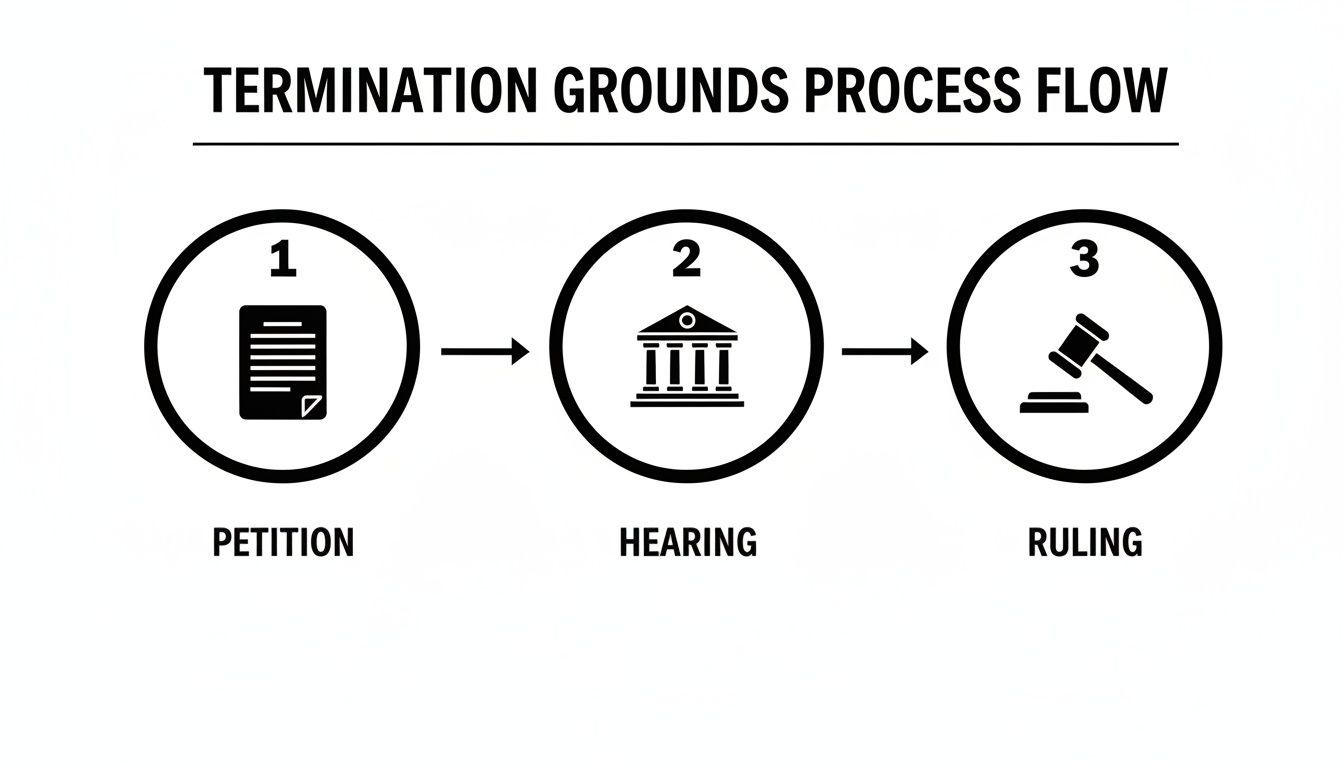
As you can see, the journey is linear: it starts with a formal request, moves to a court hearing, and ends with a judge's final decision.
The Court Hearing and Judicial Decision
The centerpiece of the entire process is the court hearing. This is where a judge reviews all the evidence, listens to testimony, and makes a final decision based on one single standard: the best interests of the child.
The evidence presented will depend on the specifics of the case. It might include testimony from the parents, social workers, psychologists, or other relevant witnesses. We also often submit documentary evidence like school records, medical reports, or communication logs. In particularly complex situations, the court may appoint a special advocate for the child. You can learn more about what a Guardian ad Litem is in Florida custody cases in our detailed article on the topic.
The timeline for these cases can vary dramatically. Some are resolved in a few months, while others can take over a year, especially if the action is contested. Because the stakes are so incredibly high—the permanent end of a parent-child relationship—having an experienced attorney guide you through each stage is essential. At Foley Family Law, we serve all members of the community in Pasco, Pinellas, and Hillsborough Counties, including all LGBTQ+ individuals, with all family law matters.
The Permanent Consequences Of Giving Up Rights
The decision to give up parental rights is absolute. In the eyes of Florida law, this is a final, irreversible act that permanently dissolves the legal relationship between a parent and child. It's critical to understand the full weight of these consequences before you take any action. Once a judge signs that final order, there is no turning back.
This is far more than just a change in custody; it's a complete severance of your legal status as a parent. Your entire identity in relation to your child is erased. At Foley Family Law, we make it a priority to ensure our clients in Pasco, Pinellas, and Hillsborough Counties fully grasp what this finality means before they ever step into a courtroom.
The End Of All Parental Decision-Making
When your rights are terminated, you lose all legal authority to participate in your child’s life. This isn't a partial loss—it's a comprehensive one that touches every single aspect of their upbringing. You will no longer have a say in any decisions, big or small.
This complete loss of rights includes:
- Custody and Visitation: You will have no legal right to have your child live with you or even to see them. Any informal promises for future contact are not legally enforceable.
- Educational Choices: You lose all input on where your child goes to school, their educational programs, or any related decisions.
- Healthcare Decisions: You give up the right to make choices about your child's medical care, from routine check-ups to life-saving treatments.
- Religious and Moral Upbringing: All decisions about the child's spiritual and ethical guidance will be made entirely without you.
Put simply, you become a legal stranger to your child. It's a profound and permanent change that demands careful, sober consideration.
A Common Misconception About Child Support
One of the biggest misunderstandings about terminating parental rights revolves around child support. Many people mistakenly believe it’s a clean slate—a way to erase all financial obligations. That's not how it works in Florida.
Terminating your parental rights does stop your obligation to pay future child support. From the moment the judge’s order is signed, you are no longer required to make ongoing payments.
However, termination does not forgive the past. Any unpaid child support that built up before your rights were terminated—known as arrears—is still legally owed. The state of Florida will continue to collect that debt, even after you are no longer legally the child's parent.
This is a critical point that often catches people by surprise. That debt doesn't just disappear, and the state will continue its enforcement actions to collect it.
The Impact On Inheritance And Family Ties
Another permanent consequence involves inheritance. When you give up parental rights, the legal line of inheritance is completely severed. This means your child will no longer have an automatic legal right to inherit from your estate if you pass away without a will.
Likewise, you lose any right to inherit from your child. The termination order legally dissolves these fundamental family ties, which can affect wills and trusts unless very specific provisions are made. While a parent can still choose to name a child in their will, the automatic legal right is gone. This finality is a key reason why it's so helpful to see how these agreements are structured. If you want to get a better sense of how rights and responsibilities are defined, you can review a child custody agreement template.
Ultimately, the process is designed to be permanent to give the child stability. For all families we serve in Hillsborough, Pasco, and Pinellas Counties, including our LGBTQ+ clients, we stress the gravity of these outcomes. We are committed to providing compassionate, non-discriminatory legal counsel for all family law matters.
Why You Need An Experienced Family Law Attorney
Trying to handle a parental rights case on your own is like attempting surgery after skimming a medical textbook. It's a field filled with immense risk and the potential for irreversible mistakes. Hiring an experienced family law attorney isn't just a good idea; it's absolutely essential to protect your interests and make sure the process is handled correctly from start to finish.
The legal system surrounding parental rights is incredibly complex. A single mistake on a form or a missed deadline can have disastrous consequences for your case.
At Foley Family Law, we understand the immense emotional and legal weight of these situations. We provide clear, strategic guidance for families across Pasco, Pinellas, and Hillsborough Counties, ensuring every step is taken with precision and care. Our job is to manage the complex legal maze so you can focus on the difficult personal decisions at hand.
The Value Of Legal Expertise
An experienced family law attorney does so much more than just fill out paperwork. We are your advocate, your strategist, and your guide through a system that is often confusing and unforgiving. The value we bring is multifaceted, ensuring your case is presented as strongly and accurately as possible.
An attorney adds crucial value by:
- Ensuring Correct Paperwork: A Petition for Termination of Parental Rights is a highly technical legal document. We make sure it's drafted perfectly, includes all necessary factual and statutory grounds, and is filed in the right court.
- Meeting Critical Deadlines: The court process runs on a strict calendar for filing documents, serving the other party, and responding to orders. An experienced family law attorney is crucial not just for their legal knowledge, but also for their meticulous approach to details, ensuring they prevent critical legal errors that could jeopardize your case.
- Gathering Compelling Evidence: A judge will not terminate parental rights without clear and convincing evidence. We know what kind of proof is required, how to obtain it through legal channels, and how to present it effectively in court to build a powerful case.
- Advocating In Court: We represent you in all court hearings, speaking on your behalf and arguing the legal points of your case. Our job is to make sure your story is heard and to frame the argument within the "best interest of the child" standard that judges are required to follow.
Without this professional support, you risk having your petition thrown out on a technicality or simply failing to meet the high burden of proof that Florida law demands.
Handling Complex Challenges
Termination of parental rights cases are rarely simple. Many come with significant complications that require a professional to untangle.
For example, what happens if the other parent can't be found? Locating an absent parent is a common hurdle. An attorney knows the legal requirements for conducting a diligent search and, if that fails, how to properly serve notice through publication.
Another major challenge is a contested petition. If the other parent objects to the termination, the case immediately becomes an adversarial legal battle. In this scenario, your attorney becomes indispensable. We handle discovery, take depositions, and prepare for a trial where we will argue your case against opposing counsel.
Having a lawyer is not just about understanding the law; it's about having a dedicated advocate who can manage conflict, navigate unforeseen obstacles, and stand up for your rights when the other party is fighting back.
At Foley Family Law, we are committed to providing this level of dedicated support to all families, including our LGBTQ+ clients. We handle all family and divorce matters with the professionalism and compassion you deserve. If you need a trusted advocate, you can learn more about finding the right family law attorney near me on our website. Our firm is proud to serve the communities of Pasco, Pinellas, and Hillsborough Counties.
Common Questions About Terminating Parental Rights
Making the choice to give up parental rights is one of the most serious and emotionally heavy decisions in family law. Because the outcome is so final, it's completely natural for people in Pasco, Pinellas, and Hillsborough Counties to have a lot of urgent questions. Here at Foley Family Law, we've heard them all, and we've provided clear, direct answers to some of the most common concerns.
Can I Voluntarily Give Up My Rights To Stop Paying Child Support?
In Florida, the answer to this is almost always a hard no. The court’s number one priority is ensuring a child’s financial and emotional well-being. A judge simply will not terminate a parent's rights just to get them off the hook for financial responsibility.
The law sees child support as a fundamental right belonging to the child, not a penalty for the parent. Letting a parent walk away from this duty would leave the child with only one source of support, which runs directly counter to the state's mission of protecting children. Any attempt to give up parental rights purely to stop payments will be shut down by the court.
Is There Any Exception To The Child Support Rule?
Yes, but it's a very narrow and specific one. A court might allow a voluntary termination that also stops future child support when it is in the child's best interest. For example, if another financially stable adult is ready and willing to legally take on full parental responsibility, the court might find this arrangement serves the child's interests.
In that scenario, the court sees that the child isn't being left with less support. Because this arrangement clearly serves the child's best interests by providing stability, a judge may approve the voluntary termination.
A voluntary termination is generally only possible when it is in the child's best interest, ensuring the child's financial security remains intact. The court will not leave a child with fewer resources simply for a parent's convenience.
What Happens To Past-Due Child Support If My Rights Are Terminated?
Terminating your parental rights is a forward-looking action. It cuts your legal ties and ends your obligation for future child support from the exact date a judge signs the final judgment.
However, it does not erase the past. Any child support payments that were due and unpaid before the termination date—known as arrears—are still very much owed. The state of Florida has a powerful interest in collecting that debt for the child.
This means that even after you are no longer legally the child's parent, the state can and will continue using enforcement tools to collect any past-due support. These methods include wage garnishment, driver’s license suspension, and seizing tax refunds. That debt doesn't just vanish when the termination order is signed.
Do I Have To Appear In Court To Give Up My Parental Rights?
Yes, you absolutely do. This is a common myth that gets a lot of people into trouble. Terminating parental rights is a formal legal process that has to go through the court system. You can't just sign a notarized paper or make an informal deal with the other parent.
A legal document called a "Petition for Termination of Parental Rights" has to be correctly drafted and filed with the court. After that, at least one court hearing is required.
During the hearing, a judge will go over all the evidence and hear testimony to make sure the legal reasons for termination are met. Most importantly, the judge has to be convinced that termination is truly in the child's best interests. Even in a simple, uncontested case where everyone agrees, a judge must issue a final order to make it legally permanent. There's no way around the courtroom.
Do You Handle Cases For LGBTQ+ Parents In The Tampa Bay Area?
Absolutely. At Foley Family Law, we are proud to serve every member of our community across Pasco, Pinellas, and Hillsborough Counties. Our firm was built on the principle of providing expert, non-discriminatory legal help to every client, no matter their sexual orientation, gender identity, or family structure.
We have deep experience handling the unique and sometimes complex issues that can come up in LGBTQ+ family law cases. Whether your case involves clarifying the rights of a non-biological parent, managing a termination in a same-sex relationship, or any other parental rights matter, we are here to offer knowledgeable and compassionate support. We are dedicated to protecting the rights and futures of all families.
Navigating the complexities of family law is tough, but you shouldn't have to do it by yourself. If you are facing a situation involving the termination of parental rights in Pasco, Pinellas, or Hillsborough County, contact Foley Family Law for a consultation. Let our experience guide you toward a clear path forward. Learn more about how we can help.


