

Before any Florida court will even look at your divorce petition, you have to prove you belong there. The core of this is the Florida residency requirement for divorce: one spouse must have physically lived in the state for the six months leading right up to the day you file your petition for dissolution of marriage. This isn't a suggestion; it's a non-negotiable legal foundation.
Meeting Florida's Six-Month Residency Rule
Think of this residency rule as your ticket to get into the family court system. If you can't prove it, a judge simply has no authority to grant your divorce, and your case gets thrown out. This isn't just a technicality—it’s a fundamental test of the court's jurisdiction, its actual power to make decisions about your life.
That six-month window has to be continuous and immediately precede the date you file the initial paperwork. It makes no difference if you lived here for 20 years, moved away, and just came back last month. The only thing that matters is that half-year stretch just before you file.
Who Needs to Meet the Requirement?
Here's the good news: only one of you needs to meet this standard. If you’ve been living in Pasco, Pinellas, or Hillsborough County for the last six months, you can file for divorce in Florida. This is true even if your spouse is living in another state or another country entirely.
This rule exists for a good reason. It prevents "forum shopping"—the practice of someone trying to file for divorce in a state with more favorable laws, even if they have no real ties there. By drawing a clear line, Florida ensures its courts are serving genuine residents.
Meeting this requirement is the very first gate you must pass through to initiate a divorce in Florida. Getting this wrong from the start means a case dismissal, forcing you to start all over again, wasting time and money.
Whether you're facing a straightforward uncontested divorce or a high-stakes, complex case, this first step is the same for everyone. Our firm is proud to handle all family and divorce issues, including for LGBTQ clients, without discrimination. Our job is to make sure this critical requirement is properly documented right from the beginning, so your case doesn't get dismissed before it even gets off the ground. You can find out more about the nuances of this rule in our detailed guide on how long you have to live in Florida to get a divorce.
How To Prove Your Florida Residency
Just saying you’ve lived in Florida for the last six months won’t cut it with the court. When it comes to legal matters, especially establishing the court's power to even hear your case (what we call jurisdiction), you need to back it up with hard proof. If you can't, the judge can dismiss your case right out of the gate, and you'll be back at square one.
The cleanest, most direct way to prove you’ve been here is with a valid Florida driver's license or a state-issued ID card. But here’s the key detail that trips people up: the issue date must be more than six months before the day you file your divorce petition. A Florida voter's registration card from that same six-month-plus timeframe is another excellent piece of evidence.
What If You Don't Have A Florida ID?
Don't panic if you don't have those specific documents. Florida law provides other ways to prove you live here. One common method is using a sworn statement, known as an affidavit, from someone else who can vouch for you. This could be a trusted friend, a neighbor, or a family member who has firsthand knowledge that you’ve been living in Florida continuously for the required six months and is willing to sign a legal document stating that under oath.
This simple decision tree lays out the basic eligibility check for any Florida divorce.
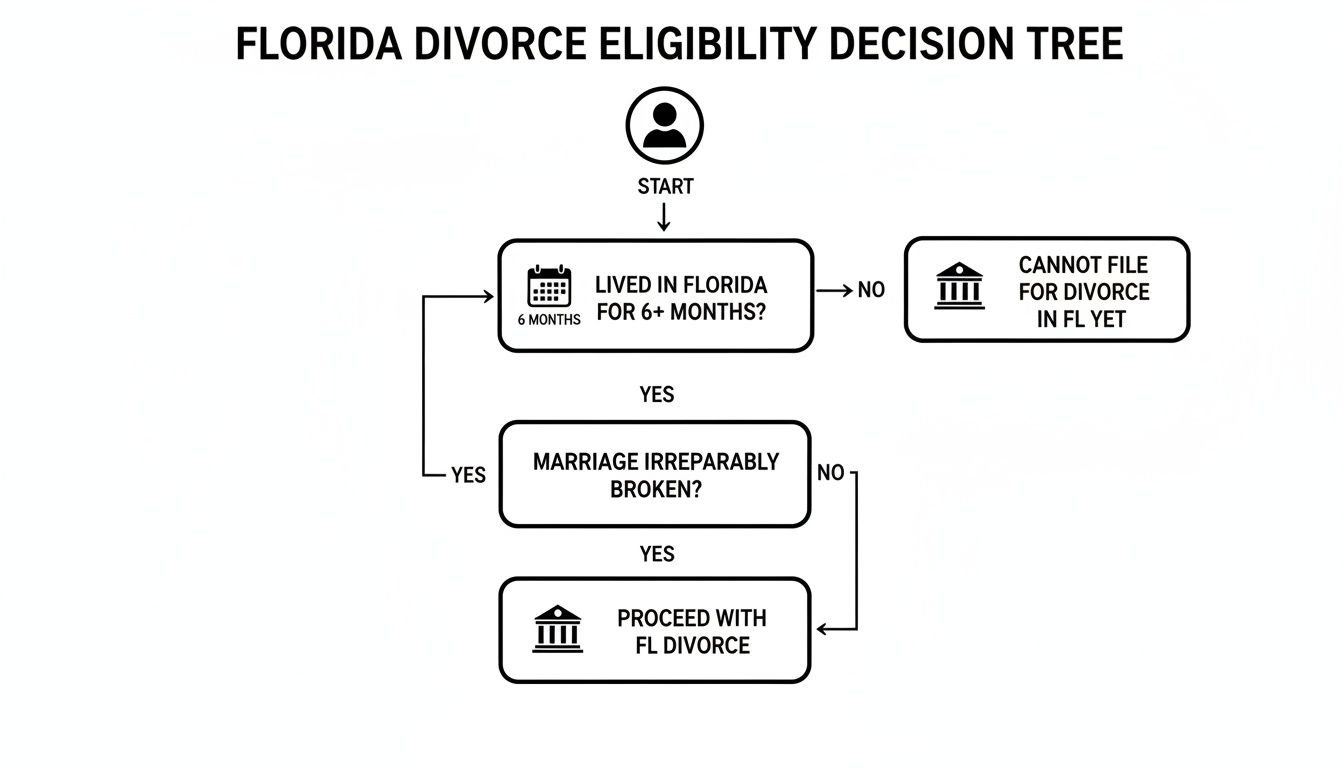
As you can see, satisfying that six-month residency rule is the non-negotiable first step. Without it, the courthouse doors are essentially closed to you.
Building A Stronger Case For Residency
Sometimes, life is messy. Maybe you travel a lot for work or still have ties to another state. In those situations, it's smart to build a stronger case by gathering more documents. The court understands that not everyone’s situation fits into a neat little box, so they will look at the whole picture to figure out where your true home is.
Here's a quick look at the most common documents used to prove residency in a Florida divorce case.
- FL Driver's License/State ID: Your primary government-issued photo ID. The issue date must be at least six months prior to your filing date.
- FL Voter's Registration Card: Proof that you are registered to vote in Florida. The registration date must be more than six months before filing.
- Affidavit of Corroborating Witness: A sworn statement from a third party. The witness must have personal knowledge of your residency and sign under oath.
- Lease or Mortgage Documents: Signed agreements showing you rent or own property in Florida. These documents should cover the required six-month period.
- Utility Bills or Bank Statements: Monthly statements mailed to your Florida address. A consistent history of bills helps establish a timeline of your presence.
- Florida Employment Records: Pay stubs or an employment verification letter. Shows you have been working for a Florida-based employer.
The more of these you can provide, the more solid your claim becomes.
At our firm, we regularly help clients across Pasco, Pinellas, and Hillsborough Counties pull together the right mix of paperwork to satisfy the court without a hitch. Getting this step right is especially critical if your divorce isn't a simple, uncontested split. You can learn more about how Florida handles these situations in our article on Florida no-fault divorces. We make sure this foundational requirement is handled perfectly from the start.
Filing Your Divorce In The Right County
Meeting Florida's six-month residency rule is a critical first step, but it doesn't automatically mean you can file your divorce petition in just any courthouse. You also have to file in the correct county—a legal requirement known as venue. This makes sure your case is handled in a location that has a direct connection to you or your spouse.
Florida law is very clear on this. The person initiating the divorce, known as the petitioner, has to file the paperwork in the circuit court of the county where they currently live. Let's say you and your spouse last lived together as a couple in Pinellas County, but you've since moved to Pasco County. In that case, you must file your divorce in Pasco County. It’s that simple.
Filing in the wrong county can trigger significant and costly delays. Your spouse’s attorney could file a motion to have the case moved or even dismissed entirely, forcing you to start the whole process over from scratch. This is exactly why having a law firm with deep roots in the local court system is so valuable.
Navigating Local Court Procedures
While Florida’s residency requirements are the same across all counties, the day-to-day procedures are not. The six-month standard applies whether you’re in a major urban center like Tampa or a smaller community, but each courthouse has its own administrative rules and filing protocols.
This framework is designed to balance accessibility for residents while preventing people from "forum shopping" or misusing the state's courts.
Choosing the correct venue isn't just about following rules; it's about setting your case up for a smooth and efficient process from day one. An error here can create unnecessary legal battles over procedure before you even begin to address the core issues of your divorce.
Our practice is exclusively focused on the family courts of Pasco, Pinellas, and Hillsborough Counties. This localized knowledge means we navigate the specific administrative rules and filing procedures of each individual courthouse every single day. We make sure your case is filed correctly the first time.
For a deeper dive, you can check out our guide on how to file for divorce in Florida.
Residency Rules For Military Service Members
Florida law understands that a military career doesn't always fit neatly into standard legal boxes. When it comes to divorce, the state makes a critical accommodation for active-duty personnel. While civilians typically have to prove they've lived here for six months straight before filing, that rule can be more flexible for service members stationed in Florida.
This isn't just a minor technicality; it’s a significant exception. The logic is simple: being stationed here under official orders creates a strong enough tie to the state for the court to have jurisdiction, or the authority to hear your case. It’s a practical solution that gives much-needed flexibility to military families facing constant relocation.
A Practical Solution For Military Families
This legal flexibility means you can handle your divorce where you currently live instead of being forced to file in a previous state where you might no longer have any real connection. It simplifies an already difficult process, which is especially important because military divorces often come with their own unique set of complexities.
For instance, dividing assets like a military pension requires a deep understanding of both state and federal law. Filing locally gives you direct access to legal support that's familiar with these nuances.
Under Florida law, military service members and their spouses can be considered residents for the purpose of a divorce action, even without meeting the standard six-month period. This exemption acknowledges the frequent relocations that are an inherent part of military service.
Our firm has extensive experience managing the unique aspects of military divorces for clients across Pasco, Pinellas, and Hillsborough Counties.
How Military Orders Function As Proof
For service members, your official military orders are the key piece of evidence. These documents prove that your presence in Florida isn't just a temporary choice but is mandated by your service obligations. This is usually all the court needs to be satisfied that it has jurisdiction.
Here's what this exception means in practice:
- Stationed in Florida: If you're assigned to a base in Florida, you can typically file for divorce here, even if you still maintain a driver's license or voter registration in another state.
- Protection of Rights: This rule ensures both the service member and their spouse have a clear and fair path to resolve their legal matters without unnecessary jurisdictional hurdles.
- Local Handling of Complex Assets: It provides a local courthouse to handle complicated issues like the division of military retirement benefits, which have their own specific rules.
Navigating the intersection of state residency laws and federal military regulations is crucial. For a more detailed breakdown, our guide includes a helpful military divorce checklist to help you get organized.
Common Residency Mistakes That Can Derail A Divorce
The Florida residency requirement for divorce might look simple on the surface, but a few common missteps can get your case thrown out, forcing you to start all over. These aren't just minor technicalities; they are critical errors that will cost you significant time, money, and emotional energy.
Knowing what these pitfalls are is the first step to avoiding them.
A frequent mistake is simply miscalculating the six-month timeline. It’s not just any six months you’ve lived in Florida. It has to be the six consecutive months immediately before you officially file your divorce petition. Being even a week or two short is all it takes for a judge to reject your case.
Filing In The Wrong County
Even if you clear the statewide six-month rule, you still have to file in the right county. This is a legal concept called "venue," and it matters. You must file where you currently live, even if your marital home was somewhere else in Florida. Filing in the wrong jurisdiction—say, the county where neither you nor your spouse currently resides—will lead to a dismissal or a long delay while the case gets transferred.
Another common pitfall is failing to show that Florida is your primary home, or domicile. This can get tricky for people who travel a lot for work, own property in other states, or split their time between different locations. A vacation home in Florida isn't enough; you have to demonstrate a clear intent to make Florida your permanent residence.
The burden of proof is always on you, the person filing for divorce, to submit convincing documentation. An out-of-state driver's license or voter registration card will work against you and can be enough to derail your case.
Failing To Provide Sufficient Proof
Finally, one of the most critical errors is simply not providing enough evidence. You can't just assume the court will take your word for it. You must present credible proof, whether it's a Florida ID with a qualifying issue date, a voter's registration card, or a sworn statement from someone who can vouch for you. Weak or insufficient evidence is a direct path to a case dismissal.
These potential mistakes highlight just how important careful preparation is. At our firm, we help clients across Pasco, Pinellas, and Hillsborough Counties avoid these costly errors. We meticulously review every detail of your residency status to ensure your petition is legally sound and filed correctly from the start, allowing your case to move forward without frustrating and unnecessary delays.
When You Should Consult A Divorce Attorney
While some residency situations seem cut-and-dried, many others need a lawyer's eye to avoid critical mistakes down the road. The Florida residency requirements for divorce can get surprisingly tricky, and a misstep at this first hurdle can put your entire case at risk.
Knowing when to call for backup is key. If you or your spouse just moved into or out of Florida, figuring out the exact timing and the right county to file in isn't something you want to guess about. It gets even more tangled when your spouse lives in another state or country, which brings up complex legal questions that go way beyond simple residency.
Navigating Complex Scenarios
Certain lifestyles and situations automatically make proving residency a bigger challenge. An attorney can bring much-needed clarity if you're dealing with any of these issues:
- Frequent Travel: If your job keeps you on the road constantly, documenting a stable Florida home requires a smart, strategic approach to gathering the right kind of proof.
- Contested Residency: Do you think your spouse might fight your residency claim just to slow things down? Getting an attorney involved from the very beginning is your best defense.
- Military Service: The rules for active-duty military members have specific exceptions. You have to apply them correctly to make sure the court has the authority—or jurisdiction—to even hear your case.
An attorney can help you pull together the strongest possible evidence, prepare necessary documents like a third-party affidavit, and make sure your case is filed correctly in Pasco, Pinellas, or Hillsborough County. Getting this initial step right sets a solid foundation for everything that follows. We handle gay divorce, custody issues, and name changes, providing inclusive representation for all LGBTQ individuals and families.
A consultation can provide the clarity and strategic plan you need to begin your divorce on a solid legal footing, preventing costly mistakes before they happen.
When you're thinking about getting legal help for a divorce, it's normal to wonder about the initial cost. Knowing the typical lawyer consultation fee can help you budget for that first important meeting. For more advice specific to your needs, check out our guide on how to choose a divorce attorney in Florida.
Answering Your Top Questions About Divorce Residency
Even after you've got a handle on the rules, real-world questions always pop up when you're trying to meet Florida's residency requirements for divorce. Let's walk through some of the most common questions we hear from people just starting this process in Pasco, Pinellas, and Hillsborough Counties.
What Happens If I File Before I’ve Lived Here for Six Months?
This is a critical misstep. If you file your divorce petition without hitting that six-month mark, the court simply doesn't have the legal authority—or jurisdiction—to hear your case.
Your spouse's attorney will likely file a motion to dismiss, or the judge might just toss the case out on their own. The result? You’re forced to wait until you meet the requirement and then start all over again, which costs you both precious time and money.
Do We Both Have to Be Florida Residents?
No, absolutely not. The law only requires one of you to have lived in Florida for the six months immediately before the divorce petition is filed.
As long as one spouse meets this core requirement, you're good to go. You can file for divorce in the right Florida county even if your spouse lives in another state or a different country entirely.
The court's main goal here is to establish a real, legitimate connection to the state through at least one of the parties. This prevents people with no ties to Florida from using our court system just to end their marriage.
Can I Move Away From Florida After Filing for Divorce?
Yes, you can. The residency clock that matters is the six-month period before you file the petition. Once your case is officially filed and the court has jurisdiction, you are generally free to move.
But—and this is a big but—you absolutely must discuss any potential move with your attorney first. Relocating, especially when kids are involved, can throw a wrench into ongoing issues related to custody, timesharing, and parenting plans. We handle all LGBTQ family and divorce issues with the same level of care, and this advice applies across the board.
Trying to figure out all the specifics of residency can be a headache, but it’s a hurdle you don’t have to clear alone. If you have questions about your unique situation, the experienced team at Foley Family Law is here to bring clarity to the process. Visit us at https://wfoleylaw.com to schedule a consultation and get the answers you need.


