

So, what exactly is a Florida postnuptial agreement? It’s a legal contract a couple creates after they’re already married. The goal is to define how assets and debts will be handled if they ever divorce.
Far from being a sign of trouble, a postnup is really a proactive tool for financial clarity. Think of it as an insurance policy for your shared future. Our firm proudly serves clients throughout Pasco, Pinellas, and Hillsborough Counties.
Defining Your Financial Future After Marriage
A postnuptial agreement is like a financial roadmap that a married couple designs together. Most people have heard of prenuptial agreements, which are set up before the wedding. A postnup does the same job, but for people who are already legally married. It’s a formal, written contract spelling out each spouse's rights and responsibilities for property, assets, and even potential spousal support if the marriage ends.
These agreements are especially useful when big life changes happen after you've already said "I do." Maybe one spouse starts a business, gets a large inheritance, or decides to leave a career to raise kids. Events like these can completely change the financial picture of a marriage, and a postnup creates a clear, mutually agreed-upon plan to handle these new realities based on Florida law.

Why Create A Postnup In Florida?
For many couples, especially those between the ages of 35 and 65, financial security is a top priority. A postnup isn't about planning to fail; it’s about building a stronger, more transparent partnership. It forces you to have open, honest conversations about money, which can actually reduce conflict and give both of you a greater sense of security.
Here in Pasco, Pinellas, and Hillsborough Counties, we see couples use these agreements for all sorts of positive reasons:
- Protecting Individual Assets: To make sure a family inheritance or a business that existed before the marriage stays separate property.
- Clarifying Financial Roles: To define how marital assets and debts will be managed, which is particularly helpful in second marriages or for couples who have children from previous relationships.
- Providing Financial Certainty: To map out a predictable outcome and avoid a drawn-out, expensive legal battle if a divorce ever happens.
A postnuptial agreement empowers spouses to take control of their financial destinies within the marriage. It replaces ambiguity with clarity, allowing both partners to move forward with confidence and a shared understanding of their financial landscape.
A Tool For Every Couple
It’s a common myth that these agreements are only for the super-rich. The reality is that a Florida postnuptial agreement is a practical tool for any married couple who wants to create financial order. We handle all LGBTQ issues, family and divorce issues, and do not discriminate.
Whether you're a business owner in Hillsborough County, a first responder in Pinellas County, or a growing family in Pasco County, this legal document can offer real peace of mind. While it’s similar to a prenup, a postnup addresses the financial realities that have popped up during the marriage.
You can learn more about how to get a prenup in our detailed guide to see how the two compare. By proactively talking about money matters, you aren’t weakening your bond; you’re reinforcing it with a foundation of honesty and mutual respect.
Why Do Tampa Bay Couples Get Postnuptial Agreements?
Couples all across Florida decide to create postnuptial agreements for a ton of practical, real-world reasons. Let's get one thing straight: getting a postnup is rarely a sign that a marriage is in trouble. In fact, it's usually the opposite. It’s a proactive tool for managing finances, getting on the same page about expectations, and ultimately making the partnership stronger.
Think of it as a smart financial management tool. It's about sitting down and addressing life's "what-ifs" together, in a calm and collaborative way, instead of waiting for a crisis to force the conversation. This kind of foresight gives couples a clear, agreed-upon plan to protect both their shared future and their individual assets. Our firm practices in Pasco, Pinellas, and Hillsborough Counties.
Protecting Assets and Clarifying Roles
One of the biggest reasons clients in Pasco, Pinellas, and Hillsborough counties come to us for a Florida post nuptial agreement is a major change in their financial situation. Life happens after the wedding, and new opportunities or responsibilities can completely change a family's financial picture.
Here are a few common scenarios that lead couples to create a postnup:
- Launching a New Business: When one spouse decides to start a high-risk venture, a postnup can act as a financial firewall. It can shield the other spouse and their shared marital assets from potential business debts or lawsuits, protecting the family’s core financial stability.
- Receiving a Family Inheritance: An agreement can clearly define an inheritance or a large gift as separate property. This is especially important if you want to ensure that money eventually goes to children from a previous marriage, keeping it from getting tangled up in the marital pot.
- Clarifying Roles in Second Marriages: For many of our clients between the ages of 35 and 65, second marriages are common. A postnup is invaluable for clarifying financial duties and protecting assets built up before the new marriage, ensuring things are fair for kids from prior relationships.
Rebuilding Trust and Securing the Future
Beyond just protecting assets, a postnup can play a huge role in healing and strengthening a relationship. Let's say there's been a case of financial infidelity—maybe hidden debt or secret spending. Working together to create a postnuptial agreement can be a powerful step toward rebuilding that broken trust. It sets clear, transparent rules for the future and helps take money off the table as a source of conflict.
A postnup, governed by Florida law, lets a married couple set their own financial rules, as long as there's full disclosure and neither person is forced or tricked into signing. With "gray divorces" on the rise for those over 50, protecting a lifetime of accumulated assets has become a top priority for many.
For most couples, just the process of creating a postnup opens up deeper, more honest conversations about money, goals, and expectations. It can actually lead to a more secure and unified partnership.
A postnuptial agreement isn't about planning for the end; it's about responsibly managing the middle. It provides a framework to handle financial complexities together, building security and mutual respect throughout your marriage.
Unique Protections for Our Local Heroes
Here in the Tampa Bay area, we work with a lot of first responders and military personnel. For them, a postnup is an incredibly valuable tool. These careers come with unique benefits like specialized pensions and retirement accounts that absolutely require careful planning.
An agreement can spell out exactly how these hard-earned assets will be handled, no matter what happens down the road. It provides peace of mind and ensures their financial future is secure. Understanding what's at stake financially can really highlight the value of this kind of planning—you can get a clearer picture by exploring the factors that influence the cost of divorce. We handle all LGBTQ issues, including gay divorce and custody matters, ensuring every client receives dedicated and respectful representation.
Crafting An Enforceable Florida Postnup
For a Florida postnuptial agreement to be more than just a piece of paper, it needs to be built on a solid legal foundation. Florida courts don't just rubber-stamp these documents. They scrutinize them closely to make sure they meet strict standards of fairness and transparency.
Think of it like building a house—if the foundation is weak, the whole structure is at risk of collapsing under the first sign of pressure. This is why the process is so much more involved than just downloading a template and signing on the dotted line. Each requirement is there for a reason: to protect both spouses and confirm the agreement is a true reflection of their mutual consent.
Here in Pasco, Pinellas, and Hillsborough Counties, we guide couples through this detailed process every day, ensuring their agreement is built to last.
The Cornerstones Of A Valid Agreement
To hold up in a Florida court, a postnup has to satisfy several key legal requirements. These elements all work together to show that the contract was created fairly and voluntarily, without one party taking advantage of the other. If you miss even one of these, the entire agreement could be in jeopardy.
At a minimum, the agreement must meet these standards:
- It Must Be a Written Contract: An oral promise or a casual understanding about how you'll divide assets won't cut it. The postnup has to be a formal, written document.
- Signed by Both Spouses: Both of you must sign the agreement. Your signatures acknowledge that you've read, understood, and agreed to everything inside.
- Created Voluntarily: The agreement is immediately void if one spouse was subjected to duress, coercion, or undue influence. This means no threats, no manipulation, and no unfair pressure was used to force a signature.
To really understand why these rules exist, it helps to be familiar with the basic elements of a contract. This context makes it clear why each requirement is so critical for creating a document that is both fair and legally sound.
Financial Disclosure: The Most Critical Step
The absolute bedrock of any enforceable postnuptial agreement in Florida is full and fair financial disclosure. This isn't a step to be taken lightly or rushed. Both spouses have a legal duty to be completely, almost painfully, honest about their financial situation.
This means putting everything on the table:
- All assets, from bank accounts and real estate to investments and business interests.
- All debts and liabilities, like mortgages, car loans, and credit card balances.
- All sources of income, big and small.
Hiding an asset or intentionally lowballing your net worth is one of the fastest ways to get a postnup thrown out by a judge. The entire point is to make sure both of you are making informed decisions with a complete and accurate picture of the marital financial landscape.
The Standard Of Fairness
Beyond disclosure and voluntary signing, a Florida court will also look at the agreement for basic fairness. The terms can't be "unconscionable"—a legal term for an agreement that is so ridiculously one-sided that it shocks the conscience of the court.
An agreement is considered unconscionable if it leaves one spouse with virtually nothing while the other retains all the assets, especially after a long marriage where both contributed to the household. The court's job is to prevent manifest injustice.
This infographic shows some of the primary reasons couples seek this level of financial clarity and protection in the first place.
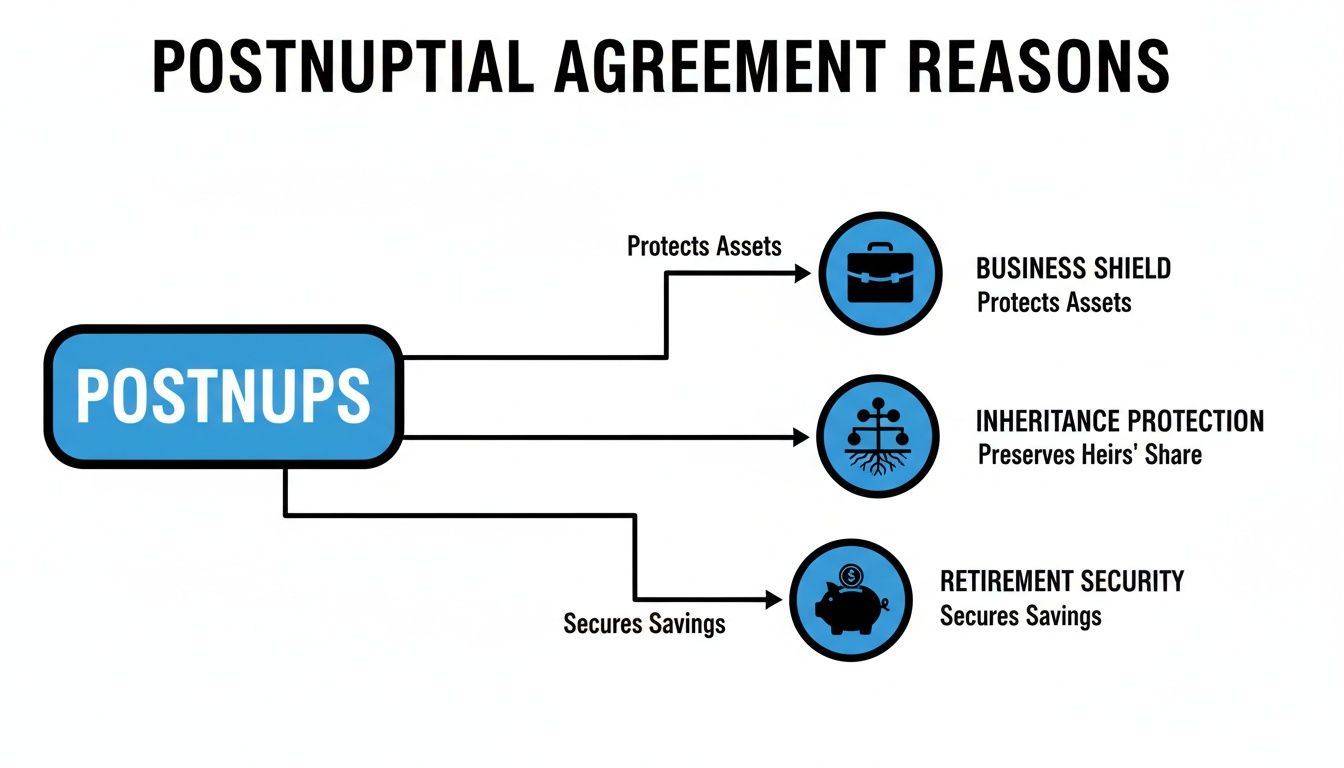
As you can see, postnups are often strategic tools for protecting specific assets, like a new business, a family inheritance, or hard-earned retirement funds.
To give you a clearer picture, let's compare what separates a postnup that will likely stand up in court from one that's on shaky ground. A strong and enforceable agreement is characterized by complete financial disclosure, independent legal counsel for both spouses, a voluntary signing process without pressure, fair and reasonable terms, and proper written formalities. In contrast, a vulnerable agreement often involves vague or misleading financial information, one lawyer for both parties (or no lawyers at all), signatures obtained under duress, grossly one-sided terms, or procedural errors like being an oral agreement.
A strong postnup is built with care and transparency, while a vulnerable one often cuts corners on the most important legal safeguards.
Finally, while it's not technically mandatory under Florida law, having independent legal counsel for each spouse is the single best way to strengthen your agreement. It provides powerful evidence that both of you fully understood your rights and the long-term consequences of what you were signing. If you need help finding the right fit, our guide on how to choose a divorce attorney offers valuable tips that apply here, too. We proudly serve all members of our community, including our LGBTQ+ clients, ensuring everyone has access to fair and knowledgeable representation.
What Your Postnuptial Agreement Can Cover
Think of a Florida postnuptial agreement as a custom-tailored financial plan for your marriage. It gives you and your spouse the power to create your own rulebook, overriding the default state laws that would otherwise dictate your financial life in a divorce. This is about being proactive and designing a blueprint that actually fits your unique circumstances.
This flexibility is incredibly powerful. You can get specific about everything from property division to spousal support, bringing clarity and certainty to your financial future. For couples in Pasco, Pinellas, and Hillsborough Counties, it’s an effective way to establish a clear, mutually agreed-upon framework and head off potential conflicts before they ever start.
Defining Your Assets And Debts
At its core, a postnup is about classification. Its primary job is to draw a bright line between what’s considered "marital property" (assets and debts you’ve accumulated together) and what’s "separate property" (assets one of you owned before the marriage or received as a personal gift or inheritance).
Your agreement can get incredibly granular, outlining exactly how different assets and debts will be handled:
- Real Estate: You can decide if a home bought during the marriage gets sold with the proceeds split, or if one spouse gets the first option to buy the other out.
- Bank Accounts and Investments: The agreement can lay out the rules for dividing joint accounts or specify how individual investment portfolios should be treated.
- Business Interests: If one or both of you own a business, a postnup is vital. It can protect the company from being fractured or liquidated in a divorce, ensuring business as usual.
- Retirement Accounts: This is a big one. You can clarify precisely how pensions, 401(k)s, and IRAs earned during the marriage will be split. This area gets complex fast, and our guide on what happens to a 401(k) in a divorce offers a deeper dive into the specifics.
Addressing Spousal Support
Spousal support, or alimony, is often one of the most emotionally charged and unpredictable parts of a divorce. A postnup lets you take control of this issue. Florida law allows you and your spouse to decide on alimony terms in advance, which can provide immense peace of mind.
You have a few options here:
- You can set specific terms, defining the amount and duration of alimony payments based on factors like the length of your marriage.
- On the other hand, you can agree to waive alimony entirely, meaning neither spouse can seek it if the marriage ends.
A postnuptial agreement allows you to substitute your own judgment for that of a court. By defining alimony terms in advance, you maintain control over your financial future and avoid the uncertainty of a judge's decision.
What A Postnup Absolutely Cannot Cover
While a postnup is a powerful financial instrument, it has firm legal boundaries. Florida law is crystal clear on one thing: you cannot use an agreement to predetermine any issues related to your minor children. A judge will always decide these matters based on the child’s best interests at the time of separation, not based on a document signed years earlier.
Specifically, your Florida post nuptial agreement cannot include provisions that:
- Set Child Support Amounts: You cannot waive a child's right to financial support or lock in a fixed amount for the future. Florida calculates child support using specific guidelines, and parents can’t contract around that.
- Dictate Child Custody: The agreement cannot determine parental responsibility or map out a time-sharing schedule. Those decisions are made based on what is best for the child when the parents actually separate.
Understanding these hard limits is just as important as knowing what you can include. It ensures your agreement is fully compliant with Florida law and will be upheld if it's ever needed. We guide clients throughout Pasco, Pinellas, and Hillsborough Counties through this entire process, making sure every couple, including our LGBTQ+ clients, creates an effective and enforceable agreement.
Common Mistakes That Can Invalidate Your Agreement
Putting a Florida postnuptial agreement in place is a smart move for financial clarity in a marriage. But this powerful legal tool is only as good as its construction. A few critical errors can render your agreement totally useless, leaving your financial future in a judge’s hands instead of following your own plans.
Knowing the common pitfalls is the first step to building a document that will actually hold up. Getting the legal details right requires precision. A simple oversight can unravel the whole thing, which is why getting professional guidance isn’t just a good idea—it’s essential for creating an agreement that delivers real peace of mind. Our firm practices in Pasco, Pinellas, and Hillsborough Counties.

The Pitfall Of Incomplete Financial Disclosure
The single biggest reason a postnup gets thrown out is a failure of financial disclosure. Florida law is crystal clear on this: marital agreements demand total transparency. Both spouses have a duty to one another, which is a legal way of saying you have to act with complete honesty and good faith.
This means putting all your financial cards on the table—every asset, every debt, and all sources of income. Hiding a brokerage account, undervaluing a business, or "forgetting" about a major loan is a form of fraud. If a court finds out one spouse wasn't truthful, it can invalidate the entire agreement.
The whole point of disclosure is to make sure both people are making informed decisions. Without a full and accurate financial picture, genuine consent is impossible, and the agreement is built on a faulty foundation.
The process involves more than just jotting down numbers; you need the documents to back them up. We often take clients through a process very similar to the legal discovery for divorce to ensure every financial stone is unturned.
The Problem Of Duress And Coercion
An agreement signed under pressure isn't a real agreement. For a Florida postnuptial agreement to stick, it must be signed voluntarily by both people. The law is designed to protect you from being forced into a contract that you don't actually agree to.
Duress and coercion can show up in obvious and not-so-obvious ways. It’s not always about explicit threats. It can be any situation where one spouse feels like they have no real option but to sign.
Common examples of duress include:
- Giving an Ultimatum: Threatening to file for divorce or make life miserable if the agreement isn't signed right away.
- Applying Unreasonable Pressure: Creating a high-stress environment and not allowing enough time to think it over or get advice.
- Blocking Access to a Lawyer: Insisting the other spouse sign the papers before they have a chance to talk to their own independent attorney.
A judge will look closely at the circumstances around the signing. If there’s evidence that one person's signature wasn't given freely, the agreement will almost certainly be thrown out. This is a huge reason why having separate, independent lawyers is so important—it’s powerful proof against future claims of coercion.
The Issue Of Unconscionability
Finally, a Florida court can refuse to enforce an agreement it considers "unconscionable." This is a legal term for a contract that is so fundamentally unfair and one-sided that it shocks the conscience of the court. While you and your spouse are free to make a deal that isn't perfectly 50/50, there is a line.
An agreement might be unconscionable if it leaves one person completely broke while the other keeps almost everything, especially after a long marriage. The court looks at whether the deal was fair at the time it was signed. For example, a postnup that has a financially dependent spouse waive all rights to alimony and property after being out of the workforce for 20 years would likely be seen as unconscionable. We are dedicated to helping all couples, including our LGBTQ+ clients who may be facing gay divorce or custody issues, craft agreements that are fair, balanced, and—most importantly—enforceable.
A Few Common Questions About Florida Postnups
When you're exploring a florida post nuptial agreement, it’s natural for questions to pop up. Below, I’ve answered some of the most frequent ones we hear from our clients across Pasco, Pinellas, and Hillsborough Counties. Getting a handle on these practical points can help you figure out if a postnup is the right move for your marriage.
Is It Too Late For A Postnup If We're Having Marital Problems?
Not necessarily. In fact, for some couples, hammering out a postnuptial agreement can be a really constructive step, especially when money is the root of the conflict. The process forces you to get everything on the table, providing clarity and taking financial stress out of the daily equation so you can focus on the relationship.
But there's a big caveat: the timing and circumstances are critical. An agreement signed under duress—or pushed as an ultimatum to "sign this or we're done"—won't hold up. A Florida court will look very closely at any postnup created during a rocky period to make sure both spouses signed willingly, without being pressured. If you're in this boat, it's absolutely vital to talk to a seasoned family law attorney to navigate the process fairly and create an agreement that’s actually enforceable.
Can We Change Or Cancel Our Postnuptial Agreement Later On?
Yes, you absolutely can. Think of a postnuptial agreement as a living document. It's not set in stone. Life happens—incomes change, a business takes off, inheritances come into play, and your financial goals might shift. Your agreement should be flexible enough to evolve with you.
Any updates (amendments) or a full cancellation (revocation) have to be done in writing. It’s not a verbal agreement. Both of you must consent to the changes and sign the new document with the same legal formalities you used for the original. One spouse can't just decide to tear it up or cross out a section on their own. We generally suggest clients pull out their postnup every few years and review it with an attorney to make sure it still reflects their reality.
How Does A Postnup Affect An Estate Plan Or Inheritance?
A postnup can—and often does—have a major impact on your estate plan. Under Florida law, a surviving spouse has powerful, automatic inheritance rights. These include certain rights to the family home and the right to an "elective share" of their deceased spouse's estate, regardless of what the will says.
Many couples, especially those in blended families, use a postnuptial agreement specifically to waive these rights. This allows each spouse to ensure their assets go directly to their own children from a previous relationship, for example.
It's absolutely crucial that your postnuptial agreement and your estate planning documents (your will, trusts, etc.) are in sync. If they contradict each other, you're creating a recipe for a messy and expensive court battle for your loved ones.
Making sure your family law attorney and your estate planning attorney are on the same page is the best way to protect your legacy and make sure your final wishes are honored.
Do We Both Really Need Our Own Lawyers?
While Florida law doesn't technically force you both to get separate lawyers, it is the single best thing you can do to create a strong, defensible agreement. From a judge's perspective, having independent legal counsel for each spouse is the gold-standard proof that the deal was fair and voluntary.
When you each have your own attorney, it demonstrates that:
- You both had the chance to get confidential advice and ask whatever questions you wanted.
- You both fully understood the rights you were giving up and the rights you were keeping.
- The agreement wasn't one-sided but was negotiated with both of your interests at the forefront.
If one lawyer tries to advise both people, it's an immediate conflict of interest. That conflict makes the postnup extremely vulnerable to being thrown out later if one spouse challenges it. To protect yourself and ensure the integrity of your florida post nuptial agreement, you and your spouse should each have your own attorney. We're proud to offer knowledgeable, fair representation to everyone in our community, including our LGBTQ+ clients in gay divorce, custody, and name change matters.
Working through the details of a postnuptial agreement requires a clear head and an experienced legal guide. If you have more questions or you're ready to create a solid financial plan for your marriage, our firm is here to serve clients in Pasco, Pinellas, and Hillsborough Counties. Contact us today to secure your financial future.


