

Here in Florida, we're a "no-fault" divorce state. That might sound a bit clinical, but what it really means is you don't have to air out your dirty laundry in court or prove that one person was "the bad guy" to end your marriage. There's no need to prove things like adultery or abandonment.
Instead, the process is much more straightforward: one spouse simply has to state that the marriage is irretrievably broken. That single phrase shifts the entire focus from assigning blame for the past to finding a practical resolution for the future.
What No Fault Divorce Really Means In Florida

The term "no-fault" can be a little confusing at first. It doesn't mean that a spouse's behavior during the marriage is completely irrelevant—it can still impact things like alimony or child custody decisions. What it does mean is that blame isn't a requirement to get the divorce itself.
Think of it less like a courtroom drama where one person has to be found guilty and more like the formal dissolution of a business partnership. The real work isn't about pointing fingers; it's about achieving a fair and orderly separation of your shared lives—your assets, debts, and parental responsibilities.
This modern approach was designed to reduce the conflict and emotional toll that came with old-school, fault-based divorces. For our clients in Pasco, Pinellas, and Hillsborough Counties, who are often between 35 and 65 and focused on protecting their financial future, this system offers a much more direct path forward.
The Legal Grounds For Divorce
In Florida, the law recognizes only two grounds for dissolving a marriage. Understanding these is the first step for anyone considering divorce in Pasco, Pinellas, and Hillsborough Counties.
- Irretrievably Broken Marriage: This is the reason behind nearly every divorce in Florida. It's a simple declaration that the marriage is beyond repair and there's no hope of reconciliation. Critically, only one spouse needs to believe this is true for the divorce to proceed—the other person doesn't have to agree.
- Mental Incapacity of a Spouse: This is a much rarer situation. It requires a formal, legal determination that one spouse has been mentally incapacitated for at least three years before the divorce filing.
This streamlined framework is beneficial for everyone. Our firm handles all LGBTQ family and divorce issues, and we do not discriminate. By removing the need to prove who did what wrong, the entire process becomes more about finding practical, forward-looking solutions instead of getting bogged down in personal attacks.
The core idea behind no-fault divorce is to let people end a marriage that just isn't working anymore, without forcing them into a public fight over who’s to blame. It moves the legal focus from the past to the future.
To help clarify these concepts, here’s a quick summary of the key principles at play.
Florida No-Fault Divorce Key Concepts
- No-Fault Principle: You don't need to prove wrongdoing (like adultery or abuse) to get divorced.
- Primary Ground: The marriage must be declared "irretrievably broken" by at least one spouse.
- Mutual Consent: Not required. One spouse can file for divorce even if the other disagrees.
- Focus of the Court: The court's goal is to resolve practical matters like asset division and parenting plans.
- Fault's Role: While not needed for the divorce itself, bad behavior can still influence alimony or custody outcomes.
This shows how the system is designed to be practical and less adversarial from the start.
How No-Fault Simplifies The Process
Florida operates as a pure no-fault divorce state, which means the old, traditional fault grounds simply don't apply here for the purpose of ending the marriage. This legal framework grew out of a nationwide "divorce law revolution" that started back in the 1970s. You can explore more about these divorce trends and their history to see just how much things have changed.
By taking the need to prove misconduct off the table, the system naturally encourages a more cooperative mindset. It allows you and your spouse to concentrate on the truly important decisions that will shape your new beginning, like dividing your property fairly and creating a stable, predictable parenting plan for your children. Our firm is committed to guiding clients in Pasco, Pinellas, and Hillsborough Counties through this process with clarity, compassion, and practical support.
Starting The Divorce Process In The Tampa Bay Area
Taking that first step toward divorce often feels like the hardest part. Before you even think about paperwork, though, Florida law has a gatekeeping rule you have to meet. It’s called the residency requirement, and it’s straightforward but absolute.
To file for divorce in Florida, at least one spouse must have lived in the state for a minimum of six months right before filing the petition. This isn’t just a technicality; it’s what gives the court the power, or jurisdiction, to handle your case. Proving it is usually as simple as showing a Florida driver’s license or voter registration card.
Filing The Initial Paperwork
Once you’ve cleared the residency hurdle, the process officially kicks off with a document called the Petition for Dissolution of Marriage. This is the formal legal paperwork that tells the court you want to end your marriage. It also lays out what you're asking for when it comes to property, your kids, and financial support.
You’ll file this petition with the Clerk of the Circuit Court in the right county. Our firm is rooted in the Tampa Bay community, so we regularly handle cases in Pasco, Pinellas, and Hillsborough Counties. Filing in the correct courthouse from the start is a critical move to avoid delays right out of the gate.
Each court system has its own local rules and quirks. Knowing the subtle differences between how things work in Pasco versus Hillsborough is a huge advantage of having a local attorney who lives and breathes Tampa Bay family law.
Understanding The Legal Roles And Terms
As soon as you file the petition, the court assigns a specific title to you and your spouse. It’s good to get these terms straight from the beginning.
- The Petitioner: This is you—the person who files the Petition for Dissolution of Marriage and gets the case started.
- The Respondent: This is your spouse. They will be formally "served" with the divorce papers and will need to file an official answer to what you’ve requested in your petition.
These titles are purely for keeping the court records organized. They don't mean one person is at fault or has more power than the other. In a no-fault state like Florida, it’s just procedural.
The Critical Step Of Serving The Papers
After you file the petition, it’s not enough for it to just sit at the courthouse. It has to be officially delivered to the Respondent. This formal delivery is called "service of process," and it’s a non-negotiable step that ensures both of you are legally aware that a divorce case has begun.
Service of process isn’t just a formality—it’s a constitutional right. It guarantees that the other person has a fair shot to respond and be heard. If you don't serve the papers correctly, the entire case can grind to a halt before it even starts.
Usually, this is handled by a sheriff's deputy or a certified private process server who physically hands the documents to your spouse. It can feel a little confrontational, but this formal step protects everyone involved. Our firm manages every detail of this process for our clients, including those in same-sex divorces and other LGBTQ family law matters, with the professionalism and discretion these situations demand. If you're just starting to explore your options, you can learn more about finding a family law attorney near me to help you navigate these first hurdles.
Navigating An Uncontested Vs. Contested Divorce
Every divorce in Florida, including for same-sex couples, travels down one of two very different roads. Think of it as a fork right at the start of your journey. One path is relatively smooth and straightforward, while the other can be long, winding, and full of detours. Grasping this difference is probably the most critical strategic decision you'll make.
The smoother path is the uncontested divorce. This is the best-case scenario, where both spouses see eye-to-eye on absolutely everything. They’ve already hammered out how to split their property and debts, whether alimony makes sense, and, if they have kids, have a complete parenting plan ready to go. There are simply no arguments left to settle.
It’s a faster, more private, and far less expensive process. We just formalize their agreement in a document called a Marital Settlement Agreement, which the court then approves.
The More Complex Path: A Contested Divorce
The second path is the contested divorce. This is the road you're on if there’s a disagreement over even one key issue. It could be a fight over who keeps the family home, how to divide a pension, the right amount of alimony, or the fine print of a time-sharing schedule. One single point of contention is all it takes.
A contested case is much more formal and involves a series of legal steps that are completely absent in an uncontested divorce. While "contested" might bring to mind high-drama courtroom battles, the reality is that most of these cases eventually settle through negotiation or mediation long before a trial ever happens.
Key Procedural Steps In A Contested Case
When you and your spouse can't agree, the legal system has a structured process to work through the disputes. This framework ensures both sides get a fair shot to present their case and gather the facts.
- Discovery: This is the formal information-gathering stage. Both sides can request financial documents, send written questions (called interrogatories), and conduct depositions to get a complete picture of the marital assets and other crucial facts.
- Mediation: In nearly every contested case here in Pasco, Pinellas, and Hillsborough Counties, the court will require you to attend mediation. It’s a confidential meeting with a neutral professional mediator whose entire job is to help you find common ground and reach a settlement.
- Hearings and Trial: If mediation doesn't resolve everything, the case inches closer to temporary hearings and, eventually, a final trial. This is where a judge will listen to the evidence from both sides and issue a binding ruling on all the outstanding issues.
The flowchart below shows the basic procedural steps for getting a divorce started in Florida, which is the jumping-off point for both contested and uncontested cases.
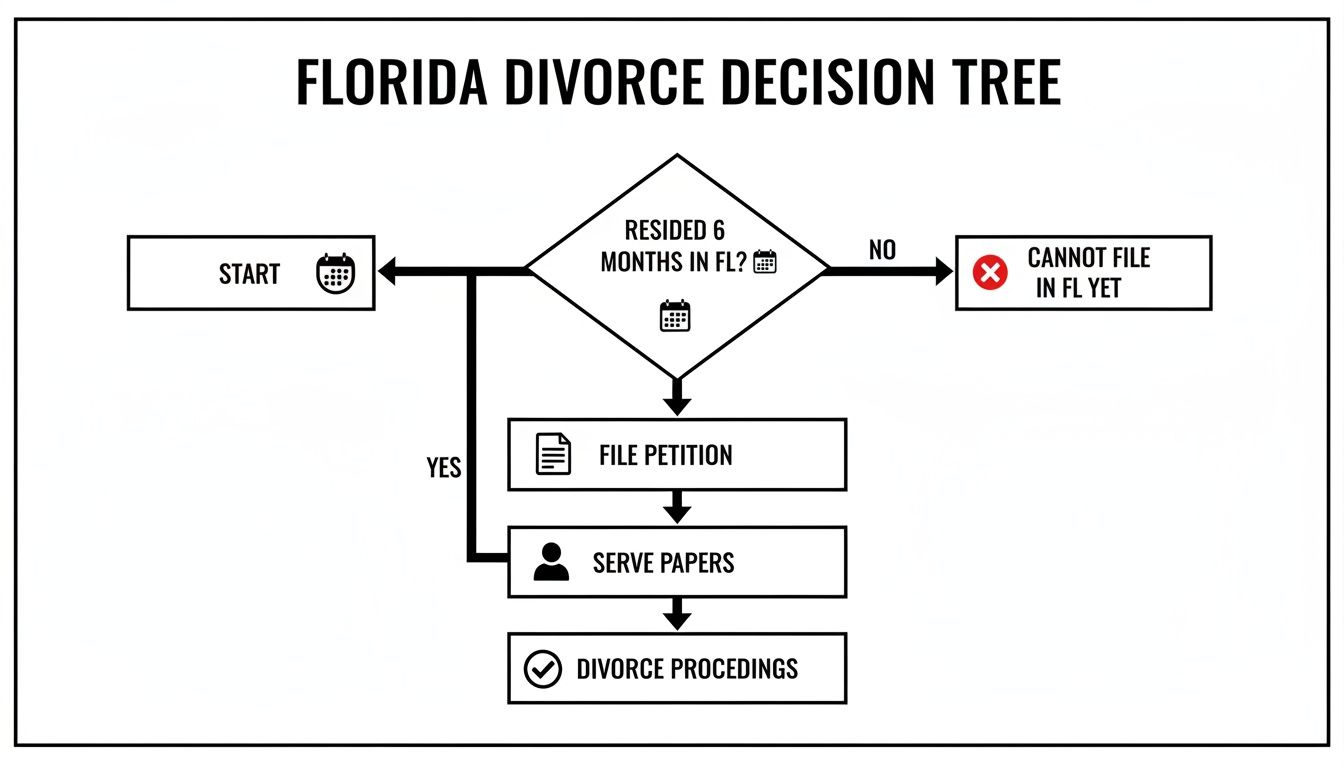
As you can see, the initial steps—meeting the residency rules and filing the petition—are identical, no matter which path your divorce ultimately follows.
Making An Informed Choice
The decision between an uncontested and a contested divorce has huge consequences for your timeline, your wallet, and your emotional health. While our firm handles every family law matter with the goal of finding the most efficient path to resolution, the way forward always comes down to the willingness of both people to cooperate. For a deeper dive, you can explore the real difference between contested and uncontested divorce in our related article.
Florida’s divorce statistics show some interesting trends. Back in 2011, the state's divorce rate hit a high of 4.5 divorces per 1,000 residents, one of the highest in the country. By 2020, that rate had dropped by 33% to a low of 3.0. As of 2024, it has crept back up to 3.4 per 1,000 residents, which is still about 40-50% higher than the national average.
Dividing Property And Determining Alimony
Even though Florida is a no-fault state, which means you don’t have to prove who was "to blame" for the marriage ending, the real work begins when it's time to separate your financial lives. The court’s job isn’t to punish anyone. Instead, its focus is on untangling your shared finances in a way that’s both fair and follows the law. This entire process hinges on a legal principle called equitable distribution.
Right away, that term can be misleading. “Equitable” doesn’t automatically mean a clean 50/50 split. It means the division must be fair, and a judge will weigh a long list of factors to decide what a just outcome actually looks like. For our clients across Pasco, Pinellas, and Hillsborough Counties, grasping this difference is the first step toward building a secure financial future.
Marital Property Vs Non-Marital Property
Before a single asset can be divided, it has to be sorted. Florida law places everything you own into one of two buckets: marital property or non-marital property.
- Marital Property is the stuff you acquired or earned during the marriage. This includes the house you bought together, cars, bank accounts, retirement funds, and even a business launched after you were married. It rarely matters whose name is on the title or the account.
- Non-Marital Property is anything you owned before the marriage. It also includes personal gifts or inheritances you received during the marriage, but only if you kept them completely separate and didn’t mix them with joint funds.
Here's a classic example: Say your parents left you an inheritance, and you deposited it into a brand-new savings account under your name only. That's almost certainly your non-marital property. But if you put that same inheritance into a joint checking account and used it for groceries and mortgage payments, you've likely converted it into marital property by commingling it.
Think of equitable distribution like sorting through a shared storage unit after a business partnership ends. The first job is to figure out what each partner owned before they started, what they bought together, and then divide the jointly-owned items in a way that's fair—even if it's not a perfectly even split.
The Role Of Alimony In Florida
Once the assets and debts are sorted out, the conversation often turns to alimony, which is ongoing financial support. Alimony is never a given. A court will only award it if one spouse can demonstrate a genuine need for support and the other spouse has the ability to pay it. The goal is to help the lower-earning spouse maintain a lifestyle that’s reasonably similar to the one they had during the marriage.
Florida law has several types of alimony, each designed for a different scenario. When deciding, a judge looks at everything: the length of the marriage, each person's age and health, their earning potential, and their contributions to the marriage (like being a stay-at-home parent). This area of family law has seen some major changes recently, making it one of the most complex parts of any divorce.
Navigating Complex Financial Situations
For many of our clients, particularly those between 35 and 65, the financial stakes are enormous. You might be dealing with high-net-worth assets, a complex business that needs valuation, or specialized pensions from careers as first responders. These cases demand an incredible amount of detail to get to a truly fair result. A huge piece of the puzzle is figuring out what to do with the family home, and knowing the different strategies for splitting home equity in a divorce is often a critical starting point.
Our firm has deep experience handling these kinds of intricate financial separations for all families, including those in the LGBTQ community, making sure every client gets the dedicated and knowledgeable guidance they deserve. It's also vital to understand the legal framework Florida uses for division. You can learn more about how equitable distribution vs community property systems differ in our detailed guide. Protecting your financial stability is the most important thing you can do during a divorce, and it all starts with understanding your rights and the road ahead.
Resolving Parenting Plans And Child Support

When kids are involved in a divorce, untangling the finances suddenly takes a back seat. For most parents we work with, the most critical part of the entire process is ensuring their children feel supported, stable, and can continue to thrive.
In Florida, the entire legal framework for these decisions is built on one guiding principle: the best interests of the child.
This isn't just some legal phrase; it's the lens through which every decision about children is made. The court’s job isn't to reward one parent or punish the other. It's to approve a plan that best supports a child's health, safety, and emotional well-being. This philosophy shapes every single discussion, from where the kids will sleep at night to how major life decisions are made.
The Shift From Custody To Cooperation
Florida law has intentionally moved away from old-school, combative terms like "custody" and "visitation." Today, the focus is on cooperation and shared duties, and you can see that shift in the language the courts now use. Understanding this is key for any parent navigating a divorce in Pasco, Pinellas, or Hillsborough County.
- Parental Responsibility: This is about how parents will make the big decisions for their children—things like school, healthcare, and religious upbringing. The court almost always orders "shared parental responsibility," which means both parents have to talk and agree on these crucial choices.
- Time-Sharing: This is the modern term for the schedule. It details exactly when the children will be with each parent. It can be anything from a schedule where one parent has most of the overnights to a nearly 50/50 split, depending entirely on what makes sense for the children.
This change in language isn't accidental. It’s designed to push parents to see themselves as a team working toward a common goal—raising healthy children—rather than as opponents fighting to "win."
Creating A Florida Parenting Plan
The centerpiece of every decision involving children is the Parenting Plan. This is a detailed, legally required document that acts as a roadmap for how you'll co-parent after the divorce. It has to be incredibly specific to cut down on future arguments and give everyone clarity.
A strong Parenting Plan is like a detailed business operating agreement. It anticipates potential disagreements and provides a clear, pre-agreed process for resolving them, ensuring stability and predictability for the children.
The plan must map out the time-sharing schedule, how you'll communicate daily, and how transportation and holidays will work. A judge will review it to make sure it covers every required element and, most importantly, serves the child's best interests. To get a feel for what these documents look like, you can review this helpful child custody agreement template to see the level of detail involved.
Calculating Child Support
Alongside the Parenting Plan, the court will establish child support. This isn't a penalty or a prize; it's a child's legal right to be financially supported by both of their parents. Florida uses a specific formula based on state guidelines to keep the calculation fair and consistent across the board.
The main factors that go into the child support calculation include:
- The net monthly income of both parents.
- The costs of health insurance and childcare for the children.
- The number of overnight stays each parent has with the children, as laid out in the time-sharing schedule.
That last point is critical—the time-sharing schedule has a direct and significant impact on the final support amount. The system is set up to recognize that both parents contribute financially to raising their children, both through direct payments and by covering daily costs when the child is in their care. Our firm is dedicated to handling these sensitive matters for all families, including providing guidance on gay custody issues, with the dignity and respect every family deserves.
Special Considerations for Florida Families
While the core principles of a no-fault divorce apply to every Florida family, the reality is that no two separations are exactly alike. Many cases come with unique circumstances that need a more specialized game plan. A divorce might involve complex assets, demanding careers, or military service—all of which require specific legal knowledge. For our clients across Pasco, Pinellas, and Hillsborough Counties, understanding how these variables affect their case from the start is absolutely key.
Our community is home to many military families, and when a service member is involved in a divorce, a layer of federal law comes into play alongside Florida’s statutes. This isn't something you can just gloss over. We're talking about critical issues like how to properly divide a military pension or create a practical time-sharing schedule that works around deployments. Getting these details wrong can have a lasting impact on your financial stability. If you're a service member or a military spouse, it's worth taking a closer look at the unique rules that apply to a military divorce lawyer near me.
High-Asset and Complex Financial Cases
For families with significant wealth, a divorce becomes much more than just splitting a checking account. It's a deep dive into complex financial analysis. A high-asset divorce almost always brings challenges that require a team of experts, from business valuation specialists to forensic accountants who can trace where every dollar went.
These cases often require us to untangle:
- Business Valuations: What is the real, provable value of a family-owned business or a professional practice?
- Complex Retirement Accounts: How do you divide specialized pensions, like those for first responders, that have their own complicated set of rules?
- Hidden Assets: What if one spouse has been intentionally hiding money or property? We have to find it.
Successfully navigating these situations means making sure every single asset is accounted for. Only then can we ensure the final property division is truly equitable.
In a high-asset divorce, the goal isn’t just to divide what’s sitting in plain sight. It’s about building a complete and accurate financial picture to prevent an unfair settlement based on missing information.
Our Commitment to All Families
Our firm was built on a simple principle: every person who trusts us with their case deserves dedicated, respectful legal guidance, period. We proudly handle all aspects of family and divorce law for the LGBTQ community and do not discriminate, ever.
This includes extensive experience with gay divorce, gay custody issues, and helping gay or transgender individuals with legal name changes. We believe every family deserves an advocate who is not only legally sharp but also affirming and supportive of who they are. That's the level of service we are committed to providing every single client.
Common Questions About No-Fault Divorce in Florida
When you're facing a divorce in Florida, it's natural to have questions. The no-fault system is designed to be straightforward, but real life is rarely that simple. Here are some of the most common questions we hear from our clients across Pasco, Pinellas, and Hillsborough Counties.
How Long Does a No-Fault Divorce Take in Florida?
This is the big question everyone asks, and the honest answer is: it depends entirely on cooperation.
An uncontested divorce, where you and your spouse see eye-to-eye on everything from dividing the furniture to the parenting plan, can move fairly quickly. In many cases, these can be wrapped up in just a few months.
On the other hand, a contested divorce is a different story. If there are disagreements over assets, alimony, or child custody, the timeline stretches out. The process will likely involve mediation and court hearings to resolve disputes, which can easily take many months or even more than a year.
Can Adultery Affect My Divorce Case Even in a No-Fault State?
Yes, absolutely. While Florida is a no-fault state—meaning you don't need to prove infidelity to get a divorce—adultery can still play a significant role in the outcome. Its impact isn't automatic; it depends entirely on the specific facts of your case.
For example, if one spouse spent a significant amount of marital money on an affair (think gifts, trips, or supporting another household), a judge can take that into account. That "wasted" money might be credited back to the innocent spouse when dividing assets or calculating an alimony award.
Adultery can also become a factor in child-related decisions, but only if the behavior is proven to have a direct, negative impact on the children's well-being.
Do I Have to Go to Court for a No-Fault Divorce?
Not always. If you have a fully uncontested divorce, it’s very common to finalize the entire process without ever setting foot in a courthouse. When a complete written agreement is submitted, many Florida counties will grant the divorce based on the paperwork alone, waiving the need for a final hearing.
The primary goal of negotiation and mediation is to settle every issue outside of the courtroom. However, if even one issue remains unresolved, court appearances for hearings or a trial will be necessary to get a final judgment. Our firm is dedicated to finding the most efficient path forward for all families, including those navigating LGBTQ divorce and custody issues.
Navigating a divorce requires clear guidance from an experienced legal team. For personalized advice tailored to your specific situation in Pasco, Pinellas, or Hillsborough Counties, contact Foley Family Law to schedule a consultation and create a plan of action.


