

Family law appeals are formal legal requests asking a higher court to review whether a trial court made a significant legal or procedural error. They are not a second trial, and they do not allow new evidence or new witnesses. If you received an unfavorable ruling in a Florida family court on custody, support, or property division, understanding how the appellate process works is the first step toward deciding whether an appeal is right for your situation.
What are the legal grounds for family law appeals?
Appealing a family law decision requires more than disagreeing with the outcome. Florida appellate courts, like most courts across the country, demand a specific legal basis before they will review a trial court’s ruling.
The most common grounds for a family court appeal include:
- Misapplication of law. The trial judge applied the wrong legal standard. For example, a judge who uses an incorrect definition of “best interests of the child” when deciding custody has made a legal error.
- Abuse of discretion. The judge’s decision fell so far outside reasonable bounds that no reasonable judge would have made the same call. This is a high bar.
- Procedural errors. The court failed to follow required procedures, such as denying a party the right to present evidence or failing to provide proper notice of a hearing.
- Insufficient evidence. The trial record does not contain enough evidence to support the judge’s findings.
Appeals require showing significant legal errors, not just unfairness. Feeling that the judge got it wrong is not enough. You must point to a specific error in law or procedure that affected the outcome.
Consent orders present a separate challenge. If you agreed to a settlement and the court entered it as a consent order, your ability to appeal is severely limited. You generally cannot appeal terms you voluntarily accepted.

Pro Tip: Before filing anything, write down every moment during your trial where you believe the judge made a legal mistake. Concrete examples are the foundation of any viable appeal.
How does the appeal process work in Florida family court?
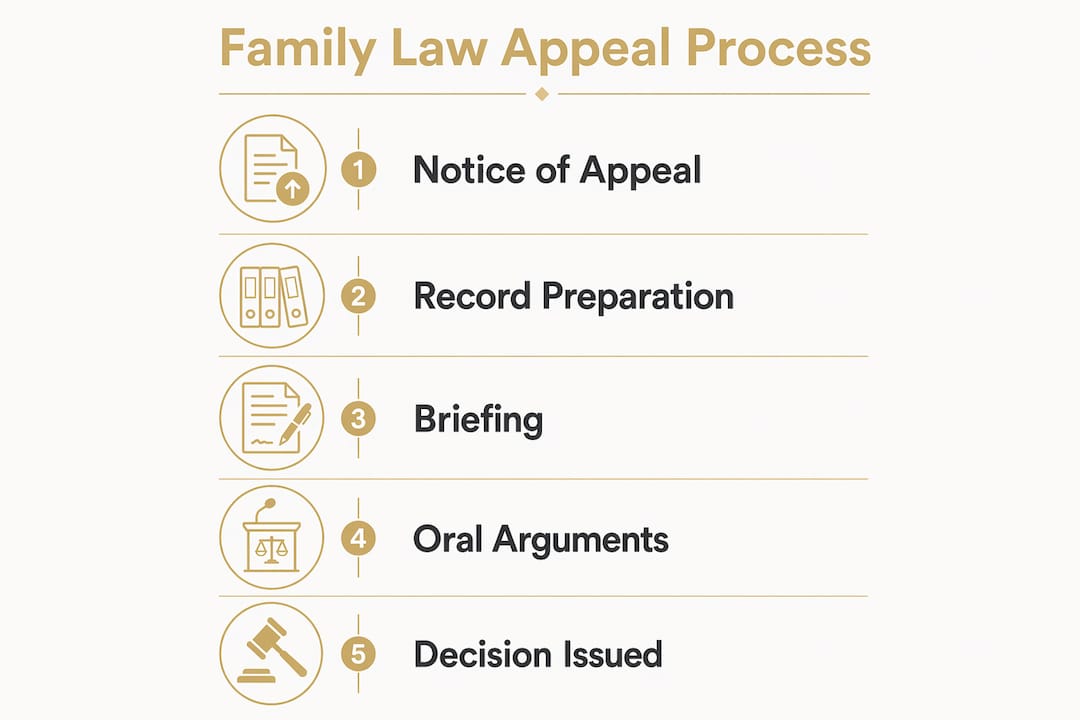
The appellate process follows a strict sequence of steps. Missing any one of them can end your case before it begins.
- File a Notice of Appeal. Most US jurisdictions require filing this document within 30 days of the final order. In Florida, this deadline is firm. Missing it generally results in a permanent loss of your right to appeal.
- Designate the record. You must identify which transcripts and trial documents the appellate court will review. This is called designating the record on appeal.
- Order transcripts. Court reporter transcripts must be ordered and submitted within the required timeframe. Deadlines vary by jurisdiction. For example, certain jurisdictions require transcripts within 45 days of filing the notice of appeal.
- File the initial brief. The appellant (the person appealing) submits a written argument explaining the legal errors made at trial.
- Receive the answer brief. The opposing party responds in writing, defending the trial court’s decision.
- File a reply brief. The appellant may file a final written response to the opposing party’s arguments.
- Oral argument. Not every appeal includes oral argument. When it does occur, each side presents a short verbal argument to a panel of appellate judges.
Family law appeals typically last between 6 and 18 months, depending on court backlog and case complexity. That timeline matters because life does not pause during an appeal.
| Stage | Typical Timeframe |
|---|---|
| Notice of Appeal | Within 30 days of final order |
| Record designation and transcripts | 30–45 days after notice |
| Initial brief | 70 days after record is filed |
| Answer brief | 20 days after initial brief |
| Appellate decision | 6–18 months total |
Pro Tip: The notice of entry of judgment triggers your appeal clock. Confirm the exact date it was served on you, and count your deadline from that date, not from the hearing date.
How do appellate courts review family law cases?
Appellate courts do not hold new hearings. They read the written record from the trial court and apply specific legal standards to decide whether an error occurred.
“Appeals focus exclusively on whether the trial court made legal errors, not on re-evaluating facts or evidence. The appellate court reviews abuse of discretion for factual and discretionary rulings, and applies de novo review for pure questions of law. This narrow scope means most of what happened at trial stays exactly as it was.”
Appellate courts do not consider new evidence. The record is fixed the moment the trial ends. No new witnesses, no new documents, no new arguments that were not raised below. This is why strong trial representation matters so much before an appeal ever becomes necessary.
The possible outcomes of an appeal include:
- Affirm. The appellate court agrees with the trial court and the original order stands.
- Reverse. The appellate court finds a serious error and overturns the decision.
- Remand. The case is sent back to the trial court with instructions to correct the error or hold a new hearing on a specific issue.
- Modify. The appellate court changes part of the order without sending it back.
Financial remedy appeals are particularly difficult because trial judges hold broad discretion over property division and support. Appellate courts intervene only when a decision falls completely outside reasonable bounds.
One point many people miss: filing an appeal does not automatically stay enforcement of the trial court order. You must comply with the existing order while the appeal is pending unless you separately request and receive a stay. Ignoring this can result in contempt proceedings.
What challenges should you expect when appealing a family court ruling?
Appeals are expensive, time-consuming, and difficult to win. Understanding the real obstacles helps you make a clear-eyed decision.
The core challenges include:
- High burden of proof. Trial court judges have broad discretion in family law, and appellate courts rarely overturn decisions that fall within a reasonable range of judgment. You must show the error was clear and consequential.
- Financial cost. Appellate attorneys charge for extensive brief writing, record review, and oral argument preparation. A full appeal can cost significantly more than the original trial.
- Time pressure on family life. A custody arrangement or support order remains in effect during the appeal. Children’s lives, living situations, and routines continue under the existing order for 6–18 months.
- Emotional toll. Prolonged litigation keeps conflict alive and can affect co-parenting relationships and children’s wellbeing.
- Static record risk. Strong appellate cases hinge on clear documentation of specific legal errors at trial. If those errors were not properly objected to during the trial, they may be waived on appeal.
Before committing to an appeal, consider whether alternatives fit your situation better. A motion to modify custody may be faster and less costly if circumstances have changed since the original order. Settlement negotiations or mediation can also resolve disputes without the uncertainty of appellate review.
Consulting a specialized appellate attorney early is the single most important step you can take. An attorney can assess whether your grounds are viable, estimate realistic costs, and advise whether an appeal or an alternative path better serves your goals.
Pro Tip: Ask any attorney you consult to identify the specific legal error in writing before you agree to file. If they cannot name it clearly, the appeal may not have a strong foundation.
Key Takeaways
Family law appeals succeed only when a clear legal or procedural error occurred at trial, not simply because the outcome felt unfair.
| Point | Details |
|---|---|
| Appeals target legal errors | You must identify a specific error in law or procedure, not just an unfavorable outcome. |
| Deadlines are absolute | Florida requires a Notice of Appeal within 30 days of the final order; missing it ends your right to appeal. |
| No new evidence allowed | The appellate court reviews only the trial record, making strong trial preparation critical. |
| Enforcement continues during appeal | The existing court order stays in effect unless you obtain a separate stay. |
| Alternatives may serve you better | Motions to modify or mediation can resolve disputes faster and at lower cost than a full appeal. |
Why the trial record is your most valuable asset
Most people focus on the appellate brief when they think about winning an appeal. The real work happens much earlier. After years of watching family law cases move through the appellate system, the pattern is consistent: appeals that succeed are built on trial records that were carefully constructed from day one.
Every objection your attorney raised at trial, every ruling the judge made on the record, every piece of evidence that was admitted or excluded. These moments form the foundation of any appeal. If an error was not objected to at trial, it is often waived. You cannot raise it for the first time on appeal and expect the court to act on it.
The emotional reality of appeals is also worth naming directly. Clients often come to the appellate stage exhausted and financially strained from the original proceedings. An appeal adds months of uncertainty on top of that. That does not mean appeals are never worth pursuing. It means the decision deserves clear thinking, not reactive anger at an outcome you did not expect.
The cases where an appeal genuinely makes sense share a common feature: there is a specific, identifiable legal error that the trial court made, and that error changed the outcome in a meaningful way. When that is present, an appeal can correct a real injustice. When it is absent, the appellate court will almost certainly affirm the trial court’s decision, and you will have spent significant time and money to arrive at the same place.
Seek a board-certified family law specialist for your initial evaluation. The assessment you receive in that first consultation will tell you more about your chances than any amount of research on your own.
— William Foley
Foley Family Law is ready to review your family law appeal
Facing a family court ruling you believe was legally wrong is one of the most stressful positions a parent or spouse can be in. Foley Family Law’s team, led by William S. Foley, focuses exclusively on family law in Hillsborough, Pinellas, and Pasco counties. The firm handles the full appellate process, from evaluating your grounds and filing the Notice of Appeal to preparing briefs and representing you through oral argument.

Time is the most critical factor in any appeal. Deadlines are strict, and waiting too long eliminates your options entirely. Contact Foley Family Law to schedule a consultation and get a clear, honest assessment of your case before your window closes.
FAQ
What is a family law appeal?
A family law appeal is a formal request asking a higher court to review whether a trial court made a legal or procedural error. It is not a new trial and does not allow new evidence.
How long does a family court appeal take in Florida?
Family law appeals typically take between 6 and 18 months, depending on court backlog and the complexity of the issues involved.
What is the deadline to file a family law appeal in Florida?
Florida requires filing a Notice of Appeal within 30 days of the final order. Missing this deadline generally eliminates your right to appeal.
Can I introduce new evidence during a family law appeal?
No. Appellate courts review only the record created at trial. No new witnesses, documents, or arguments are permitted on appeal.
What happens to my existing court order while I appeal?
The original order remains in effect during the appeal unless you separately request and receive a stay from the court. Non-compliance can result in contempt proceedings.
Recommended
- Law Blog – Foley Family Law
- What Is Appellate Law: Understanding Florida Appeals – Foley Family Law
- Legal Name Change in Florida: Your 2026 Guide – Foley Family Law
- How to Change Custody Agreement: Florida Guide 2026 – Foley Family Law


