

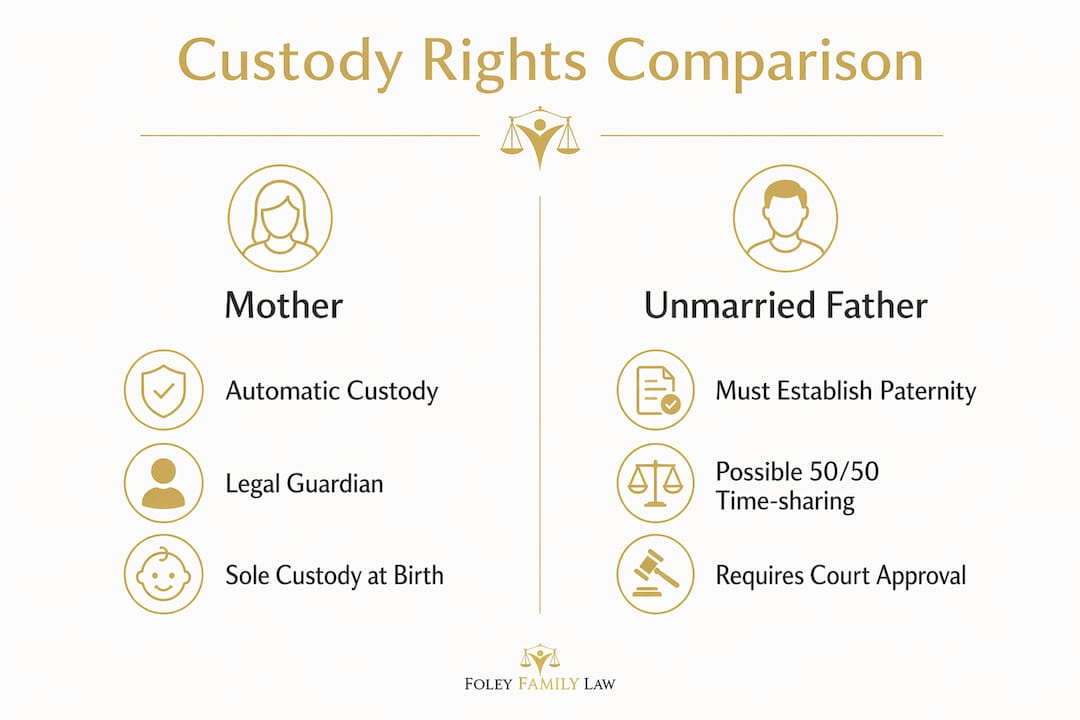
Under Florida custody laws for unmarried parents, the mother holds sole legal custody and guardianship of the child from birth. The father has no automatic rights, regardless of whether his name appears on the birth certificate. Here is what that means in practice:
- Mother’s default status: Florida Statute § 744.301(1) designates the mother as the child’s natural guardian and sole custodian when parents are unmarried.
- Father’s position before paternity: An unmarried father cannot make medical decisions, enroll the child in school, or prevent relocation without a court order establishing paternity.
- Establishing paternity: Fathers can establish paternity through a Voluntary Acknowledgment, a Department of Revenue administrative order, or a circuit court judicial order.
- Equal rights after paternity: Once paternity is legally confirmed, both parents gain equal custody and time-sharing rights under Florida Statute § 61.13.
- 50/50 presumption: Florida courts presume an equal time-sharing schedule serves the child’s best interests after paternity is established.
- Parenting plans: All custody arrangements must be documented in a court-approved parenting plan to be legally enforceable.
- Dispute resolution: Mediation and court intervention are both available to resolve disagreements and modify existing orders.
1. What are the mother’s automatic custody rights in Florida?
Florida Statute § 744.301(1) is unambiguous: the mother of a child born out of wedlock is the natural guardian and sole custodian by default. No court order is needed to establish her authority. She can make every major decision about the child’s education, healthcare, and welfare from day one.
A common misconception is that a father’s name on the birth certificate changes this. It does not. The birth certificate creates a record of parentage, but it does not grant custody or visitation rights under Florida family law. Legal paternity must be established through a separate, formal process.
This default creates a real legal gap for unmarried fathers. Until paternity is resolved, a father cannot authorize emergency medical treatment, obtain a passport for the child, or challenge a mother’s decision to relocate. The law protects the child’s welfare by placing clear authority with one parent at birth, but it leaves fathers without standing until they take action.
2. How can an unmarried father establish paternity in Florida?
Florida law provides three recognized paths to establish paternity:
- Voluntary Acknowledgment of Paternity (Form DH-511 or DH-432): Both parents sign the form at the hospital or a child support office. This is the fastest and least costly method, typically free of charge. It establishes legal paternity but does not automatically create a parenting plan or time-sharing schedule.
- Administrative order via the Department of Revenue: The Department of Revenue can order genetic testing and issue an administrative paternity determination. Many parents prefer this route because it handles paternity and child support simultaneously, avoiding the adversarial nature of court proceedings.
- Circuit court judicial order: When paternity is disputed or the other methods are unavailable, either parent can file a Petition to Determine Paternity under Florida Statute § 742.011. Filing fees for a paternity action range from $300 to $442 depending on the county, and DNA testing for court-admissible results costs $300–$500, though the Florida Department of Revenue Child Support Program provides free genetic testing for eligible families.
One critical deadline fathers must not miss: Under Florida Statute § 63.054, an unmarried biological father must file a notarized claim of paternity with the Florida Putative Father Registry before a petition for termination of parental rights is filed. Missing this window can permanently bar a father from asserting paternity rights, including in adoption proceedings. The claim can be filed any time before the child’s birth, but not after that petition is filed.
Pro Tip: If you are an unmarried father and the mother is considering placing the child for adoption, file with the Florida Putative Father Registry immediately. Waiting even a few days can cost you all parental rights.

3. What custody rights do you have after paternity is established?
The Good Dad Act, effective july 1, 2023, and codified in Florida Statute § 742.10, changed the landscape for unmarried parents’ custody rights significantly. Once paternity is legally confirmed, Florida courts apply the same standards to unmarried parents as to divorcing married couples.
Florida Statute § 61.13 creates a rebuttable presumption that equal time-sharing, meaning 50/50 overnight time with the child, is in the child’s best interests. A parent seeking a different arrangement must prove by a preponderance of evidence that an unequal schedule serves the child better.
Courts evaluate 20 statutory factors under Florida Statute § 61.13(3) when determining the best arrangement. Key considerations include:
- Each parent’s ability to provide a stable home environment
- The child’s established routine and relationship with each parent
- Any documented history of domestic violence or substance abuse
- Each parent’s willingness to support the child’s relationship with the other parent
- The child’s school, community, and healthcare needs
Modifying orders after the initial determination is possible but requires showing a substantial change in circumstances. Under Florida Statute § 61.13(3), the parent requesting a modification must file a motion with the circuit court and demonstrate that the change serves the child’s best interests. Courts may require mediation before scheduling a hearing.
Domestic violence carries particular weight. If a court finds credible evidence of abuse, the 50/50 presumption does not apply. Instead, the court presumes that shared parental responsibility would harm the child, and the burden shifts to the abusive parent to prove otherwise.
4. How does legal decision-making authority work for unmarried parents?
Florida distinguishes between two types of custody. Legal custody refers to the right to make major decisions about the child’s education, healthcare, and religious upbringing. Physical custody, called time-sharing in Florida, refers to where the child lives and when.
After paternity is established, both parents typically share legal decision-making authority unless a court orders otherwise. This is called shared parental responsibility, and it is the default under Florida law. Sole parental responsibility, where one parent holds all decision-making authority, is reserved for situations where shared responsibility would harm the child.
Without established paternity, an unmarried father has no legal standing to participate in decisions about his child’s schooling, medical care, or even travel. Establishing paternity is not just about time-sharing. It is the foundation of every parental right a father holds.
Child support obligations run alongside custody arrangements. A father who establishes paternity becomes legally responsible for financial support, and the court will address support as part of the paternity or parenting plan proceedings. Custody and support are treated as separate issues, meaning a mother cannot withhold visitation because a father misses a payment, and a father cannot withhold support because he disagrees with a custody order.
A court-approved parenting plan is required for all custody arrangements in Florida. Informal agreements between parents carry no legal weight and cannot be enforced through contempt proceedings. Both parents must sign the plan before a notary, file it with the circuit court clerk, and receive judicial approval.
5. Insights from Florida family law firms on navigating custody for unmarried parents
Experienced Florida family law attorneys consistently point to one avoidable mistake: unmarried fathers who wait too long to establish paternity. Every week without a legal order is a week the mother can relocate, make unilateral medical decisions, or pursue adoption without the father’s consent.
Foley Family Law, led by William S. Foley and serving Hillsborough, Pinellas, and Pasco counties, emphasizes transparent communication and cost-effective strategies to guide unmarried parents through these proceedings without unnecessary conflict. Their approach focuses on protecting parental rights while keeping the child’s welfare at the center of every decision.
Mediation is widely recommended by Florida family law practitioners as a first step before litigation. It reduces conflict, lowers legal costs, and produces agreements both parents are more likely to follow. Mediation helps parents focus on the child’s best interests rather than adversarial positions, and courts often require it before scheduling contested hearings.
Several respected Florida firms handle custody and paternity matters for unmarried parents across the state. The Florida Probate & Family Law Firm serves clients in the Coral Gables area with a focus on family and probate law. Bacchus Law Firm provides compassionate family law representation in South Florida, covering custody agreements, paternity, and child support. South Florida Legal Rescue offers personalized representation in Palm Beach County, with a focus on affordable solutions for custody and time-sharing disputes. Lewert Law LLC, based in Boca Raton, holds board certification in marital and family law from The Florida Bar since 2009 and certification as a Florida Supreme Court Certified Family Law Mediator. DivorcePro Non-Lawyer Documents Service and Non-Attorney Divorce offer document preparation services for parents handling straightforward, uncontested matters without full legal representation.
Pro Tip: Preparing a parenting plan early, even informally, helps both parents stay focused on the child’s needs and reduces the emotional cost of later disputes. Bring a draft to your first legal consultation.
Custody disputes involving unmarried parents carry real stakes. If you are navigating paternity, time-sharing, or parenting plan questions in Hillsborough, Pinellas, or Pasco County, the team at Foley Family Law offers the focused family law experience and transparent guidance you need. Learn more about what family law attorneys do and how legal representation protects your rights and your child’s future.

Key Takeaways
Florida custody laws for unmarried parents grant the mother sole legal custody at birth, with fathers gaining equal rights only after paternity is formally established under Florida Statute § 61.13.
| Point | Details |
|---|---|
| Mother’s default custody | Florida Statute § 744.301(1) designates the mother as sole natural guardian from birth. |
| Birth certificate limitation | A father’s name on the birth certificate does not create custody or visitation rights. |
| Paternity filing deadline | Fathers must register with the Florida Putative Father Registry before a termination of parental rights petition is filed. |
| 50/50 time-sharing presumption | Courts presume equal time-sharing serves the child’s best interests once paternity is established under § 61.13. |
| Parenting plan requirement | All custody agreements must be court-approved to be legally enforceable in Florida. |
FAQ
Who has legal custody when parents are not married in Florida?
Under Florida Statute § 744.301(1), the mother is the child’s sole natural guardian and custodian at birth when parents are unmarried. The father has no enforceable custody or visitation rights until paternity is legally established.
Does signing the birth certificate give a father custody rights in Florida?
No. Signing the birth certificate creates a record of parentage but does not establish legal paternity or custody rights under Florida law. A father must complete a Voluntary Acknowledgment of Paternity or obtain a court order to gain enforceable parental rights.
What is the new custody law for unmarried parents in Florida?
The Good Dad Act, effective july 1, 2023, applies the same 50/50 time-sharing presumption to unmarried parents that previously applied only to divorcing married couples. Once paternity is confirmed, both parents have equal standing under Florida Statute § 61.13.
Do fathers have the same rights as mothers in Florida custody cases?
Yes, once paternity is legally established. Before that point, the mother holds all legal authority. After paternity is confirmed, Florida law treats both parents equally and presumes shared time-sharing serves the child’s best interests.


