

A financial detective for divorce is a forensic accountant who specializes in uncovering concealed assets and verifying financial disclosures to protect your right to a fair property division. In contested Florida divorces, one spouse often hides income, undervalues businesses, or routes money through third parties to reduce what the other receives. Forensic accountants apply court-admissible investigative methods, including lifestyle analysis and document tracing, to expose those tactics. Their work covers detecting hidden assets in divorce and producing reports that hold up under Florida’s strict evidentiary rules. Engaging this expertise early can be the difference between a fair settlement and a costly loss.
What methods does a financial detective use to find hidden assets?
Forensic accountants build their case from documents, not assumptions. Forensic accountants request a minimum of five years of financial records, including tax returns, bank statements, credit card histories, W-2s, 1099s, K-1s, and all relevant tax schedules. That five-year window is long enough to reveal patterns that a single year would hide.
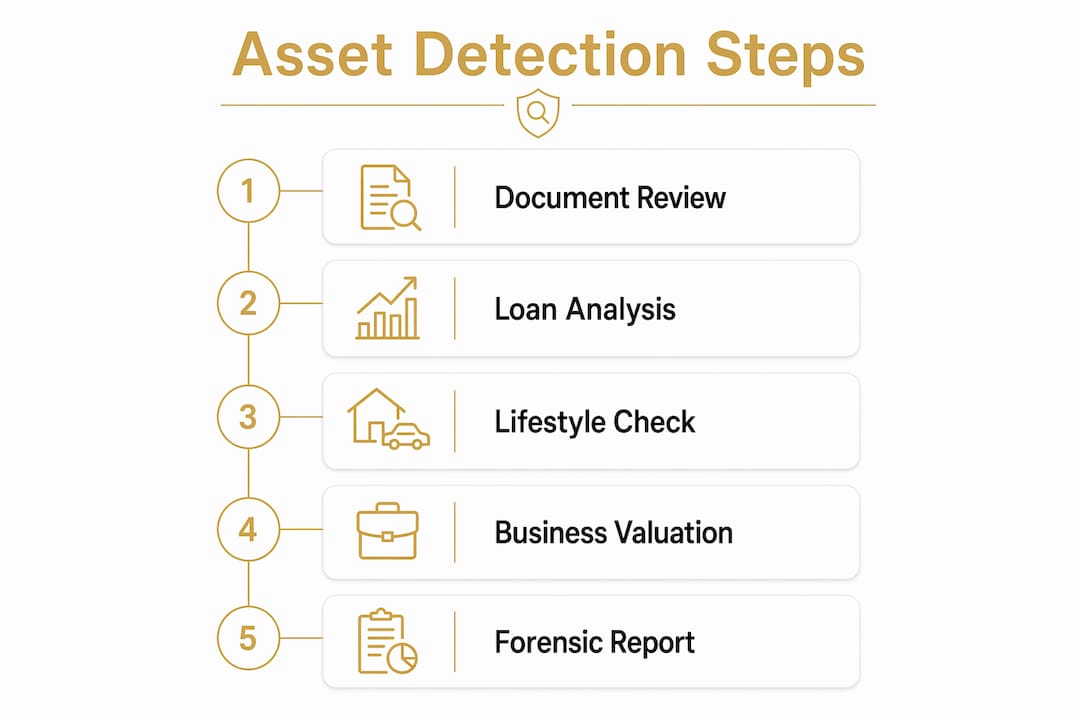
The document review extends well beyond obvious bank accounts. Loan applications are among the most revealing and most overlooked sources. Spouses frequently report higher income and asset values to lenders than they disclose in divorce court. That inconsistency alone can shift a case significantly.

Digital money trails are equally important. Forensic accountants trace transactions across Venmo, PayPal, Zelle, and cryptocurrency wallets, where informal transfers are easy to miss during standard discovery. Cash is more complicated. Cash transactions leave no digital trail, so investigators rely on pattern analysis, looking for regular large withdrawals that do not correspond to known household expenses.
Common concealment tactics the investigation targets include:
- Round-tripping: Money leaves an account, passes through one or more third parties, then returns to the original owner. The loop disguises the asset as a legitimate expense.
- Underreported business income: A business owner delays invoicing clients or defers contracts until after the divorce is final, artificially suppressing reported revenue.
- Personal expenses charged to business: Vacations, vehicles, and home renovations run through a business account to reduce apparent personal wealth.
- Inflated payroll: Fake employees or salary advances to family members drain marital assets before division.
Lifestyle analysis compares reported income with actual spending to identify discrepancies. Luxury purchases, unexplained withdrawals, or a standard of living that exceeds declared income are all red flags that trigger deeper investigation. Net worth reconstruction works alongside lifestyle analysis, rebuilding a complete financial picture from the ground up using primary source documents.
Pro Tip: Keep every financial statement, tax return, and loan document you can access before filing. Your attorney and forensic accountant will need them, and early access prevents a spouse from restricting document availability later.
How does a forensic accountant affect divorce outcomes?
A forensic accountant’s role goes far beyond what a standard CPA provides. A forensic accountant’s deep investigative role extends well beyond tax preparation and compliance, focusing on uncovering red flags like suppressed income and inflated deductions across multiple jurisdictions. That distinction matters enormously in high-asset Florida divorces involving business interests, investment portfolios, or real estate holdings.
Neutrality is the forensic accountant’s most powerful asset in court. A forensic accountant’s primary duty is to the court, not to either party. That impartiality gives their reports and testimony a credibility that advocacy-driven financial statements cannot match. Judges and opposing counsel both recognize the difference.
“The ultimate goal of a detailed forensic financial investigation is to develop an irrefutable financial narrative that encourages settlement before trial, saving clients significant time and emotional costs.”
That goal is realistic. When a forensic report clearly documents concealed assets or misrepresented values, the opposing party faces a difficult choice: settle fairly or face a damaging cross-examination at trial. Forensic accountants serve as pivotal experts in high-asset cases involving assets valued from $250 million to over $500 million, with experienced practitioners handling more than 100 litigation engagements. Even in cases well below that scale, the financial stakes justify the investment.
Business valuation is one area where forensic involvement is especially critical. A business owner who controls the books can manipulate reported earnings, depreciation schedules, or owner compensation to lower the apparent value of the enterprise. A forensic accountant reconstructs true economic income using industry benchmarks, comparable sales, and normalized financial statements. The result is a defensible valuation that courts can rely on.
When and how should you engage a forensic accountant?
Timing determines how much a forensic accountant can accomplish. Engaging a forensic accountant early during the discovery phase enables direct comparison of sworn financial disclosures to primary source documents, deterring misrepresentation before it takes hold. Waiting until trial preparation limits the investigation and gives the opposing party time to craft a misleading financial narrative.
The practical steps for engagement follow a clear sequence:
- Consult your attorney first. Your divorce lawyer defines the scope of the financial investigation and identifies the specific questions the forensic accountant needs to answer. That scope definition shapes the engagement letter and controls costs.
- Review the engagement letter carefully. The letter should specify the documents requested, the methodologies to be used, the deliverables expected, and the billing structure. Hourly rates vary widely based on complexity and the expert’s credentials.
- Understand who pays. Florida courts can order one spouse to contribute to the other’s expert fees, particularly when a significant financial disparity exists. Discuss this with your attorney before assuming you bear the full cost.
- Gather your own documents. Collect tax returns, bank statements, credit card bills, mortgage documents, and any loan applications you have access to. Review Wfoleylaw’s guide on preparing financially for divorce for a practical checklist.
- Cooperate fully with the investigation. The forensic accountant needs complete information from your side to build an accurate picture. Gaps in your own disclosures weaken the overall report.
- Expect a structured report. Forensic accountant reports include scope, summary of findings, detailed methodology, supporting schedules, and reimbursement claims. That structure is what makes the report admissible and credible.
Pro Tip: Ask your forensic accountant to flag any document requests the opposing party delays or refuses. Obstruction patterns are themselves evidence of concealment and can be raised before the court.
What legal standards govern forensic accounting in Florida divorce cases?
Florida courts do not accept financial expert testimony simply because someone holds credentials. Florida courts require forensic accounting reports to meet the Daubert standard under Florida §90.702, meaning findings must rest on replicable, peer-tested methodologies grounded in primary documents. A report that fails this standard can be excluded from evidence entirely, which can collapse a case built around it.
The table below summarizes the key legal requirements forensic accounting reports must satisfy in Florida divorce proceedings.
| Requirement | What it means in practice |
|---|---|
| Replicable methodology | Another qualified expert must be able to follow the same steps and reach the same result |
| Peer-reviewed techniques | Methods must be recognized within the forensic accounting profession |
| Primary document support | Conclusions must trace directly to source records, not summaries or estimates |
| Defined scope | The report must clearly state what was and was not examined |
| Expert witness qualification | The accountant must demonstrate credentials and relevant experience before testifying |
Meeting the Daubert standard is not a formality. Courts weigh forensic accounting evidence heavily when the methodology is sound and the expert can defend it under cross-examination. Conversely, a report built on shortcuts or unsupported assumptions gives opposing counsel a straightforward path to exclusion. Selecting a forensic accountant with litigation experience, not just accounting credentials, is the practical safeguard against that risk.
Florida’s Daubert framework also protects you. When the opposing party submits a forensic report, your attorney can challenge its admissibility if the methodology does not meet §90.702. That challenge can neutralize a report that appears authoritative but rests on flawed analysis.
Key Takeaways
A forensic accountant is the most effective tool for detecting hidden assets in a Florida divorce, and engaging one early in discovery produces the strongest financial evidence for settlement or trial.
| Point | Details |
|---|---|
| Five-year document review | Forensic accountants request at least five years of tax returns, bank statements, and credit card records to establish financial patterns. |
| Round-tripping and lifestyle analysis | Common concealment tactics like round-tripping and spending-versus-income gaps are primary targets of forensic investigation. |
| Court neutrality matters | Forensic accountants owe their duty to the court, giving their reports credibility that party-retained financial statements lack. |
| Daubert standard in Florida | Reports must meet Florida §90.702 requirements or risk exclusion; choose an expert with litigation experience. |
| Early engagement wins | Involving a forensic accountant during discovery deters misrepresentation and preserves the strongest possible evidence. |
Why I think most people wait too long to call a financial expert
Working closely with contested divorce cases over the years, I have seen one mistake repeat itself more than any other. Clients wait until they suspect something is wrong before they call a forensic accountant. By then, accounts have been restructured, business records have been “corrected,” and the financial narrative has already been shaped.
The smarter move is treating forensic involvement as a standard step in any complex divorce, not a reaction to suspected fraud. You do not need proof of concealment to justify the engagement. The investigation itself determines whether concealment occurred. Clients who engage early almost always end up with cleaner, faster resolutions because the opposing party knows the numbers will be scrutinized.
One area clients consistently overlook is loan applications. People focus on tax returns and bank statements, which are obvious targets. Loan applications, however, capture a moment when the other spouse had every incentive to report maximum income and maximum assets. That document can contradict sworn divorce disclosures in ways that are very difficult to explain away.
The emotional cost of a protracted financial dispute is real and significant. A thorough forensic investigation, done early, often shortens the entire process. It levels the playing field against a spouse who controls the finances, and it gives you and your attorney a factual foundation that holds up under pressure.
Protecting your financial interests with Wfoleylaw
Contested divorces with complex finances require legal counsel that understands both the law and the numbers. Wfoleylaw’s team, led by William S. Foley, has extensive experience handling high-asset and contested divorce cases across Hillsborough, Pinellas, and Pasco counties.

Wfoleylaw works directly with forensic accounting professionals to build a complete financial picture for clients facing asset concealment or disputed valuations. If you believe your spouse is hiding assets or misrepresenting finances, the time to act is now, before discovery closes and financial narratives harden. Visit the Tampa divorce attorneys at Wfoleylaw to schedule a consultation and get a clear plan for protecting what you are owed. You can also review Wfoleylaw’s detailed resource on protecting your assets in a Florida divorce for additional guidance.
FAQ
What is a financial detective for divorce?
A financial detective for divorce is a forensic accountant who investigates concealed assets, unreported income, and financial misrepresentation during divorce proceedings. Their findings are presented in court-admissible reports that support equitable property division.
How do forensic accountants find hidden assets in Florida?
Forensic accountants trace money flows across bank accounts, digital payment platforms, and business records, using lifestyle analysis and net worth reconstruction to identify discrepancies between reported income and actual spending.
What documents does a divorce financial investigator review?
Investigators typically request at least five years of tax returns, bank statements, credit card histories, W-2s, 1099s, K-1s, and loan applications, since loan documents often reveal income figures inconsistent with divorce disclosures.
Does a forensic accountant’s report have to meet a legal standard in Florida?
Yes. Florida §90.702 requires forensic accounting reports to meet the Daubert standard, meaning methodologies must be replicable, peer-reviewed, and grounded in primary documents, or the report risks exclusion from evidence.
When should I hire a forensic accountant during my divorce?
Engage a forensic accountant during the discovery phase, before sworn financial disclosures are finalized. Early involvement deters misrepresentation and gives your attorney the strongest possible evidentiary foundation.


