

TL;DR:
- To file for divorce in Florida, at least one spouse must have resided in the state continuously for six months and submit a petition in the proper circuit court. The process involves serving the spouse, waiting at least 20 days before final judgment, and choosing between simplified, uncontested, or contested dissolution paths. Proper documentation, adherence to procedures, and understanding residency proof are essential to ensure a smooth case progression.
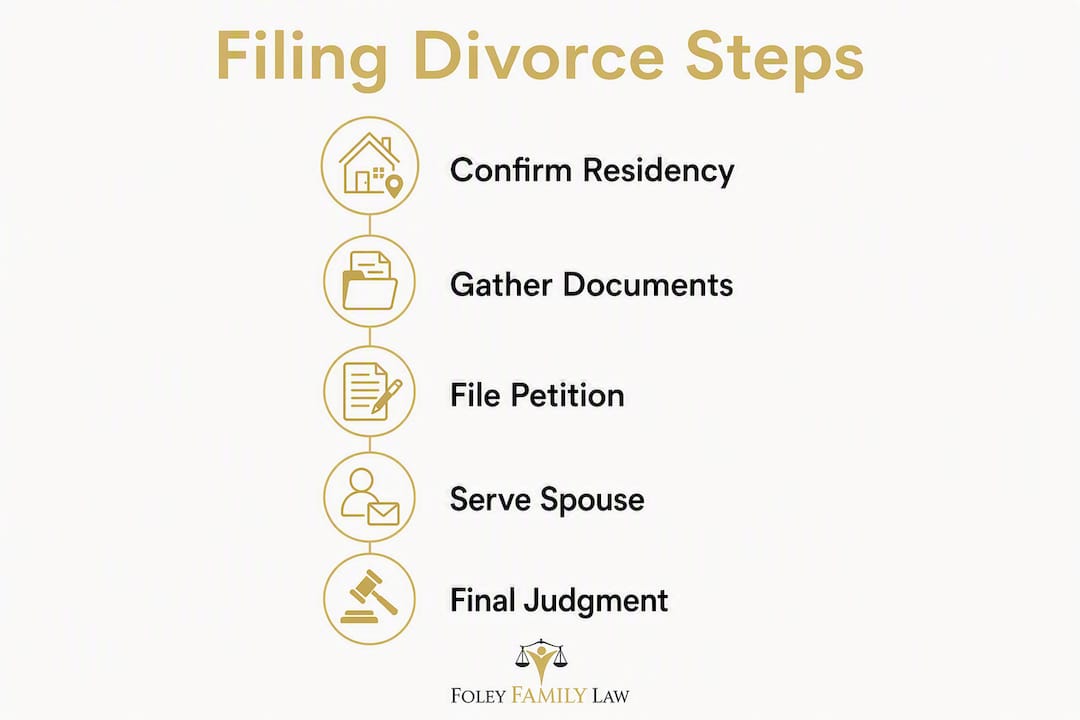
To start filing for divorce in Florida, confirm that at least one spouse has lived in Florida continuously for six months immediately before filing, then file a Petition for Dissolution of Marriage in the circuit court of the county where either spouse resides, per Fla. Stat. § 61.043. Once filed, you must serve the petition and a summons on your spouse. Under Fla. Stat. § 61.19, no final judgment can be entered until at least 20 days after the original petition is filed.
Quick checklist before you file:
- Confirm six-month Florida residency for at least one spouse and gather documentary proof
- Decide whether you qualify for simplified dissolution or need the regular petition route
- Collect government-issued ID, marriage certificate, financial records, and children’s documents (if applicable)
- Download the correct Florida Supreme Court family law forms from flcourts.gov
- File with the circuit court clerk, pay the filing fee (approximately $408 plus a $10 summons fee), or apply for a fee waiver
- Serve your spouse and track the 20-day statutory waiting period
Who can file for divorce in Florida?
Florida’s residency requirement is jurisdictional, meaning a court cannot hear your case without it. Fla. Stat. § 61.021 requires that at least one spouse must have continuously resided in Florida for six months immediately before filing the petition. “Continuously” means uninterrupted domicile, not just frequent visits.
Courts expect documentary proof, not just a statement. Acceptable evidence includes:
- A Florida driver’s license or state-issued ID issued at least six months before filing
- Florida voter registration card
- A residential lease, mortgage statement, or utility bills showing a Florida address
- Affidavits from people who can corroborate your Florida residency (Form 12.902(i) is commonly used)
Practitioners treat this proof as non-waivable. If your documentation is thin, a judge may delay or dismiss the petition entirely. Gathering multiple types of proof before you file is the safest approach. Foley Family Law’s guide on Florida residency requirements for divorce explains what courts in Hillsborough, Pinellas, and Pasco counties typically accept.
Grounds for dissolution in Florida
Florida is a no-fault divorce state. Under Fla. Stat. § 61.052, a court will grant dissolution only when one of two grounds is established:
- The marriage is irretrievably broken. This is the standard ground. You do not need to prove fault, infidelity, or misconduct.
- Mental incapacity of one spouse. The incapacitated spouse must have been adjudged mentally incapacitated for at least three years before the petition is filed.
The vast majority of Florida divorces proceed on the “irretrievably broken” ground. You simply plead it in the petition; the court does not require you to prove why the marriage failed.
Pro Tip: Gather at least two forms of residency documentation before you visit the clerk’s office. A driver’s license alone is strong, but pairing it with a lease or utility bill in your name eliminates any ambiguity about continuous domicile.
Which type of dissolution fits your situation?
Florida offers several procedural paths, and choosing the right one affects your timeline, paperwork load, and costs significantly.

Simplified dissolution of marriage
Simplified dissolution is the fastest route, but eligibility is narrow. Both spouses must agree on all terms, appear together at the final hearing, and meet every condition below:
- No minor or dependent children (and the wife is not pregnant)
- Both parties waive their right to a trial and appeal
- Both parties have made a full financial disclosure
- Both agree on the division of all property and debts
- Neither party is seeking alimony
If you qualify, the process can be completed relatively quickly after the 20-day statutory wait, with minimal court appearances.
Uncontested regular dissolution
You and your spouse agree on all issues (children, property, support), but one or both of you have minor children or other circumstances that disqualify you from the simplified route. This path still moves faster than a contested case and typically resolves within a few months after filing, depending on the court’s calendar.
Contested regular dissolution
Spouses disagree on one or more issues: timesharing, child support, property division, or alimony. This path involves discovery, possible temporary hearings, mandatory mediation in most Florida circuits, and potentially a trial. Timelines range from several months to more than a year.
Mediated and collaborative options
Florida courts require mediation in most contested cases before a trial is scheduled. Collaborative divorce is a voluntary process where both parties and their attorneys commit to resolving all issues outside of court. Both options can reduce litigation costs and preserve a working co-parenting relationship.
Pro Tip: Even if you believe your case is uncontested, have an attorney review the final agreement before you sign. Overlooked provisions about retirement accounts, tax dependency, or future modifications can create expensive problems years later.
How to file for divorce in Florida: the full step-by-step process
The Florida dissolution process follows a defined sequence. Skipping or misordering steps causes delays, additional fees, and sometimes dismissal.
Confirm residency and choose the correct venue. Verify that at least one spouse meets the six-month rule. File in the circuit court of the county where either spouse currently resides.
Prepare your petition and dissolution questionnaire. Complete the Petition for Dissolution of Marriage using the official Florida Supreme Court family law forms. Per Fla. Stat. § 61.043, the proceeding is titled “In re the marriage of [husband] and [wife].” The dissolution questionnaire is filed separately and is not part of the public record in most circuits.
Gather supporting documents. Before you walk into the clerk’s office, have these ready:
- Government-issued photo ID for both spouses
- Certified copy of your marriage certificate
- Financial records: pay stubs, tax returns (last two years), bank statements, retirement account statements
- Property documents: deeds, mortgage statements, vehicle titles
- Children’s information: birth certificates, school records, health insurance documentation
File with the circuit court clerk. Submit your completed petition and any required attachments at the clerk’s office. The clerk will stamp the petition with a filing date, which starts the 20-day clock under Fla. Stat. § 61.19.
Pay the filing fee or apply for a fee waiver. The typical petition filing fee is several hundred dollars, plus a summons fee. If you cannot afford the fee, ask the clerk for an indigent status application. Approved applicants may have fees waived or deferred.
Serve your spouse. The petition and summons must be served on the respondent spouse. Personal service by a process server or sheriff’s deputy is the standard method. Your spouse may also sign a Waiver of Service if they agree to accept the documents voluntarily.
Wait for a response. After service, the respondent generally has 20 days to file an answer. If no answer is filed, you may pursue a default.
Attend required hearings or mediation. Most contested circuits require mediation before a final hearing is scheduled. Temporary hearings for custody, support, or use of the marital home may be scheduled during this period.
Submit final paperwork and obtain the final judgment. Once all issues are resolved, the parties submit a proposed Final Judgment of Dissolution of Marriage. The judge reviews and signs it. No final judgment may be entered until at least 20 days after the original petition was filed, per Fla. Stat. § 61.19, though the court may waive this delay in cases where injustice would result.
Temporary orders and special procedural issues
If you need immediate relief during the case, such as temporary custody, temporary child support, exclusive use of the marital home, or a domestic violence injunction, you can file a motion for temporary orders early in the process. These orders remain in effect until the final judgment is entered and can significantly affect interim living and financial arrangements. Courts take these motions seriously, and having organized documentation from the start strengthens your position.
Where do you get the official Florida divorce forms?
Use only the official Florida Supreme Court family law forms. The Florida Courts family law forms page is the authoritative source, and many circuit clerks also publish local packet PDFs. The Hillsborough County Circuit 13 family law forms packet is a good example of how circuits bundle required forms with procedural instructions.
Commonly required forms include:
- Petition for Dissolution of Marriage (with or without minor children, depending on your situation)
- Summons (issued by the clerk after filing)
- Dissolution Questionnaire (filed separately; typically not part of the public record)
- Financial Affidavit (short or long form, depending on income level)
- Parenting Plan and Child Support Guidelines Worksheet (required when minor children are involved)
- Notice of Social Security Number (required in all cases)
County clerks sometimes add local cover sheets or standing order acknowledgments. Always check your specific circuit’s website or ask the clerk’s self-help center before you print and complete forms.
| Form | When Required | Where to Get It |
|---|---|---|
| Petition for Dissolution of Marriage | All cases | flcourts.gov / clerk’s office |
| Financial Affidavit | All cases | flcourts.gov |
| Parenting Plan | Cases with minor children | flcourts.gov |
| Child Support Guidelines Worksheet | Cases with minor children | flcourts.gov |
| Dissolution Questionnaire | All cases (filed separately) | flcourts.gov / clerk’s office |
Pro Tip: Many circuit clerk offices have a self-help center staffed by trained personnel who can help you identify the correct forms and check for completeness. They cannot give legal advice, but they can tell you if you have the wrong version of a form or are missing a required attachment. Call ahead to confirm hours.
What does it cost to file for divorce in Florida?
The direct answer: expect to pay approximately $408 for the petition filing fee plus a $10 summons fee, though county surcharges vary and you should verify the exact amount with your local clerk before filing.
| Cost Item | Approximate Amount | Notes |
|---|---|---|
| Petition filing fee | ~$408 | Varies slightly by county; verify with clerk |
| Summons / judgment fee | $10 | Per summons issued |
| County surcharges | Varies | Check local clerk fee schedule |
| Process server / sheriff service | $40–$100+ | Depends on county and method |
| Mediation fees | Varies | Court-connected programs may offer reduced rates |
| Fee waiver application | No charge to apply | Based on indigent status |
If cost is a barrier, Florida courts offer an indigent status application that can waive or defer filing fees for qualifying applicants. Ask the clerk’s office for the form or download it directly from the Florida Courts website.
Beyond court fees, additional costs often include:
- Private process server fees
- Guardian ad litem fees (when the court appoints one for children)
- Property appraisal or business valuation fees
- Mediation session fees (private mediators typically charge hourly)
- Attorney fees, which vary based on case complexity
For contested or high-asset cases, attorney fees can represent the largest single expense. Foley Family Law offers flat fees for certain uncontested matters and hourly or retainer arrangements for contested cases, with transparent communication about likely costs from the first consultation.
What happens with children, custody, and child support?
If you have minor children, a parenting plan and a child support calculation are required components of your dissolution. Florida courts will not enter a final judgment without them.
Parenting plans and timesharing
A parenting plan must address:
- The timesharing schedule (which parent has the children on which days, holidays, and school breaks)
- Each parent’s responsibilities for daily decisions (school pickups, medical appointments, extracurricular activities)
- Major decision-making authority (education, healthcare, religious upbringing)
- Communication methods between the child and each parent
Florida law uses the term “timesharing” rather than “custody,” and courts start from a presumption that both parents should be involved in the child’s life. The Florida Courts dissolution of marriage page provides additional guidance on parenting plan requirements.
Child support basics
Child support is calculated using the Florida Child Support Guidelines, which consider both parents’ net incomes, the number of overnights each parent has, health insurance costs, and childcare expenses. The guidelines produce a presumptive support amount, though courts can deviate from it when justified.
Documents you will need for the child support calculation:
- Recent pay stubs and last two years of tax returns for both parents
- Documentation of health insurance premiums for the children
- Childcare or daycare expense records
- Birth certificates for each child
Pro Tip: If you need temporary child support or a temporary timesharing arrangement while the case is pending, file a motion for temporary orders early. Courts can enter temporary relief relatively quickly, and having a formal order in place protects both the children and your financial position during what can be a lengthy process.
How does Florida divide property, and when does alimony apply?
Florida uses equitable distribution for marital assets and debts, meaning the court divides them fairly, not necessarily equally. The starting point is an equal split, but courts can deviate based on statutory factors. Alimony is determined separately, based on one spouse’s need and the other’s ability to pay.
Property division factors courts consider
- Length of the marriage
- Each spouse’s economic circumstances at the time of distribution
- Each spouse’s contribution to the marriage (including homemaking and child-rearing)
- Whether either spouse intentionally wasted or depleted marital assets
- Desirability of retaining the marital home for a custodial parent
Marital assets generally include everything acquired during the marriage, regardless of whose name is on the title. Separate property (owned before marriage or received as a gift or inheritance) is typically excluded, but commingling can complicate that distinction.
Alimony types and factors
Florida recognizes several forms of alimony: bridge-the-gap, rehabilitative, durational, and permanent (for long marriages with a demonstrated need). Courts weigh factors including the standard of living during the marriage, each spouse’s earning capacity, age, health, and contributions to the other’s career or education. For a detailed breakdown of how Florida courts calculate and award alimony, Foley Family Law’s guide on how Florida determines alimony covers the statutory framework and common outcomes.
Documents to gather now
- Deeds and mortgage statements for all real property
- Vehicle titles and loan statements
- Retirement account and pension statements (401(k), IRA, pension)
- Business ownership documents and recent valuations
- Bank and investment account statements (at least two years)
- Credit card and loan statements showing marital debt
Pro Tip: Get a preliminary valuation of significant assets, particularly real estate and business interests, as early in the case as possible. Disputes over value are one of the most common sources of delay and cost in contested divorces. Early appraisals also preserve a baseline if a spouse later claims assets depreciated or were spent legitimately.
For readers navigating property decisions that intersect with mortgage qualification after divorce, understanding how to document income for a mortgage in Florida can help you plan your post-divorce financial position.
How do you serve the petition, and what if your spouse doesn’t respond?
After filing, the petition and summons must be served on the respondent spouse, following the same rules as any civil action in Florida. Service is not optional; the court cannot proceed without proof that the respondent received notice.
Common service methods:
- Personal service by a licensed process server or county sheriff’s deputy (most common and most reliable)
- Waiver of service (the respondent signs a notarized acknowledgment accepting the documents voluntarily)
- Service by publication (used when the respondent’s location is unknown after a diligent search; requires court approval and publication in a local newspaper)
Fees for sheriff’s service vary by county, typically ranging from $40 to over $100 depending on the number of attempts required.
Steps to document service properly
- Retain the original proof of service (return of service form) filed by the process server or sheriff.
- File the proof of service with the circuit court clerk promptly after service is completed.
- Note the exact date of service, as it starts the respondent’s response deadline.
- Keep copies of everything in a secure location.
What happens if the respondent doesn’t answer?
After service, the respondent generally has 20 days to file a written answer. If no answer is filed within that window, the petitioner may request a clerk’s default. Once a default is entered, the petitioner can move toward a final hearing. However, courts still require the petitioner to present evidence supporting the requested relief, including a proposed parenting plan or property distribution, before entering a final judgment. A default does not mean automatic approval of everything requested.
How long does the Florida divorce process take?
The minimum statutory wait is 20 days from the date the petition is filed before a final judgment can be entered, per Fla. Stat. § 61.19. In practice, most cases take considerably longer.
Typical timelines by case type
- Simplified dissolution: As few as 30–60 days from filing if both parties are prepared, the paperwork is complete, and the court’s calendar allows a prompt final hearing.
- Uncontested regular dissolution: Typically 2–4 months, depending on how quickly both parties exchange financial disclosures and the court schedules the final hearing.
- Contested dissolution: Commonly 6–18 months or longer, particularly when discovery is needed, property valuations are disputed, or custody issues require a guardian ad litem.
Milestone timeline
- File petition with circuit court clerk
- Serve spouse (within a reasonable time after filing)
- Respondent’s 20-day answer period begins
- File for temporary orders if needed (can happen early in the process)
- Mandatory mediation (required in most circuits before a final hearing)
- Final hearing or trial
- Judge signs Final Judgment of Dissolution of Marriage (no earlier than 20 days after filing)
Scheduling bottlenecks are real. Court calendars in high-volume circuits like Hillsborough and Pinellas can push final hearing dates out by weeks or months. Temporary orders, which address living arrangements and support during the case, help both parties manage the interim period. Foley Family Law’s Florida divorce timeline resource provides county-specific context on what to expect.
When should you hire an attorney for your Florida divorce?
Hire an attorney when your case involves any of the following: minor children and a disputed timesharing arrangement, significant marital assets or debts, complex income sources (business ownership, commissions, stock options), a spouse who has already retained counsel, a history of domestic violence, or a situation where you cannot safely negotiate directly with your spouse.
Even in uncontested cases, an attorney reviewing the final agreement before you sign can prevent costly mistakes. Provisions about retirement account division (which typically require a Qualified Domestic Relations Order), tax dependency claims, and future modification standards are easy to overlook and expensive to fix after the judgment is entered.
What an attorney does for you
- Analyzes your case and advises on realistic outcomes for property, support, and timesharing
- Drafts and files motions for temporary orders when immediate relief is needed
- Manages discovery requests and responses
- Represents you in mediation and negotiates settlement terms
- Prepares you for hearings and handles courtroom representation
- Handles enforcement and post-judgment modifications if circumstances change
Foley Family Law focuses exclusively on family law, serving clients in Hillsborough, Pinellas, and Pasco counties. The firm handles contested divorces, uncontested matters, high net worth divorce cases, custody disputes, and post-judgment modifications. William S. Foley leads the team with a focus on transparent communication and cost-effective strategy.
Pro Tip: Bring these items to your initial consultation: a summary of marital assets and debts, your last two tax returns, a rough timesharing proposal if children are involved, and a list of your most pressing questions. A focused consultation produces better strategic advice and helps the attorney give you a realistic cost estimate from the start.
For an overview of what family law attorneys actually do and how representation works, Foley Family Law’s page on what family law attorneys do is a useful starting point.
Key Takeaways
Filing for divorce in Florida requires confirmed six-month residency, the correct circuit court forms, proper service on your spouse, and a minimum 20-day wait before any final judgment can be entered.
| Point | Details |
|---|---|
| Residency is jurisdictional | At least one spouse must have lived in Florida continuously for six months before filing, per Fla. Stat. § 61.021. |
| No-fault grounds apply | Florida courts grant dissolution when the marriage is irretrievably broken; fault does not need to be proven. |
| Filing fee is approximately $408 | Plus a $10 summons fee and possible county surcharges; verify the exact amount with your local clerk before filing. |
| 20-day minimum wait | No final judgment can be entered until at least 20 days after the petition is filed, per Fla. Stat. § 61.19. |
| Foley Family Law serves Tampa Bay | For contested, uncontested, or high-asset divorces in Hillsborough, Pinellas, and Pasco counties, Foley Family Law offers case assessments and full representation. |
What the filing process reveals about preparation
Most delays in Florida divorces are not caused by the courts. They are caused by incomplete paperwork, insufficient residency proof, and financial records that were never organized before the petition was filed. The petition you file on day one shapes every issue the court will consider, from property division to temporary custody. Inconsistent or vague requests in the initial pleadings force amendments, additional motions, and extra fees.
The cases that move most efficiently share a common trait: both parties, or at least the filing party, arrived at the process with organized financial records, clear documentation of residency, and a realistic picture of what they were asking the court to decide. Early mediation, even before contested issues fully develop, often resolves disputes that would otherwise require a trial.
Florida’s no-fault framework removes the burden of proving wrongdoing, but it does not remove the burden of proof on financial and parenting issues. Those disputes are evidence-driven, and the side with better-organized documentation consistently reaches resolution faster and at lower cost.
Foley Family Law is ready to help you move forward
Divorce is one of the most consequential legal processes you will go through, and the difference between a case that resolves efficiently and one that drags on for years often comes down to early preparation and sound legal strategy. Foley Family Law handles contested divorces, uncontested matters, high-asset cases, and custody disputes for clients across Hillsborough, Pinellas, and Pasco counties, with a focus on keeping clients informed and in control at every stage.

Whether you are at the very beginning and need help confirming your eligibility to file, or you are already in the process and facing a contested hearing, the firm offers initial consultations to assess your situation and outline a realistic path forward. Read through Foley Family Law’s practical guide on how to prepare financially for divorce to get a head start before your consultation. To schedule a consultation or ask a question, visit wfoleylaw.com or call the firm directly.
This article provides general information about the Florida dissolution of marriage process and is not legal advice. Laws and court procedures can change, and individual circumstances vary. Consult a licensed Florida family law attorney or verify current rules with the Florida Courts or your local clerk of court before taking action.
Useful sources and official resources
Before you file, bookmark these primary sources and verify current fees and procedures with your local clerk.
Florida statutes:
- Fla. Stat. § 61.021 — Residency requirement
- Fla. Stat. § 61.043 — Commencement of dissolution proceedings
- Fla. Stat. § 61.052 — Grounds for dissolution
- Fla. Stat. § 61.19 — Entry of judgment delay period
Official forms and court resources:
| Resource | Description | Link |
|---|---|---|
| Florida Courts family law forms | Official Supreme Court forms for all dissolution types | flcourts.gov forms |
| Florida Courts dissolution page | Overview of the dissolution process and self-help resources | flcourts.gov dissolution |
| Circuit 13 family law packet | Sample forms packet showing required documents for Hillsborough County | Circuit 13 packet PDF |
| Indigent status application | Fee waiver application for qualifying filers | flcourts.gov fee waiver |
Many county clerks also post their own fee schedules and e-filing instructions online. Search for your county’s clerk of court website and look for the family law or civil division page to confirm current filing hours, accepted payment methods, and any local standing orders that apply to your circuit.
FAQ
What is the first step in filing for divorce in Florida?
Confirm that at least one spouse has lived in Florida continuously for six months immediately before filing, then file a Petition for Dissolution of Marriage in the circuit court of the county where either spouse resides, per Fla. Stat. § 61.043.
How much does it cost to file for divorce in Florida?
The typical petition filing fee is approximately $408, plus a $10 summons fee and possible county surcharges. Readers who cannot afford the fee can apply for indigent status through the clerk’s office.
Is there a seven-year divorce rule in Florida?
No. Florida law does not have a “seven-year rule” for divorce. The only statutory waiting period is the 20-day minimum between the filing date and the entry of a final judgment, per Fla. Stat. § 61.19. Length of marriage is relevant to alimony calculations, but it does not affect your right to file.
What can be used against you in a Florida divorce?
Florida is a no-fault state, so marital misconduct generally does not affect the grounds for divorce. However, financial misconduct such as hiding assets, wasting marital funds, or dissipating property can influence how the court divides assets. In custody matters, evidence of substance abuse, domestic violence, or a pattern of behavior that harms the children’s welfare is directly relevant to the timesharing determination.
Recommended
- How To File For Divorce In Florida A Practical Guide – Foley Family Law
- Getting A Divorce In Florida: Your Tampa Bay Guide – Foley Family Law
- Uncontested Divorce Forms Florida: Your Guide To A Simpler Filing – Foley Family Law
- Choosing the Right Divorce Lawyer in South Tampa, Fl: a Comprehensive Guide to Safeguarding Your Interests


