

Let's get one thing straight right from the start: Florida law doesn't talk about "visitation rights" for fathers anymore. That's old-school thinking. The legal landscape has shifted dramatically, and terms like "visitation" and "custody" have been replaced with timesharing and parental responsibility.
This isn't just a matter of semantics. It’s a fundamental change in philosophy. The law now begins with the presumption that having equal time with both parents is what’s best for a child.
What Are A Father's Timesharing Rights In Florida?
The switch from "visitation" to "timesharing" signals a massive shift in how Florida courts view a father's role. You're not a visitor in your child's life; you're a parent. Period. The law recognizes you as an essential co-parent, putting you on the same legal footing as the mother, assuming one crucial step has been taken: establishing your legal paternity.
This modern approach is designed to level the playing field from day one. The court’s primary mission is to foster a stable, supportive environment where a child can build a meaningful relationship with both parents. For fathers here in Pasco, Pinellas, and Hillsborough Counties, this means the law is on your side when it comes to being an active, involved parent.
The Foundation Of A Father’s Rights
Before a court can even begin to sketch out a timesharing schedule, there's a non-negotiable first step. Your rights as a father have to be legally locked in.
- Establishing Paternity: This is the legal process of being officially named the child's father. Without this, you have no enforceable right to timesharing. It's the key that unlocks everything else.
- Equal Standing: Once paternity is established, you stand shoulder-to-shoulder with the mother in the eyes of the court. You have the same right to ask for time with your child and to be involved in their life.
- Parental Responsibility: This isn't just about time; it's about decision-making. It’s your right to have a say in your child's education, healthcare, and overall well-being.
The guiding principle is simple: a child deserves the love, care, and guidance of two parents. Florida's timesharing laws were built to make that a reality, leaving behind the outdated idea of a "primary" and "secondary" parent.
Understanding what is paternity is absolutely critical. It’s the legal anchor for your entire relationship with your child. At Foley Family Law, we're dedicated to helping all parents secure their rightful place in their children's lives, including those in the LGBTQ community who may face unique legal hurdles in Pasco, Pinellas, and Hillsborough Counties. We handle all LGBTQ issues and do not discriminate.
Overcoming Old Biases
Let's be honest—fathers have historically faced an uphill battle in family court. While things are getting better, some national statistics show that courts have traditionally awarded majority timesharing to fathers less often than to mothers.
These numbers underscore why it's so important to assert your rights confidently under Florida's progressive, gender-neutral laws. Study after study confirms that an involved father is vital to a child's happiness and development, and our state’s legal framework finally reflects that truth.
The Critical First Step To Secure Your Rights
Before a court can even begin to think about a timesharing schedule, a father has to take one non-negotiable step to lock in his rights under Florida law: establishing legal paternity.
Think of it like building a house. Paternity is the foundation. Without that solid legal concrete, any structure you try to build on top of it—like a parenting plan or a timesharing agreement—is unstable and can collapse at any moment. This legal recognition is the absolute bedrock of all a father's rights.
Many dads think having their name on the birth certificate is enough, and while it's a great start, it doesn't always grant the full, enforceable rights you need. Paternity is what legally connects you to your child, giving you the official standing to ask a court for timesharing and a say in the big decisions that shape their life. Of course, it also establishes your responsibilities, like providing financial support.
This flowchart breaks down the basic path for establishing your rights as a father.
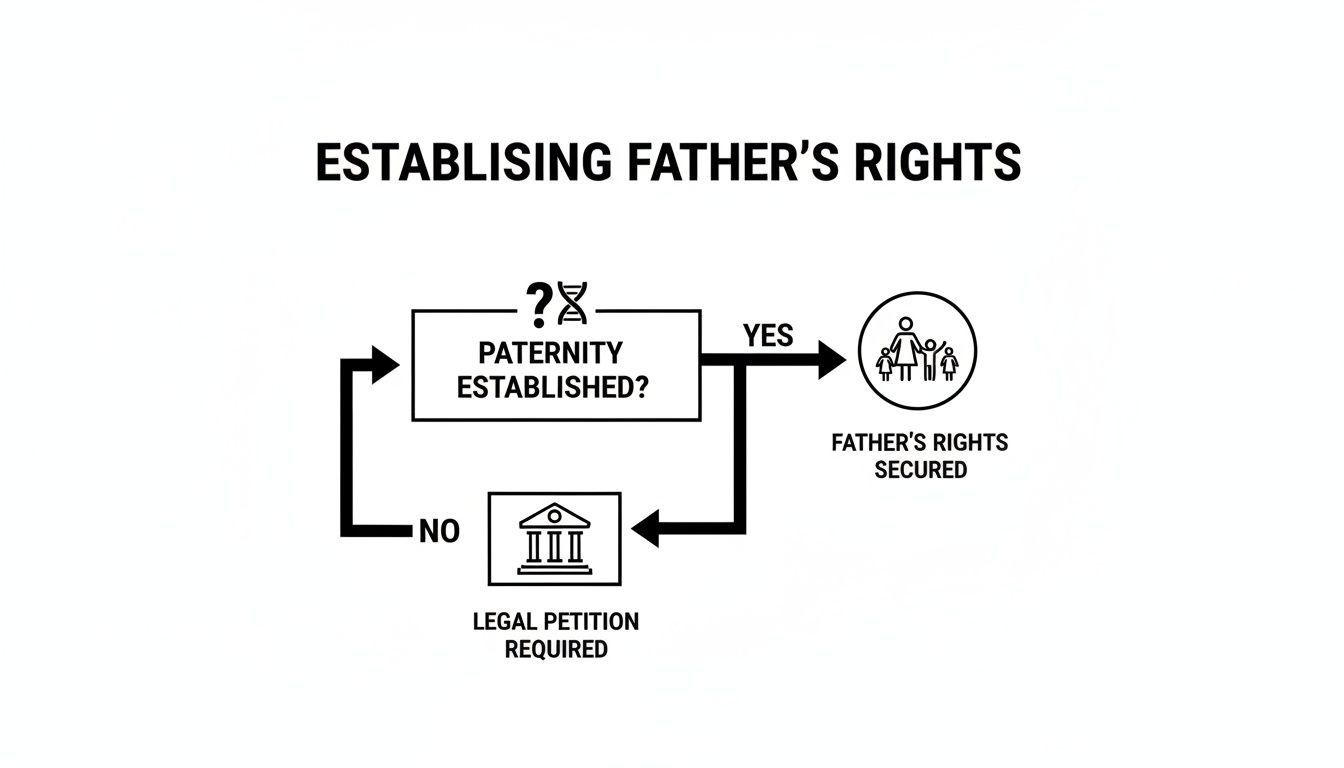
As you can see, every father's journey starts at the same place: determining if paternity is legally established. If the answer is yes, you can move forward with creating a parenting plan. If not, the court system provides a clear path to get it done.
How Is Paternity Established In Florida?
Florida law offers several straightforward ways to establish legal fatherhood. Each one is designed for different situations, but they all lead to the same crucial outcome: legally recognized parental rights. The right path for you usually depends on your relationship with the child's mother when the child was born and in the time since. Here's a look at common methods:
- Marriage: This applies to couples who are married at the time of the child's birth. The husband is automatically presumed to be the father, and paternity is established by default under the law.
- Voluntary Acknowledgment: This is for unmarried parents who agree on the father's identity. Both parents sign a legal form, often at the hospital. Once filed, this document has the full force of a court order.
- Court Order: This is used when parents disagree or are uncertain about paternity. One parent files a petition with the court, and a judge issues a final order, often after genetic testing.
No matter which method you use, the result is the same: a legal bond that gives you the right to seek timesharing and be an active part of your child’s life. At Foley Family Law, we guide fathers through this essential first step every day across Hillsborough, Pinellas, and Pasco Counties.
Why This Step Is Too Important To Skip
Failing to formally establish paternity leaves you in a dangerously weak position. Without it, you have no legal ground to stand on if the mother decides to limit or even deny your time with your child. It is the only way to transform your role from just a biological father into a legal parent with rights a court can enforce.
This is especially critical because, let's be honest, some systemic challenges still exist. Even though the laws are gender-neutral, some attorneys feel that certain judges may still default to the outdated presumption that children belong with their mothers.
Establishing paternity is your proactive shield. It ensures that your relationship with your child is protected by a court order, not just dependent on the goodwill of the other parent.
If you're in a tough spot where your access to your child is being denied and you need to act fast, you might need to look into an emergency custody order in Florida. When you're fighting for your rights, having a responsive legal team is crucial. New technologies, like an AI phone answering service designed for family lawyers, are helping modern firms streamline communication and make sure clients get timely support when they need it most.
Crafting A Timesharing Schedule That Works
Once legal paternity is established, the real work begins: creating a detailed parenting plan. This isn't just a calendar you hang on the fridge. Think of it as the official rulebook for your co-parenting relationship, and in Florida, it's a legal requirement for any case involving children's time. A well-thought-out plan is your single best tool for preventing future fights and locking in your rights as a father.
The goal is to build a practical guide for how you and the other parent will raise your child while living in separate homes. This document gets submitted to a judge in Pasco, Pinellas, or Hillsborough County. They will scrutinize it to make sure it meets one critical legal standard: serving the "best interests of the child." A thorough, sensible plan signals to the court that you're a serious, organized, and committed parent.

Key Components Of A Florida Parenting Plan
To get a judge's approval, your parenting plan has to cover several non-negotiable areas. It needs to be specific enough to leave no room for argument but also flexible enough to grow with your child. It’s the blueprint for their childhood.
Your plan absolutely must outline:
- Timesharing Schedule: This is the nitty-gritty. It spells out the exact days and times the child will be with each parent, covering everything from regular weekdays and weekends to holidays, school vacations, and summer break.
- Parental Responsibility: This section tackles the big decisions. Who has the final say on things like schooling, medical care, and religious upbringing? Will you make these choices together, or will one parent have ultimate authority?
- Communication Protocols: The plan has to clarify how you and the other parent will talk to each other. It also needs to set rules for how each of you can communicate with your child when they're with the other parent.
A detailed parenting plan is your best defense against future misunderstandings. When the rules are clear, there is less room for conflict, allowing both parents to focus on what truly matters: the child.
At Foley Family Law, we guide all families, including LGBTQ+ parents, in creating these vital documents in Pasco, Pinellas, and Hillsborough Counties. A solid plan protects your rights and, more importantly, gives your child the stability they deserve. For a more detailed look, you can learn more about crafting a parenting plan in a divorce and what Florida courts demand.
Common Timesharing Schedules
Every family is different, but over the years, a few common timesharing arrangements have become standard in Florida. The right schedule for you will hinge on your child's age, how far apart the parents live, and your work schedules. The court’s primary concern will always be what provides the most consistency for the child.
A few popular schedules include:
- Equal (50/50) Timesharing: This is the default starting point for many Florida courts. Common ways to split time equally include alternating weeks (often called a "Week On/Week Off" schedule) or the 2-2-5-5 rotation, where one parent always gets Mondays and Tuesdays, the other always gets Wednesdays and Thursdays, and you alternate weekends.
- Majority/Minority Timesharing: In this setup, the child lives with one parent most of the time. The other parent typically has a set schedule, like every other weekend plus one evening during the week for dinner.
- Long-Distance Plans: When parents don't live near each other, the schedule has to adapt. This often means the non-majority parent gets the child for the bulk of summer vacation and then alternates major holidays or school breaks to make the travel time worth it.
The Best Interests Of The Child Standard
Every single decision a judge makes about your rights as a father will be viewed through one critical lens: the best interests of the child. This isn't just a feel-good phrase; it's a specific list of factors defined by Florida law that a judge is required to weigh when approving your parenting plan.
When you put your proposed schedule in front of the court, they are going to analyze how it benefits your child's well-being. Judges in Hillsborough, Pasco, and Pinellas Counties will look at each parent’s ability to offer a stable home, their willingness to foster a healthy relationship between the child and the other parent, and any history that might pose a risk to the child's safety.
Ultimately, proposing a plan that is fair, practical, and truly centered on your child is the most powerful way to secure a meaningful and consistent role in their life.
Handling Complex Timesharing Situations
Family life doesn't always fit into a neat box. Sometimes, tough circumstances pop up that can throw a wrench into a father's timesharing rights. When you're dealing with issues like safety concerns, long-distance moves, or active military service, a standard parenting plan just might not cut it anymore.
Florida's courts have specific ways of handling these complexities, and their number one priority is always—always—the child's well-being. These situations demand a careful, legally sound approach to protect both the child and a father's vital role in their life. At Foley Family Law, we've guided countless fathers in Hillsborough, Pinellas, and Pasco Counties through these exact scenarios, ensuring every family, including LGBTQ+ parents, gets the knowledgeable and compassionate representation they deserve.
When Timesharing Requires Supervision
In some rare and serious cases, a court might decide that a child’s safety or well-being could be at risk during visits with a parent. This usually stems from significant allegations like substance abuse, domestic violence, or severe mental health struggles. When these red flags are raised, a judge has the option to order supervised timesharing.
This simply means that a father's time with his child must happen with an approved third party present. This supervisor could be a trusted family member, someone from a professional agency, or another neutral person the court appoints. The goal here isn't to punish the dad; it's to guarantee the child stays safe while still giving that crucial parent-child bond a chance to grow.
Usually, a supervised timesharing order comes with a roadmap back to normal. A judge will lay out clear steps the father needs to take to get back to unsupervised time. This could mean completing counseling, an anger management course, or a substance abuse treatment program. The key to restoring your standard timesharing rights is successfully checking every box the court gives you.
The Strict Rules For Parental Relocation
Life happens. A new job, a better opportunity, or a family need might require a parent to move. But when there are kids involved, you can’t just pack up the U-Haul and go.
In Florida, if a parent wants to move more than 50 miles away from where they currently live for at least 60 consecutive days, they have to follow a very specific legal process. This is called parental relocation. The parent who wants to move has two options: get written, signed consent from the other parent, or file a formal petition with the court.
If it goes to a judge, they will decide if the move is truly in the child's best interest. They'll look at everything, including:
- The child’s relationship with both parents.
- The reasons each parent has for wanting or fighting the move.
- How the move will affect the child's stability and development.
- Whether a realistic, long-distance timesharing schedule is even possible.
Trying to skip this process can backfire, big time. A court could order the child's immediate return and might even change the whole parenting plan to favor the parent who stayed behind.
Special Protections For Military Fathers
Military service creates a unique set of challenges for dads trying to maintain a consistent presence in their kids' lives. Deployments, temporary duty assignments, and frequent relocations are just part of the job.
Fortunately, Florida law recognizes this sacrifice and provides specific protections to make sure a service member's fathers visitation rights aren't permanently lost because of their commitment to our country. If a father's military orders make it impossible for him to exercise his timesharing, he can't be penalized for it. A court is not allowed to use his deployment as a reason to permanently strip away his time.
Upon returning from deployment, a military father is entitled to resume the timesharing schedule that was in place before he left. This protection ensures that serving the nation does not mean sacrificing your role as a parent.
What's more, a deploying parent can even designate a family member—like a grandparent or stepparent—to step in and exercise some of their timesharing while they're away. This is a huge help in keeping the child connected to their father’s side of the family during a long absence. In these kinds of intricate cases, a court might appoint a professional to advocate specifically for the child's best interests. To get a better handle on that role, you can read our guide explaining what is a Guardian ad Litem.
How To Enforce Or Modify Your Parenting Plan
A court-ordered parenting plan isn't just a suggestion—it's a legally binding document meant to create consistency for your child. But life happens. Sometimes, the other parent just stops following the schedule. Other times, a big life change makes the current plan totally unworkable. When you hit these roadblocks, you have options. Florida law gives you two very different tools: enforcement to make someone comply and modification to change the plan itself.

Knowing how to use these legal tools is the key to protecting your rights as a father. Here at Foley Family Law, we're constantly helping parents across Pasco, Pinellas, and Hillsborough Counties make sure their court orders are followed and updated when life calls for it. We are proud to provide dedicated legal support to all families, including LGBTQ+ parents, and do not discriminate.
Taking Action When The Other Parent Violates The Plan
It's infuriating when the other parent just decides not to follow the timesharing schedule. More importantly, it damages your relationship with your child. Florida courts take these violations seriously, but you have to go through the proper channels to get results. Trying to solve it yourself by withholding child support is a huge mistake that will land you in hot water.
The right tool for the job is a Motion for Contempt and Enforcement. Think of it as formally asking a judge to step in, declare that the other parent is breaking the rules, and order them to stop.
To have the best shot at winning, you need proof. Documentation is everything.
- Keep a Detailed Log: Write down every single time a violation occurs. Note the date, time, and exactly what happened. Be specific.
- Save Communications: Keep every text message, email, or messaging app conversation related to the timesharing denial.
- Identify Witnesses: Did another adult see what happened? Their testimony could be a game-changer.
Filing this motion forces the court to address the problem head-on. A judge has the power to order make-up timesharing, force the other parent to pay your attorney’s fees, and impose other penalties to ensure it doesn't happen again.
Adapting Your Plan When Life Changes
Parenting plans are a snapshot in time, built around your family's reality at that moment. But life doesn't stand still—people get new jobs, kids get older, and what worked last year might not work today. When a major life event throws things off balance, your current plan might no longer be in your child's best interest. That's when you file for a modification.
To get a parenting plan modified in Florida, you have to convince the court of three key things:
- A substantial change in circumstances has occurred.
- This change is material, meaning it has a real impact on the child or parents.
- The change was unanticipated when the original order was created.
The bar for modification is set high on purpose. Courts don't like to disrupt a child's routine without a very good reason. The change needs to be big enough to justify rewriting the rules and creating a new normal.
Common reasons people seek a modification include one parent relocating for a job, a parent's work schedule changing dramatically, or a child's needs evolving as they become a teenager. If you think your situation qualifies, your first step should be to learn about the process from experienced Tampa custody modification lawyers. While not the same, understanding some general contract management best practices can also provide a helpful framework for thinking about how to uphold and adapt complex legal agreements.
In the end, whether you need to hold the other parent accountable or adjust to life's next chapter, the court system has a pathway. Protecting your role as a father means knowing which path to take and when to start walking.
Practical Steps To Protect Your Role As A Father
It’s not all about what happens in the courtroom. The daily actions you take play a massive role in protecting your relationship with your child and strengthening your legal position. Protecting your fathers visitation rights isn't just about winning a legal argument in front of a judge; it's about the consistent, responsible parenting you do every single day.
Taking control starts with being organized and intentional. Simple habits can create a powerful record of your commitment, one that speaks for itself if you ever need it to.
Document Everything Meticulously
Think of your documentation as an insurance policy. When disagreements pop up, having a clear, factual record is your best defense against false accusations and messy "he said, she said" arguments.
It doesn’t have to be complicated. Start a simple journal or use a notes app on your phone. For every interaction, log:
- Dates and Times: Be precise. Note when timesharing exchanges happened or when you sent a text.
- Key Details: Keep it brief and factual. "Picked up child at 6:05 PM. Mother was 5 minutes late."
- Communications: Screenshot important text messages and save emails about schedules, your child's needs, or any conflicts that arise.
This log builds an objective timeline that can be incredibly valuable. It shifts the focus from emotional drama to concrete facts—exactly what a judge in Pasco, Pinellas, or Hillsborough County wants to see.
Maintain Child-Focused Communication
How you talk to the other parent matters. A lot. Courts want to see parents who can put their personal feelings aside for the good of their child. Your goal should always be respectful, business-like, and child-focused conversations.
A great way to do this is by using a co-parenting app. These tools are designed to keep communication on track with shared calendars and secure messaging, minimizing opportunities for conflict and creating a clean, official record.
Your goal is to show that you are the reasonable, stable parent focused on solutions, not drama. This approach not only lowers your own stress but also proves to a judge that you're capable of effective co-parenting.
Stay Actively Involved
Your involvement needs to go way beyond your scheduled timesharing days. Being a consistent presence in all areas of your child's life is powerful proof of your commitment.
Make it a priority to:
- Show up for parent-teacher conferences and school events.
- Be there for doctor's appointments and extracurricular activities.
- Communicate directly with teachers, coaches, and caregivers.
This level of engagement proves you are an integral part of your child's support system. It shows that you're not just a "weekend dad" but a fully invested co-parent. At Foley Family Law, we handle all LGBTQ issues, family and divorce issues, and do not discriminate. We are committed to helping every parent maintain their essential role in Pasco, Pinellas, and Hillsborough Counties. When your rights are on the line, the most effective step is to seek experienced legal help.
Frequently Asked Questions About Fathers' Rights
When you're fighting for time with your child, questions and anxieties can pile up fast. Here are some straightforward answers to the common concerns we hear from dads across Florida.
Does Florida Law Favor Mothers Over Fathers?
Absolutely not. Florida law is explicitly gender-neutral, and a judge is legally forbidden from siding with a parent just because of their gender.
The court's one and only guiding principle is the "best interests of the child." A father who is actively involved and a positive force in his child's life has just as much right to significant timesharing as the mother.
What If The Mother Is Denying My Court-Ordered Timesharing?
It's an incredibly frustrating situation, but it's critical you don't take matters into your own hands. The first step is to meticulously document every single time she violates the parenting plan. Note the date, the time, what was said, and what happened.
Once you have that log, it's time to call an experienced family law attorney. We can file a Motion for Contempt and Enforcement, which formally asks the court in Pasco, Pinellas, or Hillsborough Counties to step in, enforce its own order, and uphold your rights as a father.
Whatever you do, don't stop paying child support to retaliate. The court sees these as completely separate issues, and withholding support will only land you in legal trouble. There's a proper legal path to fix this—use it.
Can I Stop Paying Child Support If I'm Not Seeing My Child?
No, you absolutely cannot. In Florida, child support and timesharing are two distinct legal duties. Withholding child support payments is a direct violation of a court order and can bring on serious consequences, including heavy fines or even jail time.
The only correct way to address denied visitation is by filing an enforcement action with the court. Your financial responsibility to support your child doesn't stop just because the other parent isn't following the schedule. Protecting your fathers' visitation rights means using the proper legal tools, not creating new problems for yourself.
Figuring out the complexities of timesharing and parental rights isn't something you should do alone. At Foley Family Law, we are committed to protecting the rights of fathers throughout Pasco, Pinellas, and Hillsborough Counties. We handle all LGBTQ issues, family and divorce issues, and do not discriminate. If your role as a dad is being challenged, reach out so we can build a clear plan of action. Visit us at https://wfoleylaw.com to get started.


