

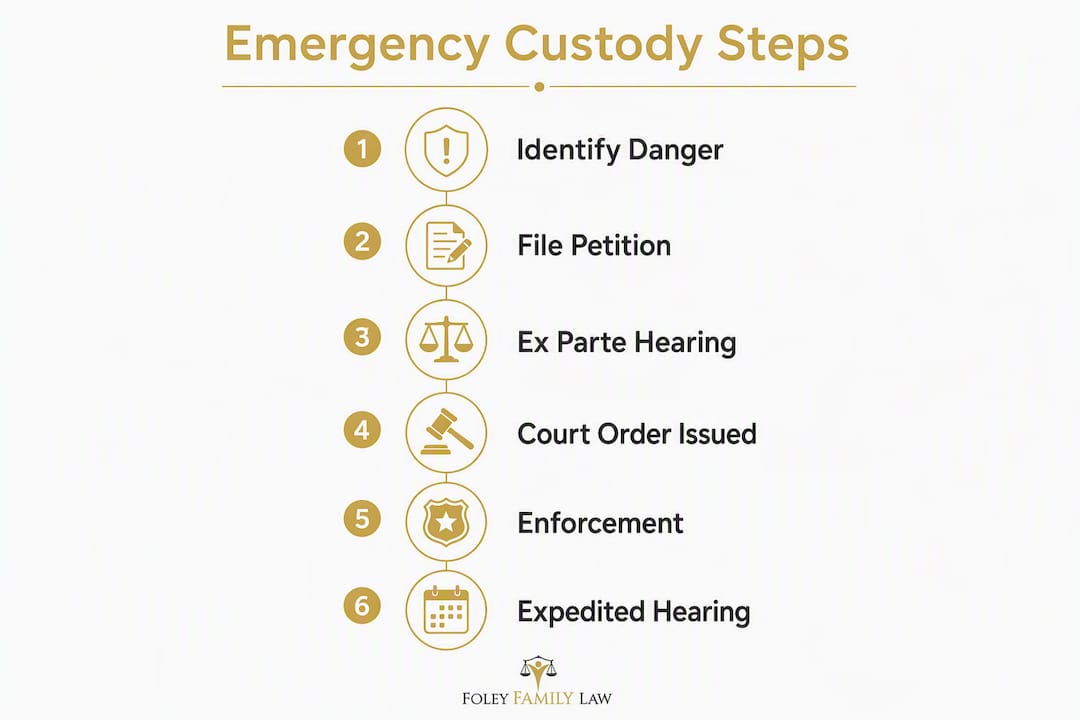
If a child is in immediate danger, call 911 first. Once the child is safe, your next step is to file an Emergency Verified Motion for Child Pick-Up Order (Florida Supreme Court Approved Family Law Form 12.941(d)) with the county clerk where the child is physically located, or ask the court for temporary emergency jurisdiction under Florida Statutes section 61.517. These are the two primary legal tools for emergency custody in Florida, and knowing which one applies to your situation can make a critical difference.
Here is what to do immediately:
- If the child faces imminent physical harm: Call 911 before anything else. Law enforcement can intervene without a court order when a child is in danger.
- Move the child to safety if you can do so without creating additional risk or legal exposure.
- File Form 12.941(d) at the county clerk’s office in the county where the child is located. Ask specifically about emergency family law intake and duty judge availability.
- Bring certified copies of any existing custody or time-sharing order, or the child’s birth certificate if you are the birth mother with no prior order. Form 12.941(d) requires a pre-existing legal right to possession; without one, the clerk or judge may reject the motion.
- Preserve all evidence before you file: photographs of injuries, screenshots of threatening messages with visible timestamps, medical records, and police report numbers.
Pro Tip: Call 911 for any imminent threat before touching a single form. Courts look favorably on parents who prioritized the child’s safety over paperwork, and a police report created that day becomes your strongest piece of corroborating evidence.
What qualifies as grounds for emergency custody in Florida?

Florida law gives courts two distinct pathways to act on an emergency basis, and the one a judge uses depends heavily on whether a custody order already exists and where the child is located.
Statutory grounds under F.S. 61.517
Florida Statutes section 61.517 grants Florida courts temporary emergency jurisdiction when the child is present in Florida and one of three conditions applies:
- The child has been abandoned.
- An emergency exists to protect the child because the child, a sibling, or a parent is subjected to or threatened with mistreatment or abuse.
- An emergency exists to protect the child for another recognized reason the statute covers.
When parallel custody proceedings exist in another state, Florida courts are required to communicate with that state’s court and coordinate jurisdiction. The emergency order can remain in effect only until a court with proper jurisdiction issues a subsequent order, or for the specific period the Florida court sets.
Pick-up orders and the pre-existing right requirement
Form 12.941(d) is available only to a person who already has a legal right to physical possession of the child. That means either an existing custody or time-sharing order naming you, or birth mother status with no prior court order in place. Fathers who have not established paternity or obtained a custody order generally cannot use this form to compel a pick-up. For unmarried fathers, establishing parental rights is a prerequisite.
How judges evaluate emergency requests
Judges scrutinize emergency motions closely because ex parte relief, meaning relief granted without the other parent present, is an extraordinary remedy. Vague accusations are routinely rejected. A judge needs specific, verifiable facts: dates, times, locations, named witnesses, observed injuries, and corroborating reports from police or medical professionals. The more concrete and documented the allegations, the more credible the motion.
How to file an emergency custody petition in Florida
Filing correctly the first time matters. Procedural errors are the most common reason emergency motions are rejected before a judge ever reads them.
Forms you need to file
- Form 12.941(d) — Emergency Verified Motion for Child Pick-Up Order (the primary motion)
- Form 12.941(e) — Order to Pick-Up Minor Child(ren) (the proposed order for the judge to sign)
- Form 12.902(d) — UCCJEA Affidavit (establishes child’s location and any prior proceedings in other states)
- Form 12.900(h) — Notice of Related Cases
- Certified copy of your existing custody/time-sharing order or the child’s certified birth certificate if you are the birth mother
- Supporting affidavit with specific dates, times, witnesses, and observed harm
- Certified police or medical reports, if available
Clerk pro se checklists for emergency pick-up motions explicitly warn that missing the UCCJEA affidavit, Notice of Related Cases, or certified custody records will result in immediate rejection at intake. Do not skip these attachments.
Where and how to file
- File at the county clerk’s office in the county where the child is physically located, not necessarily where you live or where a prior case was filed.
- Ask the family law intake staff specifically about emergency processing procedures and whether a duty judge is available that day or after hours.
- Bring originals plus at least three copies of every document. Clerks keep one set, the judge needs one, and you need a file-stamped copy for your records.
- If the clerk’s office is closed, ask about after-hours emergency filing procedures — many circuits have a duty judge accessible through law enforcement or a court administrator.
Requesting ex parte relief
“Ex parte” means the judge considers your motion without the other parent present. Courts are cautious about this because it bypasses due process. To obtain ex parte relief, your affidavit must demonstrate that notifying the other parent in advance would create additional risk to the child or defeat the purpose of the order. Safety concerns, flight risk, or documented threats can justify proceeding without notice.
Once an order is entered, take certified copies to the sheriff’s office immediately and follow any instructions in the order about the scheduled hearing date.
Pro Tip: Contact the clerk’s family law intake desk before you arrive. Ask whether the circuit uses an emergency docket or a duty judge, and confirm which forms they require locally. Procedures vary by county, and a five-minute phone call can prevent a wasted trip.
What evidence should you bring to an emergency custody filing?
Strong evidence is what separates a motion a judge acts on from one that gets set for a routine hearing weeks later. Organize your materials before you walk into the clerk’s office.
Core documents
- Police reports with case numbers and officer names
- Medical records documenting injuries, with dates of treatment
- Photographs of injuries, unsafe living conditions, or property damage (with visible metadata or timestamps)
- Text messages and emails showing threats, admissions, or dangerous behavior (screenshots that preserve the sender’s name, date, and time)
- School records reflecting unexplained absences, behavioral changes, or teacher concerns
- Prior custody orders or paternity judgments, certified
- Certified birth certificate
What your affidavit must contain
The affidavit is the heart of the motion. It must be verified, meaning signed under oath, and it must state:
- Specific dates and times of each incident
- Exact locations
- Names of witnesses who observed the harm or dangerous conditions
- Description of observed injuries or threats, in plain, factual language
- Any prior reports to law enforcement or DCF
- The specific relief you are requesting and why immediate action is necessary
Avoid general statements like “he is a danger to the children.” Courts need facts, not conclusions.
Witness statements and corroboration
Signed, dated affidavits from police officers, teachers, pediatricians, or neighbors who witnessed relevant events carry significant weight. If a witness cannot provide a written affidavit before you file, note their name and contact information in your motion and indicate they are available to testify at the hearing.
Practical handling at the clerk’s office
- Label each exhibit clearly (Exhibit A, Exhibit B, etc.) and include an exhibit index with your motion.
- Bring courtesy copies for the duty judge if the clerk’s office requests them.
- Keep originals separate from copies and never hand over your only original.
Pro Tip: For digital evidence, preserve the original file with metadata intact. Take screenshots that show the full conversation thread, the sender’s contact information, and the date. Back up everything to a secure cloud location before you file, so nothing is lost if a device is damaged or seized.
What happens at an emergency hearing and how long does it take?
Emergency custody hearings in Florida move faster than standard family law proceedings, but “fast” is relative and depends on the circuit, the duty judge’s availability, and how compelling your facts are.
Types of emergency hearings
- Ex parte hearing: The judge reviews your motion and affidavit without the other parent present. This can happen the same day you file if a duty judge is available and your facts are urgent. The judge may sign a pick-up order or issue a temporary emergency custody order on the spot.
- Expedited hearing with notice: If the judge does not grant full ex parte relief, an expedited hearing is typically scheduled within a few days, giving the other parent an opportunity to respond. Both parties appear and present evidence.
- After-hours filings: Some circuits allow emergency filings through law enforcement or a court administrator when the clerk’s office is closed. Duty judges can be reached in genuine emergencies.
What the emergency order typically contains
A signed emergency order will usually specify:
- Direction to the sheriff to locate and pick up the child
- Where the child is to be placed (with the movant, held for an immediate hearing, or placed with DCF)
- A scheduled date for the expedited full hearing
- Service requirements for the other parent
- Duration of the order
This is a critical point. Even if a judge signs a pick-up order, the child may be brought before the court rather than handed directly to you. Be prepared to attend an immediate hearing with your evidence ready.
Timeline expectations
Same-day relief is possible but not guaranteed. When facts are compelling and a duty judge is available, a pick-up order can be signed within hours of filing. More commonly, an expedited hearing is set within a few business days. The emergency order remains in effect for the period specified by the court or until a court with proper jurisdiction enters a subsequent order under F.S. 61.517.
How emergency orders are enforced and what happens if they are violated
Once a judge signs a pick-up order, enforcement moves to the sheriff’s office. Understanding what the order authorizes, and what it does not, helps you act quickly and correctly.
How sheriff enforcement works
Form 12.941(e) explicitly authorizes sheriffs to take custody of the child and directs them to act day or night. The order specifies one of three placement options:
- Hand the child to the movant (the parent who filed)
- Hold the child for an immediate court hearing
- Place the child with DCF pending the hearing
Take certified copies of the signed order to the sheriff’s office immediately after it is entered. Do not wait. Bring multiple certified copies because the sheriff keeps one and you need one for your records.
Arrest language in the order
Form 12.941(e) contains templates that can instruct sheriffs to arrest a party who violates the order in the presence of a law enforcement officer. Violating a court order also exposes the non-complying parent to contempt proceedings, which can result in fines, sanctions, or incarceration.
Do not attempt self-help
Never try to physically take the child yourself, even if you believe you have the legal right to possession. Self-help removals can result in criminal charges, create an appearance of wrongdoing in court, and seriously damage your position at the upcoming hearing. Use the court and the sheriff.
After enforcement
Attend the scheduled expedited hearing with all your corroborating evidence. Be prepared to explain the relief you are seeking long-term, whether that is a temporary custody order, a modification of an existing order, or another remedy. The emergency order is a bridge to that hearing, not a final resolution.
How emergency custody differs from temporary and final custody orders
Parents often use these terms interchangeably, but they describe three legally distinct stages with different standards, durations, and consequences.
Emergency custody orders
These are immediate, short-term measures based on imminent danger. They are designed to protect a child while the court schedules a full hearing. An emergency order is typically in effect for a short term, and it does not resolve the underlying custody dispute. The evidentiary burden focuses on immediacy and specific danger rather than the broader best-interests analysis.
Temporary custody orders
A temporary custody order is issued after notice and a hearing, and it governs parenting time and responsibilities while the case is pending. Temporary orders in a divorce or custody case can remain in place for months or even years until a final order is entered. They carry more weight than emergency orders because both parties had an opportunity to be heard. Temporary orders in Florida proceedings often address child support, parenting schedules, and primary residence on an interim basis.
Final custody orders
Final orders are entered after full litigation or by agreement, and they replace all prior temporary and emergency orders. They are the permanent resolution of the custody dispute, subject only to future modification upon a showing of a substantial and material change in circumstances.
| Order Type | Basis | Duration | Both Parties Present? |
|---|---|---|---|
| Emergency | Imminent danger, specific verified facts | Days to weeks | Not required (ex parte possible) |
| Temporary | Notice and hearing, interim best interests | Months to years (until final order) | Yes |
| Final | Full litigation or settlement | Permanent (until modified) | Yes |
The practical difference matters for enforcement and appeals. Emergency orders are harder to appeal quickly because they are designed to expire or be replaced. Temporary orders shape daily life for the duration of the case, so getting them right is worth the effort. For parents planning ahead after an emergency, creating a Florida custody schedule early in the process helps establish a workable parenting plan for the temporary order stage.
If the other parent takes or refuses to return the child: what to do now
This situation calls for a clear, prioritized response. Panic is understandable, but a methodical approach protects both the child and your legal position.
- File an Emergency Verified Motion — and request a pick-up order. Bring certified copies of your existing custody or time-sharing order, or the child’s birth certificate if applicable. The motion should describe the specific circumstances of the removal, including dates, times, and any communications with the other parent.
Can a father take his child without the mother’s consent in Florida?
Whether a parent can lawfully take a child depends entirely on what court orders exist. If there is no custody order and the parents are unmarried, Florida law generally gives the birth mother immediate custody rights until a court order says otherwise. A father without a paternity judgment and custody order who removes the child may face criminal and civil consequences. If a custody order exists, either parent who violates it is subject to contempt and enforcement proceedings.
What to bring to an emergency custody consultation
Walking into a consultation prepared shortens the intake process and lets your attorney focus on strategy rather than document collection.
Documents to bring
- Certified copies of any existing custody, time-sharing, or divorce orders
- Child’s certified birth certificate
- Paternity judgment, if applicable
- Police reports with case numbers
- Medical records documenting injuries or neglect
- Photographs and screenshots with visible timestamps
- School records showing absences or behavioral concerns
- Any prior DCF reports or case numbers
- Relevant text messages and emails, printed and organized by date
Questions to ask your attorney
- Do you have experience with emergency pick-up orders in this county?
- What is the realistic timeline for getting a hearing before a duty judge?
- What is the fee structure for emergency filings and the expedited hearing?
- How do you coordinate with the county clerk and sheriff’s office?
- What are the likely outcomes at the expedited hearing given my facts?
What an attorney will do after intake
- Review your documents and identify which forms apply to your situation
- Draft a verified emergency motion with a detailed affidavit
- Assemble and label exhibits, prepare the UCCJEA affidavit and Notice of Related Cases
- File with the clerk and request duty-judge consideration
- Serve the opposing party as directed by the court
- Coordinate with the sheriff if a pick-up order is entered
- Prepare you for the expedited hearing, including what evidence to present and what to expect
Foley Family Law handles emergency custody filings in Hillsborough, Pinellas, and Pasco counties, including coordination with local clerks, duty judges, and sheriff’s offices. The firm’s intake process is designed to move quickly when a child’s safety is at stake.
Pro Tip: Organize your documents chronologically before the consultation. A timeline of events, even a handwritten one, helps your attorney identify the strongest facts quickly and draft a more compelling affidavit.
Key Takeaways
An emergency custody order in Florida requires verified, specific evidence of imminent danger and, for pick-up orders, a pre-existing legal right to possession — calling 911 first and filing Form 12.941(d) with the county clerk are the two most time-sensitive steps.
| Point | Details |
|---|---|
| Call 911 first | If a child faces imminent harm, law enforcement can act without a court order — safety before paperwork. |
| Pre-existing right required | Form 12.941(d) is available only to parents with an existing custody order or birth mothers with no prior order. |
| Complete filings only | Missing the UCCJEA affidavit, Notice of Related Cases, or certified custody records causes immediate rejection at intake. |
| No self-help removals | Taking the child yourself, even with legal rights, can result in criminal charges and harm your court position. |
| Foley Family Law | Handles emergency filings, sheriff coordination, and expedited hearing representation in Hillsborough, Pinellas, and Pasco counties. |
Why the paperwork is only half the battle in emergency custody cases
The most common misconception about emergency custody in Florida is that filing the right forms is the hard part. It is not. The harder part is assembling evidence that a judge finds credible enough to act on without hearing the other side, and then sustaining that position at the expedited hearing days later when the other parent shows up with their own account.
Courts are appropriately skeptical of ex parte emergency motions. Judges see these filings regularly, and they know that genuine emergencies and tactical filings can look similar on paper. What separates them is specificity: a parent who can point to a dated police report, a pediatrician’s note from last Tuesday, and three text messages with timestamps is far more persuasive than one who describes a pattern of general concern. Vague allegations do not just fail to win emergency relief; they can signal to the judge that the motion is being used as a litigation tactic, which damages credibility for everything that follows.
There is also a procedural reality that surprises many parents: even when a judge signs a pick-up order, the child is often brought before the court rather than handed directly to the filing parent. The order is designed to secure the child’s safety and get both parties in front of a judge quickly, not to resolve custody on the spot. Parents who understand this going in are better prepared for what the expedited hearing actually requires.
Experienced counsel matters here not because attorneys have special access to judges, but because they know what a specific county’s duty judge expects, how to structure an affidavit that reads as credible rather than conclusory, and how to avoid the procedural errors that cause immediate rejection. Those details are not intuitive, and the cost of getting them wrong is measured in days or weeks of delay while a child remains in an unsafe situation.
This article is general legal information, not legal advice specific to your circumstances. Consult a qualified Florida family law attorney before taking legal action.
Foley Family Law handles emergency custody cases in the Tampa Bay area
When a child’s safety is at stake, the margin for procedural error is zero. Foley Family Law provides emergency custody representation in Hillsborough, Pinellas, and Pasco counties, handling the full scope of what an emergency filing requires: drafting verified motions and affidavits, assembling and labeling exhibits, filing with the clerk and requesting duty-judge consideration, and coordinating directly with the sheriff’s office when a pick-up order is entered.

The firm’s attorneys understand the local filing procedures that vary by county, including which circuits use emergency dockets, how duty judges prefer affidavits structured, and what the clerk’s office requires to process an emergency motion without delay. That local knowledge is what family law attorneys bring to a situation where every hour matters.
An initial consultation covers your documents, the likely procedural path given your facts, and the fee structure for emergency representation. Foley Family Law does not guarantee outcomes, but it does guarantee that your filing will be prepared correctly and that you will not face the expedited hearing alone. Call the firm now to schedule an immediate consultation.
Official forms, statutes, and county resources to use right away
- Form 12.941(d) — Emergency Verified Motion for Child Pick-Up Order (Florida Supreme Court Approved Family Law Form)
- Form 12.941(e) — Order to Pick-Up Minor Child(ren) (Florida Supreme Court Approved Family Law Form; includes sheriff directives and placement options)
- UCCJEA Affidavit — Form 12.902(d) (required attachment; establishes child’s location and prior proceedings)
- Florida Statutes § 61.517 — Temporary Emergency Jurisdiction (statutory authority for emergency custody when no prior order exists or for interstate cases)
- Hillsborough County 13th Judicial Circuit — Emergency Family Law Packet (local filing instructions and checklist for emergency pick-up motions)
FAQ
What qualifies for emergency custody in Florida?
Florida courts grant emergency custody when a child present in the state has been abandoned, is subjected to or threatened with mistreatment or abuse, or faces another recognized emergency under F.S. 61.517. For a pick-up order under Form 12.941(d), the filing parent must also have a pre-existing legal right to physical possession of the child.
How long does it take to get emergency custody in Florida?
Same-day relief is possible when a duty judge is available and the facts are compelling; otherwise, an expedited hearing is typically scheduled within a few days of filing. The emergency order remains in effect for the period the court specifies or until a court with proper jurisdiction enters a subsequent order.
What is the difference between emergency custody and temporary custody?
An emergency custody order is a short-term safety measure based on imminent danger, often granted ex parte and lasting days to weeks. A temporary custody order is issued after notice and a hearing, governs parenting time while the case is pending, and can remain in place for months until a final order is entered.
Can a father take his child without the mother’s consent in Florida?
If no custody order exists and the parents are unmarried, Florida law generally gives the birth mother immediate custody rights until a court order says otherwise. A father without a paternity judgment or custody order who removes the child may face contempt proceedings and criminal exposure. Existing court orders govern what each parent may do, and violating them carries serious legal consequences.
What happens if the other parent violates an emergency custody order?
Violating a Florida emergency custody order can result in contempt of court, which may include fines or incarceration. Form 12.941(e) can include language directing sheriffs to arrest a party who violates the order in the presence of a law enforcement officer. Report violations to law enforcement immediately and bring certified copies of the order.
Recommended
- Emergency Custody Order Florida: A Practical Guide For Florida Families – Foley Family Law
- How To Get Temporary Custody In Florida – Foley Family Law
- Temporary Custody by Extended Family in Florida: A Step-by-Step Guide – Foley Family Law
- Florida Custody Laws Explained (MN Custody Laws Guide) – Foley Family Law


