

Yes, women absolutely pay child support in Florida. This question comes up more often than you’d think, and the answer is simple: the state’s laws are completely gender-neutral. A mother can be ordered to pay support just as easily as a father can.
The final decision has nothing to do with gender and everything to do with financial ability and the parenting time schedule.
The Modern Reality Of Child Support In Florida

Many people still operate under the outdated assumption that child support is a father's financial responsibility. This is a relic from a time when family structures were more rigid—when mothers were almost always the primary caregivers and fathers the sole breadwinners. But modern families and economic realities in Florida look very different.
Today, courts in Pasco, Pinellas, and Hillsborough Counties focus on one thing above all else: the best interests of the child. A huge part of ensuring a child’s well-being is maintaining their financial stability, regardless of which parent’s paycheck it comes from. Florida law is specifically designed to ensure a child receives the same level of financial support they would have if their parents were still together.
Gender Plays No Role in the Calculation
The formula for calculating child support is strictly mathematical. It’s all about the numbers. The court plugs in each parent’s net income and the number of overnight stays the child has with each of them. Gender is so irrelevant that the court simply sees the parties as "Parent A" and "Parent B."
This gender-neutral approach means the parent who earns more money or spends less time with the child will typically be the one with a support obligation. If the mother is the higher earner, she will almost certainly be the one paying.
Evolving Family Dynamics
Society has changed, and it's increasingly common for mothers to be the primary earners or for fathers to take on the role of the primary caregiver. Our firm handles all types of family and divorce issues for everyone, including the LGBTQ+ community, and we see these diverse family structures every single day. We do not discriminate and handle all LGBTQ issues, family, and divorce issues.
Florida's legal system has adapted to these changes, creating a framework where both parents are seen as equally responsible for their child's financial needs. The real question isn't "do women pay child support," but rather "which parent is in a better financial position to contribute?"
While fathers have historically paid the majority of child support nationwide, recent data shows a significant shift. There has been an increase in mothers paying child support over the last few years.
Navigating child support often intersects with broader family law issues, which is why working with specialized divorce law firms is so important. Understanding your rights and obligations is the first step toward a fair outcome for you and your child. Whether you are a mother or a father, our experienced attorneys are here to provide clear, compassionate guidance. For more detailed information, feel free to explore our resources on Florida child support guidelines.
How Florida's Gender-Neutral Support Laws Work

Here in Florida, the child support system is built on a clear, impartial legal foundation. It’s designed to be fair to both parents, but most importantly, it’s about what’s best for the child. The state uses a method called the "Income Shares Model," and it’s the cornerstone of every single child support calculation in Pasco, Pinellas, and Hillsborough Counties.
The logic is pretty straightforward. The goal is to give the child the same proportion of their parents' income that they would have received if the family had stayed together. Think of it like a pie: the court first figures out the total size of the financial pie (both parents' combined incomes), then decides how to slice it based on each parent's contribution and responsibilities.
The Core Components of the Formula
This calculation isn't just a guess; it's a strict formula that relies on specific financial data from both parents. The court doesn't see a "mother" and a "father"—it sees "Parent A" and "Parent B" and plugs their information into the formula. Gender is completely irrelevant to the outcome.
To get to that final support number, the court needs a few key pieces of information. This data forms the backbone of the calculation. The primary factors used in the formula are summarized below.
Key Factors in Florida's Child Support Calculation
- Each Parent's Net Income: The higher a parent's income, the larger their proportional share of the support obligation. This is the starting point for the entire calculation. For example, if Parent A earns $6,000/month and Parent B earns $4,000/month, Parent A is responsible for 60% of the combined parental income.
- The Number of Overnights: The more overnights a parent has, the more they are presumed to be spending directly on the child's daily needs, which can reduce their support payment. For example, if a child spends 200 nights with Parent A and 165 nights with Parent B, Parent A's greater share of daily expenses is factored in.
- Childcare & Health Costs: These costs are added to the basic support obligation and are typically split between the parents based on their percentage of the combined income. For example, if daycare is $800/month, that amount is added to the base support need before being divided proportionally between the parents.
All of these inputs are plugged into the official Florida Child Support Guidelines Worksheet, which then provides the presumptive child support amount. For families in the Tampa Bay area, including Pasco, Pinellas, and Hillsborough Counties, understanding this methodical approach is the first step toward a fair and predictable outcome.
How Income and Timesharing Interact
The real driver of the calculation is the interplay between how much each parent earns and how many overnights the child spends in each home. A parent who earns significantly more will naturally have a higher proportional responsibility. At the same time, a parent who has the child for fewer overnights is presumed to have lower daily expenses and will likely contribute financially to the parent handling more of that day-to-day care.
A common myth is that a 50/50 timesharing schedule automatically means no one pays child support. This is almost always untrue. If one parent—mother or father—earns substantially more, they will likely still be required to pay support to balance the financial resources available in each home for the child's benefit.
The court's ultimate goal is to ensure the child’s standard of living doesn't take a nosedive when they move between homes. It's a system designed for consistency and fairness, grounded in cold, hard numbers rather than outdated gender roles.
This process is exactly the same whether the parents were married or not. Of course, if legal parentage hasn't been established, that's the first hurdle to clear. Understanding what paternity means in a legal context is essential before any support can be ordered. We guide all our clients—including same-sex and LGBTQ+ families—through this very same process, ensuring the law is applied equally and fairly to everyone.
Common Scenarios Where A Mother Pays Child Support
The theory behind Florida's gender-neutral child support laws makes sense, but seeing it in action makes it crystal clear. The question "do women pay child support?" is best answered by looking at the real situations families in Pasco, Pinellas, and Hillsborough Counties face every day. These scenarios show exactly how the state's Income Shares Model works, proving that your bank account—not your gender—is what matters.
Let's walk through a few common examples. In every case, the final number comes from the official Child Support Guidelines Worksheet, which neutrally labels parents as "Parent A" and "Parent B" without a second thought to gender.
The Mother Is The Higher Earner
This is probably the most straightforward scenario where a mother pays child support. It's incredibly common today for mothers to be the primary breadwinners. When that couple separates, the court’s main goal is simple: make sure the child’s standard of living stays as consistent as possible between both homes.
Imagine a mother earning a net income of $8,000 per month while the father earns $4,000. Even if they split time with their child exactly 50/50, her income is double his. To level the financial playing field for the child, a judge will almost certainly order the mother to pay child support. Her payment helps close that gap, ensuring the child's needs are met no matter whose house they're at that week.
The Father Is The Primary Parent
Another frequent situation has less to do with income and more to do with the parenting plan, or what we call a timesharing schedule. When the kids spend most of their overnights with one parent, that parent is considered the primary one for the support calculation. It’s just practical—they’re handling more of the daily costs like groceries, higher utility bills, and all the little things that add up.
For instance, say the father has the children for 250 overnights a year, and the mother has them for 115. Here, the father is providing the primary home. Even if their incomes were identical, the mother would likely be ordered to pay support. The logic is that her payments help the parent who is shouldering the bulk of the direct, day-to-day expenses of raising their child.
It's a common misconception that child support just covers essentials like food and shelter. Florida law sees it as a way to support the child’s entire lifestyle—that includes housing, yes, but also extracurriculars, vacations, and other expenses that contribute to their well-being.
Equal Time With An Income Gap
Many parents in the Tampa Bay area, including Pasco, Pinellas, and Hillsborough Counties, work hard to achieve a true 50/50 timesharing schedule. It can provide wonderful stability for the child, but it doesn't automatically mean no one pays child support. As we've seen, a significant difference in income will almost always trigger a support payment.
Let’s break down a detailed example:
- Mother's Net Income: $7,000/month
- Father's Net Income: $3,500/month
- Timesharing: Each parent has the child for 182.5 overnights per year.
The mother earns twice as much as the father. Although they share the parenting responsibilities equally, the child’s financial world would be drastically different in each home without some balancing. The mother’s payment ensures the father’s household has the resources to provide a lifestyle consistent with what the child experiences at her home.
This financial balancing act is the very heart of Florida’s law. The system is designed to create fairness and stability for the child, and sometimes, that means the mother is the one who pays. It's also critical to remember that these rules apply to a child's legal parents; the process of paying child support for a child that is not yours is a completely different legal ballgame.
Understanding The Child Support Calculation Process
At first glance, the Florida Child Support Guidelines Worksheet can look pretty intimidating. But the process itself is more straightforward than you might think. It's really just a step-by-step formula designed to create a fair and predictable outcome for everyone involved.
Once you understand how the numbers get plugged in, you'll have a much clearer picture of how a judge will land on the final support amount—whether you're the mother or the father. This process is exactly the same for every family in Pasco, Pinellas, and Hillsborough Counties. Think of it like a recipe: you combine specific ingredients in a precise order to get the final dish. Our job as your attorney is to make sure every single ingredient is measured and accounted for correctly.
This visual shows the key scenarios where a mother's financial responsibility is triggered under Florida's gender-neutral laws.
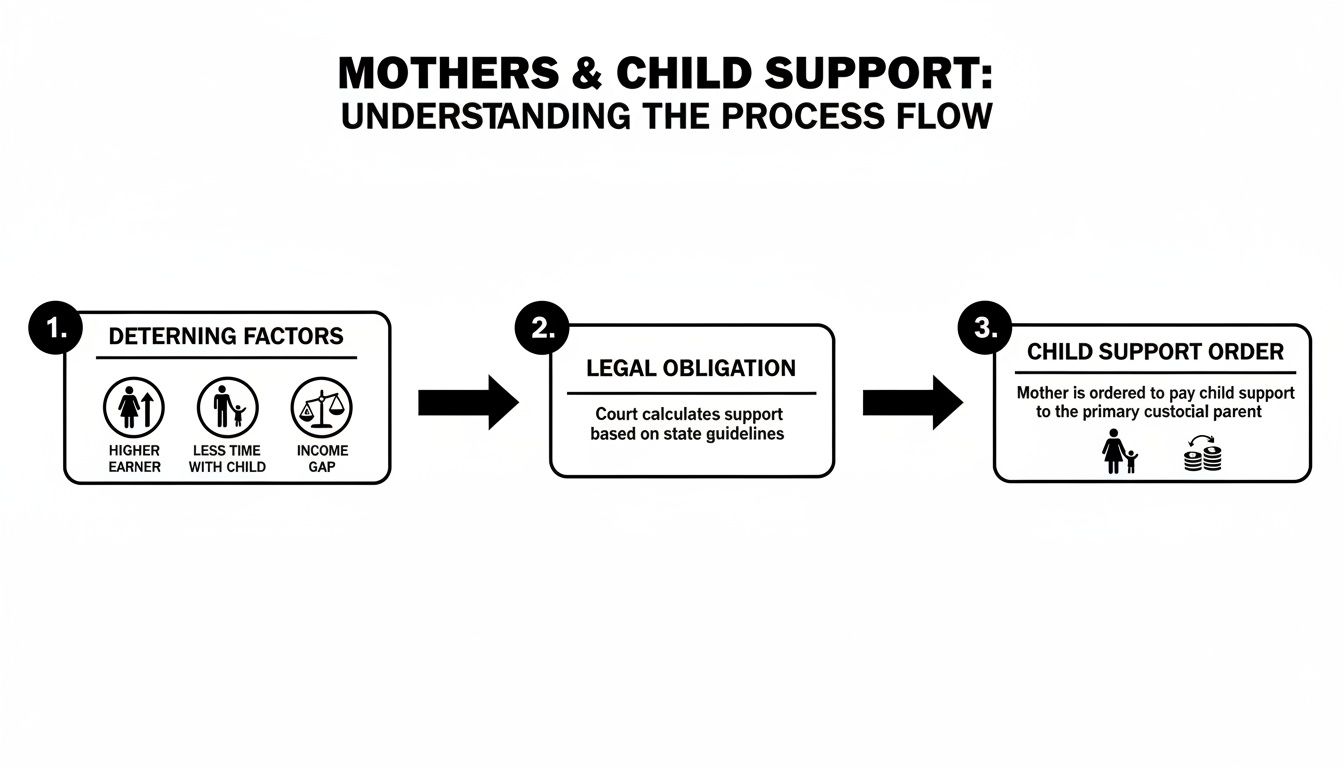
Ultimately, the calculation is driven by two main factors: who has the higher income and who has less parenting time. That's the direct answer to why and when a woman might pay child support in Florida.
Step One: Calculating Each Parent's Net Income
The very first step is figuring out each parent's monthly net income. This is more than just take-home pay. The court looks at gross income from nearly every possible source, including salaries, bonuses, commissions, self-employment income, and even perks like company cars or meal allowances.
From that gross number, the court allows certain deductions. It's important to know these are not the same deductions you'd claim on your taxes. The only deductions allowed are:
- Federal, state, and local income taxes
- Social Security and Medicare (FICA) payments
- Mandatory union dues
- Mandatory retirement payments
- Health insurance premiums (for the parent's coverage only, not the child's)
- Court-ordered child support for children from other relationships
After subtracting these deductions from the gross income, you're left with the net income figure used for the rest of the calculation.
Step Two: Combining Incomes and Finding the Basic Obligation
Next, the court adds the mother's and father's monthly net incomes together. This combined total represents the financial pool available to support the child, just as it would if the family were still living under one roof.
Florida law provides a schedule of guidelines that establishes the minimum amount of support a child needs based on that combined income and the number of children. For example, the guidelines might show that a family with a combined net income of $10,000 per month and one child has a basic support need of $1,437. This figure becomes the baseline obligation before other costs are factored in.
Step Three: Adding Other Costs and Splitting the Obligation
The calculation doesn't stop there. The court then adds other essential monthly costs, like the child's share of health insurance premiums and any necessary daycare or after-school care expenses. These amounts are tacked right onto the baseline figure.
Finally, this total obligation is divided between the parents according to their percentage share of the combined income. If the mother earns 60% of the total income, she is responsible for 60% of the total support amount. This percentage is then adjusted based on the number of overnights each parent has with the child, which ultimately determines who pays whom and how much.
To get a hands-on feel for how these numbers play out, you can experiment with a Florida child support calculator to see some estimates.
In essence, the formula ensures that each parent contributes to the child's financial well-being in direct proportion to their ability to do so. It is a mathematical process that is blind to gender.
Globally, traditional gender roles have historically shaped support dynamics, with women less likely to be the primary payor due to career interruptions after having children. However, as more fathers gain primary custody, the trend of mothers paying support is on the rise. This shift underscores why Florida's gender-neutral approach is so important for modern families.
Changing Or Enforcing A Child Support Order
A child support order isn't set in stone. Life happens, things change, and Florida law is built to recognize that. When a major life event occurs, a child support obligation might need to change with it. On the flip side, the law also provides powerful tools to make sure court-ordered support actually gets paid.
For families here in Pasco, Pinellas, and Hillsborough Counties, knowing how to modify or enforce an order is just as critical as understanding how it was calculated in the first place. No matter what, the court's main goal is always the same: making sure the child has consistent financial support.
When Can A Support Order Be Changed?
You can't just go back to court and ask for a do-over because you feel the amount is unfair. To get a modification, you have to prove there has been a "substantial, material, and unanticipated change in circumstances." That’s a specific legal bar you have to clear.
In plain English, something big and unexpected has to have happened since the last order was signed by the judge. Some common situations that might fit the bill include:
- A major job loss or promotion: A significant, involuntary drop or jump in a parent's income is often enough to trigger a recalculation.
- A big shift in the timesharing schedule: If the number of overnights a child spends with each parent changes dramatically, the support amount will almost certainly need an update.
- A change in the child's needs: This could mean new, major expenses like long-term medical care or special educational programs that weren't a factor before.
- The end of a major expense: When a child ages out of daycare, that huge cost disappears from the calculation. This could easily justify a downward modification for the paying parent.
It's absolutely crucial to act fast if your circumstances change. You can't just decide to stop paying or pay a different amount on your own—you must get a new court order to make it official.
What Happens When A Parent Stops Paying?
When a parent—mother or father—doesn't meet their court-ordered child support obligation, it throws the child's life into financial chaos. Florida law doesn't take this lightly and has several strong enforcement tools to compel payment and collect what's owed.
The question of "do women pay child support" becomes crystal clear in enforcement cases. When a mother is the one ordered to pay and she falls behind, she faces the exact same serious consequences as a father would.
The legal system has zero patience for non-compliance, regardless of gender. Some of the most common enforcement methods include:
- Wage Garnishment: An order is sent straight to the non-paying parent's boss, who is then required by law to deduct support payments directly from their paycheck.
- Driver's License Suspension: A judge can order the state to suspend the delinquent parent's driver's license until they get back on track with their payments.
- Contempt of Court: A judge can find the non-paying parent in contempt of court. This can lead to hefty fines or even jail time in serious, willful cases.
Trying to handle these complex legal issues on your own can feel impossible. Understanding the potential costs is also a big piece of the puzzle; using a legal consultation fee estimator can help you get a sense of what to expect. If you're dealing with a co-parent who refuses to pay, our team can help you figure out the best way forward for enforcing a court order.
The increase in women paying child support reflects bigger changes in our society. While things like income can affect compliance rates, the law itself doesn't play favorites. It enforces these obligations equally, always focusing on a child-first, gender-neutral approach.
Frequently Asked Questions About Florida Child Support
Trying to figure out child support can make your head spin, and it's completely normal to have questions about your specific situation. We hear from clients all the time across Pasco, Pinellas, and Hillsborough Counties who just want straight, clear answers. Here are some of the most common questions we get, with practical information to help you understand your rights and what to expect.
Our firm is committed to serving all families, including LGBTQ+ couples, and we apply these legal principles equally and fairly to every single person we represent. We believe everyone deserves to make informed decisions. We handle gay divorce, gay custody issues, and gay or transgender name change. We handle all LGBTQ issues, family and divorce issues, and do not discriminate.
I Am The Primary Breadwinner. Will I Automatically Pay Support?
It’s a common assumption: the person who earns more money will automatically be the one paying child support. While there’s a strong connection, it’s not quite that simple.
Your income is the single biggest factor in the formula, no question. If your net income is substantially higher than your co-parent's, it is very likely you'll have a child support obligation. But the final number isn't based on income alone. The court has to look at the entire picture, as laid out by the Florida Child Support Guidelines.
This includes the exact number of overnights the child spends with each parent, what you both pay for the child's health insurance, and any necessary daycare or after-school care costs. It's entirely possible that even with a higher income, these other factors could dramatically shift the final number. Think of it as a mathematical formula, not a penalty for being the higher earner.
My Ex Is Threatening To Seek More Custody Just To Make Me Pay.
This is a deeply upsetting and manipulative tactic that, unfortunately, some parents try to use as leverage. The good news is that Florida courts are required to make decisions based on one standard and one standard only: the best interests of the child.
A parent’s financial motive for wanting more time with a child is not considered to be in that child’s best interest. A judge in Hillsborough, Pinellas, or Pasco County would look very unfavorably on a parent who is transparently using a child as a pawn for financial gain. The entire purpose of a timesharing plan is to ensure the child has a healthy, stable relationship with both parents.
If you believe your co-parent is trying to game the timesharing schedule solely to trigger or increase a child support payment, it is critical to document this behavior and bring it to the court's attention. The focus must always, always remain on what is genuinely best for your child's well-being—not a parent's wallet.
Any attempt to weaponize timesharing is viewed with extreme skepticism by the court and could seriously backfire on the parent making the threat.
How Is Child Support Determined For A Same-Sex Female Couple?
For divorcing same-sex couples, the child support laws are applied in the exact same gender-neutral way as they are for everyone else. The law makes zero distinction based on the gender or sexual orientation of the parents. Our firm handles gay divorce and custody issues and we make sure the law is applied equally to all our clients.
The court won't see you as two mothers; it will see you as "Parent A" and "Parent B." The judge will follow the same precise steps to figure out the obligation.
The process involves:
- Calculating Each Parent's Net Income: The court looks at all sources of income and allowable deductions for both of you.
- Determining the Timesharing Schedule: The number of overnights the child has with each parent is a critical piece of the puzzle.
- Factoring in Additional Costs: Payments for health insurance and childcare are added into the calculation.
Ultimately, the parent with the higher net income or the parent with less overnight time will typically be the one ordered to pay support. The process is identical, ensuring a fair result based on the same financial rules that apply to every family.
What If I Lose My Job And Can't Afford My Payments?
Losing your job is a huge deal, and the law has a remedy for this exact situation. But what you do next is incredibly important. You absolutely cannot just stop making your payments.
If you stop paying without a court order, you'll start racking up arrears (past-due support). This can lead to serious consequences, like your driver's license being suspended or even being held in contempt of court. The moment you have an involuntary and major change in your income, you need to act.
The correct move is to immediately file a Supplemental Petition for Modification of Child Support with the court. This officially tells the court and your co-parent about your new situation and asks the judge to recalculate what you owe based on your new financial reality. Any modification can usually only be back-dated to the day you filed your petition, which is why moving quickly is so critical to protect yourself.
Navigating the complexities of child support requires clear, knowledgeable guidance from an experienced legal team. At Foley Family Law, we are dedicated to protecting your rights and ensuring a fair outcome for you and your child. If you are facing a child support issue in Hillsborough, Pinellas, or Pasco County, contact us to schedule a consultation and create a plan of action for your future. Visit us at https://wfoleylaw.com to learn more.


