

TL;DR:
- A divorce vocational evaluation estimates a spouse’s real earning capacity to help courts determine fair support. It involves interviews, standardized tests, and a local labor market survey, with costs ranging from $4,900 to over $7,000. The results influence support orders by assigning imputed income based on the spouse’s skills and local job availability.
A divorce vocational evaluation is a professional assessment that estimates a spouse’s realistic earning capacity after separation, giving courts the objective evidence they need to set fair spousal and child support amounts. Known formally as a vocational assessment, this process replaces guesswork and subjective claims with standardized testing, labor market data, and expert analysis. Florida courts rely on these evaluations when income discrepancies are significant or when one spouse has been out of the workforce for years. Understanding how the process works, what it costs, and how it shapes support orders puts you in a far stronger position during proceedings.
What does a divorce vocational evaluation involve?
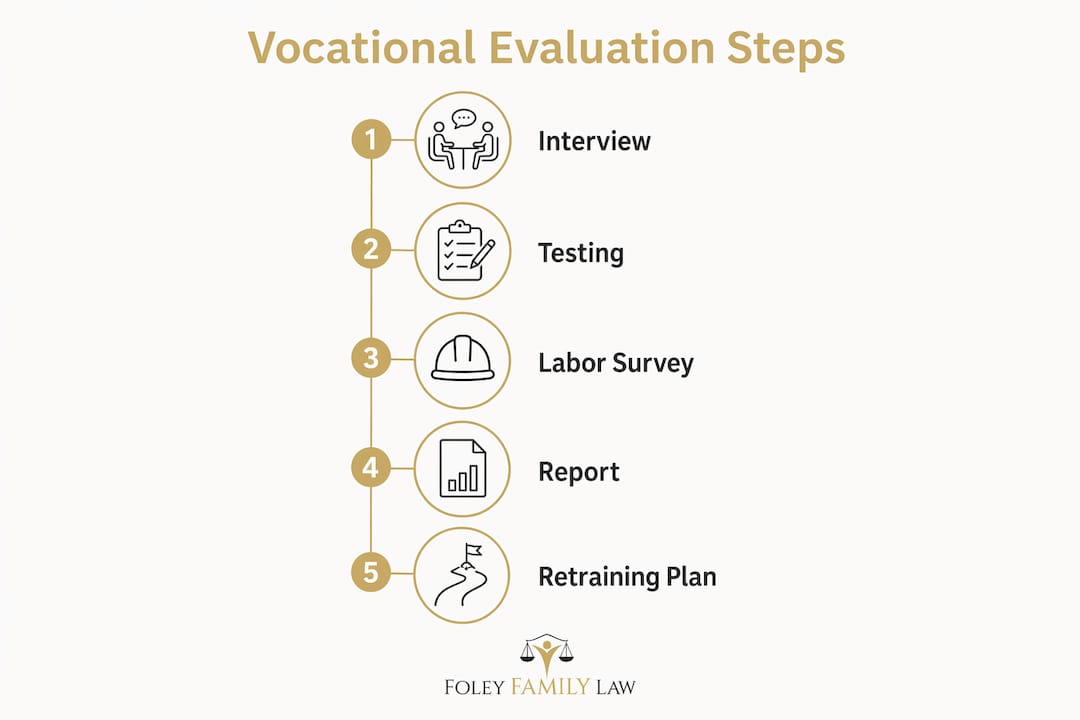
A vocational assessment follows three structured phases: an in-depth interview, standardized testing, and a local labor market survey. Each phase targets a distinct question the court needs answered before setting support.
The interview phase covers your full career history, educational background, physical or mental health limitations, and any practical barriers to employment such as childcare responsibilities or geographic constraints. The evaluator reviews your resume, past tax returns, medical records, and any prior employment documentation. Standardized aptitude testing measures verbal, mathematical, and technical skills relevant to realistic job options.
The labor market survey is where the evaluation gains its legal weight. Vocational experts identify specific job titles, open positions, and median salaries within a 30-mile radius that match the evaluated spouse’s skills and background. This localized data is what separates a credible report from one that courts dismiss.
Evaluators credentialed through bodies such as the Commission on Rehabilitation Counselor Certification (CRC) or holding a Certified Vocational Evaluator (CVE) designation carry greater weight in court. The evaluation also includes a transferable skills analysis that maps your prior experience to occupations you may not have considered, expanding the realistic job pool beyond your most recent title.
Pro Tip: Bring organized documentation to your evaluation appointment. A clear employment history, medical records, and any training certificates help the evaluator build an accurate picture of your situation, which protects you if your limitations are genuine.
Why do courts order vocational evaluations in divorce cases?
Courts order a vocational assessment most often when the financial picture between spouses does not add up. Common triggers include:
- A long-term homemaker re-entering the workforce after years away
- A significant gap between one spouse’s reported income and their apparent lifestyle
- A suspicious income drop shortly before or after filing for divorce
- Disability or health claims that affect earning capacity
- Requests for long-term or permanent spousal support
The legal authority for ordering these evaluations in California is California Family Code 4331, which gives courts the power to appoint a vocational expert. Florida courts exercise similar authority under their own statutes governing imputed income and spousal support. The evaluation directly affects imputed income calculations, meaning a court can assign an income figure to a spouse based on what they are capable of earning, not just what they currently report.
One concept closely tied to this process is the Gavron warning. A Gavron warning is a court’s formal notice to a supported spouse that they are expected to make reasonable efforts toward financial independence. A vocational evaluation often serves as the evidence base for that warning, documenting what steps toward self-sufficiency are realistic and on what timeline.
Pro Tip: If you suspect your spouse is deliberately underemployed or hiding income, requesting a vocational assessment early in proceedings can shift the entire negotiation. Courts take imputed income seriously when supported by expert evidence.
What does a vocational evaluation cost in a Florida divorce?
Cost is one of the first practical questions divorcing individuals ask, and the answer is specific. Standard evaluation fees range from $4,900 to $5,400 for the full assessment and written report. If the expert is called to testify at trial, additional fees of $1,100 to $1,700 apply, bringing the total to roughly $6,000 to $7,100 as of 2026.

That figure sounds significant, but context matters. In a case where spousal support runs $2,000 per month, a $6,000 evaluation that reduces or eliminates that obligation pays for itself within three months. The math shifts in lower-asset cases, where the evaluation cost may represent a larger share of the overall divorce expenses.
Courts can order either party to pay for the evaluation, or split the cost between spouses. In some cases, the requesting party pays upfront and seeks reimbursement through the final order. Well-constructed vocational reports often enable settlements before costly trial testimony is needed, making the expert fee a strategic investment rather than a sunk cost.
Pro Tip: Ask your attorney whether the evaluation cost can be factored into the overall settlement. In many Florida cases, the party who benefits most from the findings ends up absorbing the fee as part of a negotiated resolution.
How do courts use evaluation results to set support?
Vocational evaluation results translate directly into support orders through the concept of imputed income. If a spouse is capable of earning a specific amount but chooses not to, the court assigns that earning figure to them for support calculation purposes. This is not punitive. It reflects the court’s responsibility to base support on realistic financial capacity, not voluntary underemployment.
The practical impact unfolds in several ways:
- Job-specific salary data from the labor market survey sets the income figure the court uses. A finding that a spouse can realistically earn $52,000 per year as an administrative coordinator in the Tampa Bay area, for example, directly reduces the support obligation of the paying spouse.
- Retraining plans included in the report outline training costs, program duration, and expected entry-level wages after completion. This supports rehabilitative alimony, which is time-limited support designed to fund a spouse’s path to self-sufficiency.
- Step-down support structures use the evaluation’s timeline to reduce support payments incrementally as the supported spouse’s earning capacity increases.
A vocational report that includes a retraining plan gives the court measurable milestones rather than open-ended support obligations. That specificity benefits both parties. The paying spouse gets a defined end date. The supported spouse gets a structured path forward.
Courts also use imputed income figures when calculating child support, not just spousal support. If a parent is voluntarily unemployed or underemployed, Florida courts can base child support on their earning capacity rather than their reported income.
Pro Tip: If the evaluation finds you capable of earning more than you currently make, do not ignore that finding. Work with your attorney to address any errors in the report before it reaches the judge, because correcting the record after a support order is issued is far harder.
Common misconceptions about vocational assessments in divorce
The biggest misconception is that a vocational evaluation is designed to punish the lower-earning spouse. It is not. A well-conducted evaluation documents genuine limitations just as thoroughly as it identifies earning potential. If you have a documented health condition, caregiving responsibilities, or a skills gap that limits your options, a credible evaluator will capture that in the report.
Several other misunderstandings create problems for divorcing individuals:
- Outdated data undermines the report. Vocational evaluations must reflect current, local economic conditions. A report citing national salary averages without confirming local job availability is legally vulnerable and can be challenged effectively.
- Refusing to cooperate carries serious consequences. Ignoring a court-ordered evaluation can result in contempt findings, fines, or a judge imputing income based solely on the opposing party’s evidence. That is almost always a worse outcome than participating.
- Errors in reports are challengeable. Common flaws include using outdated salary surveys, failing to account for documented health limitations, or identifying jobs that do not actually exist in the local market. An attorney experienced in family law can retain a rebuttal expert to expose these weaknesses.
Pro Tip: Cooperating fully with the evaluation process, even when you disagree with its premise, gives you the best chance of influencing the outcome. Obstruction hands the other side a significant legal advantage.
Key Takeaways
A vocational assessment is the most objective tool available for resolving earning capacity disputes in divorce, and its findings directly shape support orders for years to come.
| Point | Details |
|---|---|
| Evaluation structure | Three phases cover interview, standardized testing, and a local labor market survey. |
| Cost range | Total fees run $6,000–$7,100 in 2026, including potential trial testimony. |
| Imputed income impact | Courts assign earning capacity figures to voluntarily underemployed spouses, directly reducing support obligations. |
| Retraining plans | Reports include timelines and costs for skill development, supporting time-limited rehabilitative alimony. |
| Cooperation matters | Refusing a court-ordered evaluation risks contempt findings and income imputed entirely from opposing evidence. |
What I have learned about vocational evaluations after years in Florida family law
The clients who struggle most with vocational evaluations are the ones who treat the process as an attack rather than a tool. I have seen this play out repeatedly in Hillsborough, Pinellas, and Pasco counties. A spouse who has spent fifteen years raising children and managing a household feels accused when an evaluator starts asking about job skills and salary ranges. That reaction is understandable. It is also costly.
The reality is that a thorough, well-documented evaluation protects you if your limitations are real. If you genuinely cannot work full-time due to health issues or caregiving demands, a credible evaluator will document that. The report becomes your evidence, not your adversary.
Where I see the most strategic value is in cases involving a spouse who has voluntarily reduced their income before or during proceedings. Vocational experts replace vague arguments with objective evidence of job openings and salary ranges locally available for that spouse. That evidence shifts settlement leverage in ways that attorney arguments alone rarely achieve. A judge who sees a report confirming that a spouse can earn $60,000 annually in the Tampa Bay market is far less sympathetic to claims of financial helplessness.
My advice to anyone facing this process: prepare thoroughly, cooperate fully, and work with your attorney to review the report before it is submitted to the court. Errors in vocational reports are more common than people expect, and catching them early makes all the difference.
— Foley Family Law
How Foley Family Law can help with your vocational evaluation
Vocational evaluations carry real financial consequences, and having the right legal guidance before, during, and after the process matters.

Foley Family Law works with clients in Hillsborough, Pinellas, and Pasco counties who are facing support disputes where earning capacity is contested. The firm helps you understand what the evaluator is looking for, how to document your limitations accurately, and how to challenge a report that contains errors or relies on outdated data. William S. Foley and his team bring focused family law experience to every stage of the process. If you are dealing with a vocational assessment as part of your divorce, learn more about how a family law attorney can protect your financial interests and help you reach a fair outcome.
FAQ
What is a divorce vocational evaluation?
A divorce vocational evaluation is a professional assessment of a spouse’s realistic earning capacity, conducted through interviews, standardized testing, and a local labor market survey. Courts use the findings to calculate imputed income for spousal and child support orders.
How much does a vocational evaluation cost in Florida?
Standard evaluation fees range from $4,900 to $5,400, with trial testimony adding $1,100 to $1,700, for a total of roughly $6,000 to $7,100 as of 2026.
Can I refuse a court-ordered vocational assessment?
Refusing a court-ordered evaluation can result in contempt findings, fines, or income imputed entirely from the opposing party’s evidence. Cooperating with the process consistently produces better outcomes.
What happens if the vocational report contains errors?
Errors such as outdated salary data or failure to account for documented health limitations can be challenged through a rebuttal expert. Your attorney can identify flaws in the report before it influences the court’s support decision.
Does a vocational evaluation affect child support as well as spousal support?
Yes. Florida courts use imputed income figures from vocational assessments when calculating child support, not only spousal support, if a parent is found to be voluntarily underemployed.


