

TL;DR:
- Filing for divorce in Tampa requires meeting Florida’s six-month residency rule and choosing the correct dissolution process.
- Most cases use regular dissolution, but eligibility for simplified dissolution is limited to cases without children, debts, or alimony disputes.
To get a divorce in Tampa, Florida, you file a Petition for Dissolution of Marriage with the Hillsborough County Clerk of the Circuit Court or, if you meet strict eligibility requirements, pursue a Simplified Dissolution of Marriage under Florida Statutes, Chapter 61. Your two immediate options are:
- File pro se (without an attorney): Download the required forms from the Florida Courts family law forms library or the 13th Judicial Circuit’s pro se packets, complete and notarize them, then submit at the George Edgecomb Courthouse in Tampa, a Brandon branch, or through the e-filing portal.
- Consult a Tampa family law attorney first: For contested matters, children, significant assets, or any safety concern, speaking with a local attorney before you file protects your rights and prevents costly procedural errors. Foley Family Law handles divorce, custody, and related family law matters throughout Hillsborough, Pinellas, and Pasco counties.
The Florida Bar’s consumer guide is a reliable starting point for understanding your rights. The Clerk’s office can hand you forms and accept your filing, but it cannot advise you on strategy or interpret your legal rights — that distinction matters more than most people realize before they are already in the process.
Who can file in Florida, and which type of dissolution fits your situation?
Residency requirement
Florida law requires that at least one spouse have lived in Florida for six months immediately before filing. You can prove residency with a current Florida driver’s license, a Florida ID card, a current voter registration card, or an Affidavit of Corroborating Witness (Form 12.902(i)), which must be signed on or after the date you file.
Two paths: regular vs. simplified dissolution
Florida recognizes two primary dissolution paths. Most people use the Regular Dissolution of Marriage. A smaller group qualifies for the Simplified Dissolution of Marriage, which moves faster but carries strict eligibility rules.
Simplified Dissolution is narrowly available. The Florida Bar’s consumer pamphlet cautions that many residents who start with simplified forms discover they are ineligible once they review the full checklist. Attempting it without meeting every requirement wastes time and filing fees.
To qualify for Simplified Dissolution, all of the following must be true:
- No minor or dependent children were born to or adopted by the parties, and the wife is not pregnant.
- Both spouses agree on the division of all assets and debts.
- Neither spouse is seeking alimony.
- Both spouses are willing to attend the final hearing together.
- Both spouses agree the marriage is irretrievably broken.
If any one of those conditions fails, you must use the Regular Dissolution process. The Florida Courts dissolution of marriage page and the Florida Bar’s pamphlet both provide eligibility flowcharts worth reviewing before you choose a path.
One important reminder: the Clerk’s office provides forms and procedural assistance, but clerks cannot interpret your legal rights or advise on strategy. If you are unsure which path applies to your situation, a brief consultation with a Tampa Florida family law attorney is worth the cost.
How do you file for divorce in Hillsborough County?
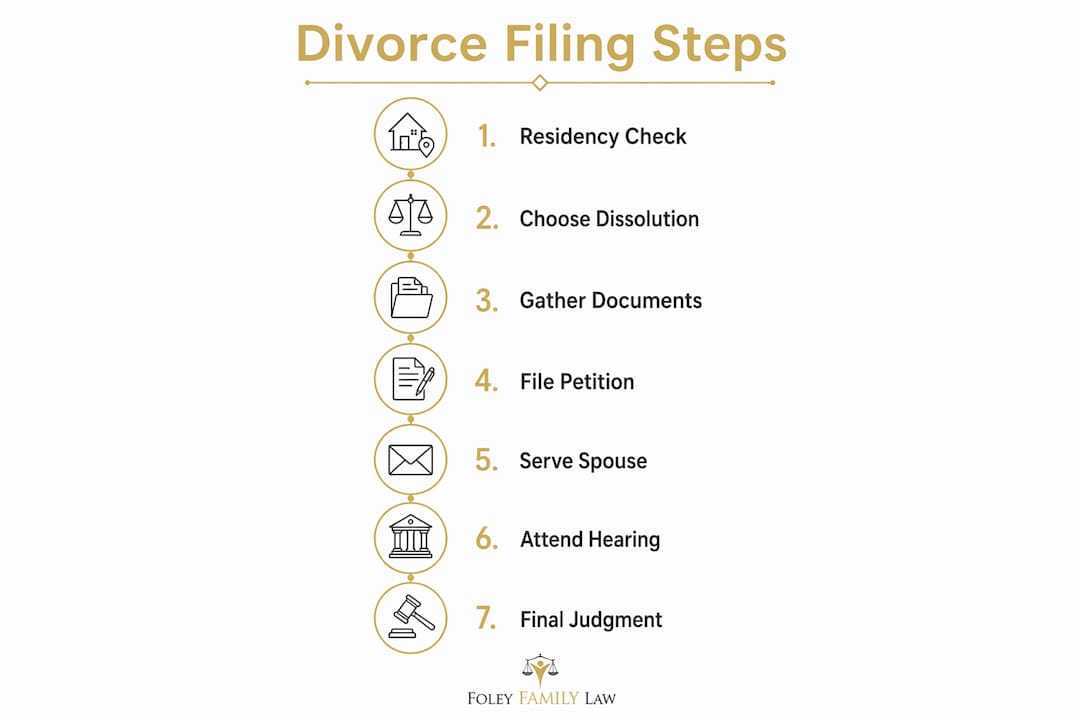
Step-by-step filing process
Prepare your petition and required forms. The core form is the Petition for Dissolution of Marriage (Form 12.901(b)(1) if children are involved, or Form 12.901(b)(2) for cases without minor children). Additional required forms typically include:
- Financial Affidavit: Short Form 12.902(b) if income is $50,000/year or less; Long Form 12.902© if income exceeds $50,000/year
- Uniform Child Custody Jurisdiction and Enforcement Act (UCCJEA) Affidavit, Form 12.902(d), when children are involved
- Child Support Guidelines Worksheet, Form 12.902(e)
- Civil Cover Sheet, Form 12.928
- Notice of Social Security Number, Form 12.902(j)
- Affidavit of Corroborating Witness, Form 12.902(i), for residency proof
- Designation of Current Address and E-mail Address, Form 12.915
Notarize the required forms. Several forms require a notary signature. Errors in notarization are among the most common reasons pro se filings are rejected, often forcing refiling and additional fees.
File with the Hillsborough County Clerk. You can file in person at three locations or through the state e-filing portal:
- Tampa (main): George Edgecomb Courthouse, 800 E. Twiggs Street, Room 101, Tampa, FL 33602
- Brandon: Brandon Regional Service Center, 311 Pauls Drive, Suite 110, Brandon, FL 33511
- Plant City: Plant City Courthouse, 301 N. Michigan, Room 1071, Plant City, FL 33563
Pay the filing fee or request a fee waiver. The Clerk collects filing fees at submission. If you qualify for indigency, you may request a fee waiver. Qualifying typically requires proof of government benefits such as Food Stamps, Medicaid, or SSDI. Bring documentation when you file.
Serve the other party. After filing, you must formally serve your spouse. Florida allows personal service (through the Hillsborough County Sheriff at 700 E. Twiggs St. or a private process server) and, in limited circumstances, constructive service by publication. Service on active military members follows additional federal rules. The 13th Judicial Circuit pro se packet lists approved process servers and explains each method.
Pro Tip: Download the complete pro se packet for your case type from the 13th Judicial Circuit’s website before you begin. The packet includes a checklist, form numbers, and notarization instructions specific to Hillsborough County. Missing even one required form can result in rejection at the counter.

What happens after you file: timeline, hearings, and final judgment
Realistic timeline expectations
Uncontested cases that settle by agreement tend to move faster than contested ones, but no two cases are identical. Many settled cases complete within a matter of months; contested matters involving disputed assets, custody, or alimony can take considerably longer. For a case-specific estimate, contact the Hillsborough County Clerk or speak with a Tampa divorce attorney who knows the current court calendar.
Key timeline factors:
- Mandatory disclosure deadlines must be met before a final hearing can be scheduled.
- When minor children are involved, both parents must complete a court-approved parenting education class and file the certificate of completion before the final hearing date is set.
- The respondent has 20 days to respond after being served; failure to respond can lead to a default judgment.
Common hearings you may encounter
- Temporary hearings: A judge can issue temporary orders for support, use of the marital home, or custody arrangements while the case is pending. These orders stay in place until a final judgment replaces them.
- Emergency orders: If there is an immediate safety concern, you can request emergency relief, including a temporary injunction or emergency custody order.
- Final hearing or trial: In uncontested or default cases, the final hearing is typically brief. In contested cases, the matter proceeds to trial, where both sides present evidence and the judge decides unresolved issues.
Statistic callout: Florida Courts guidance notes that court appearances are generally required for final hearings; missing your scheduled final hearing can result in dismissal of your case.
What the final judgment covers
The final judgment of dissolution addresses every open issue in the case: division of marital assets and debts, alimony findings, the parenting plan and timesharing schedule, child support, and any request for restoration of a former name. Once entered, the judgment is recorded with the Clerk and becomes a binding court order.
How does Florida divide money, assets, debts, and alimony?
Florida follows equitable distribution, not a community-property split. The starting presumption under Chapter 61 is an equal division of marital assets and liabilities, but courts have broad discretion to adjust that split based on factors such as the length of the marriage, each spouse’s economic circumstances, contributions to the marriage (including homemaking), and whether one party intentionally depleted marital assets. Florida is not a community property state; understanding how equitable distribution works before you file can prevent costly surprises.
What counts as marital property?
Typical marital assets and liabilities subject to division include:
- The marital home and other real estate acquired during the marriage
- Vehicles, boats, and recreational property
- Bank and investment accounts opened or funded during the marriage
- Retirement accounts and pensions accrued during the marriage
- Business interests started or grown during the marriage
- Credit card balances and mortgages incurred during the marriage
Separate property (assets owned before marriage or received as individual gifts or inheritance) is generally excluded, though commingling can complicate that line.
Retirement accounts and QDROs
Retirement accounts and pensions require a Qualified Domestic Relations Order (QDRO) to divide without triggering early-withdrawal penalties or tax consequences. A QDRO is a separate court order that instructs a retirement plan administrator to pay a portion of the account directly to the non-employee spouse. Drafting a QDRO incorrectly can cost both parties significant money, which is one reason attorneys are particularly valuable in cases involving 401(k)s, pensions, or deferred compensation plans.
Alimony basics
Florida courts may award several types of alimony depending on the circumstances. The factors courts weigh include the length of the marriage, each spouse’s earning capacity and standard of living, and contributions made during the marriage. For a detailed breakdown of how courts calculate and award support, Florida’s alimony framework covers the current statutory criteria.

Pro Tip: Before you file, pull recent statements for every account: bank, investment, retirement, and credit. Screenshot or print balances as of the filing date. Courts look at values at the time of filing as a baseline, and having that documentation ready protects you if a spouse later claims an account was depleted before the case began.
What are Florida’s rules on custody, timesharing, and child support?
Parental responsibility vs. timesharing
Florida law uses the terms parental responsibility and timesharing rather than “custody.” Parental responsibility refers to decision-making authority over major issues like education, healthcare, and religious upbringing. Timesharing describes the physical schedule each parent follows. Courts start from the position that shared parental responsibility is in the child’s best interests, and departing from that presumption requires clear evidence that shared responsibility would be harmful.
When evaluating timesharing, courts examine factors including each parent’s ability to facilitate a relationship with the other parent, the child’s ties to school and community, each parent’s moral fitness, and the child’s preference when the child is of sufficient age and maturity.
Required parenting plan and education class
Every case involving minor or dependent children requires a court-approved Parenting Plan before a final judgment can be entered. The plan must address the child’s education, healthcare, and physical, social, and emotional well-being. Florida Supreme Court Approved Family Law Forms include:
- Form 12.995(a): Regular Parenting Plan
- Form 12.995(b): Safety-Focused/Supervised Parenting Plan
- Form 12.995©: Long-Distance Parenting Plan (for parents living more than 50 miles apart)
Both parents must complete a court-approved parenting education class and file the certificate of completion with the Clerk before the final hearing can be scheduled.
Child support
Child support in Florida is calculated using statutory guidelines that account for both parents’ net incomes, the number of overnights each parent has, and costs for health insurance and childcare. The Child Support Guidelines Worksheet (Form 12.902(e)) must be filed even when the parties have agreed on an amount. Support orders can be enforced through income withholding, license suspension, and contempt proceedings, and either party can request a modification when there is a substantial change in circumstances.
Emergency and temporary orders
If safety is an immediate concern, you can request a temporary injunction for protection against domestic violence through the Hillsborough County Clerk’s office without an attorney and without a filing fee. A judge can issue an emergency order the same day. That protective order can run alongside your dissolution case and directly affect timesharing and support arrangements.
Temporary custody and support orders are available at any point during the case. An attorney can file a motion for temporary relief quickly when a parent is withholding access to children or when financial support has stopped.
What alternatives to contested litigation are available in Tampa?
Not every Tampa divorce needs to go to trial. Three alternatives can save time, cost, and emotional strain when both parties are willing to negotiate in good faith.
| Method | Best for | Speed | Cost | Privacy | Control |
|---|---|---|---|---|---|
| Mediation | Most cases; court-ordered in many contested matters | Moderate | Lower than trial | High | High |
| Collaborative divorce | Cases with complex assets or parenting issues where both parties want a structured, non-adversarial process | Moderate | Moderate | High | Very high |
| Negotiated settlement | Cases where attorneys negotiate directly without formal mediation | Fastest when parties agree | Varies | High | High |
Mediation is a structured process in which a neutral third party helps both spouses identify issues and reach a voluntary agreement. Florida courts routinely order mediation in contested family cases before setting a trial date. The mediator does not decide anything; the authority to settle stays with the parties. Family mediation in Florida covers custody, property division, support, and timesharing.
Collaborative divorce goes further. Both spouses retain attorneys trained in collaborative practice and agree in writing not to litigate. Financial neutrals and mental health professionals may join the process. If collaboration breaks down, both attorneys must withdraw and the parties start over with new counsel, which creates a strong incentive to resolve issues at the table.
Negotiated settlement happens when attorneys exchange proposals and counterproposals without a formal mediation session. It works well when both parties are represented and the issues are limited.
When alternatives are not appropriate:
- Active domestic violence or a significant power imbalance
- A spouse hiding assets or refusing to provide financial disclosure
- A party who will not negotiate in good faith
In those situations, contested litigation with experienced counsel is the safer path.
How do you protect your finances and documents before filing?
Acting early on financial documentation is one of the most practical things you can do before a Tampa divorce is filed. Courts look at asset values and account balances at or near the filing date, so a clear financial snapshot taken before you file gives you a baseline that is difficult to dispute later.
Document checklist to gather before filing:
- Bank and investment account statements (last 12 months)
- Federal and state tax returns (last 3 years)
- Retirement account statements (401(k), IRA, pension)
- Mortgage statements and property titles or deeds
- Vehicle titles
- Credit card statements (last 12 months)
- Recent pay stubs (last 3 months) and employer W-2s
- Business records, if either spouse owns or co-owns a business
- Life insurance policies with cash value
Practical steps to take:
- Open a separate bank account in your name only for post-separation income and expenses.
- Change passwords on personal email, financial accounts, and cloud storage.
- Obtain certified copies of property deeds and vehicle titles from the Hillsborough County Clerk’s records division.
- Pull your credit reports from all three bureaus to identify any accounts you were unaware of.
- Request pay-stub history from your employer’s HR department.
A word of caution on asset transfers: Moving, hiding, or dissipating marital assets after a case is filed, or in anticipation of filing, can result in sanctions, an adverse judgment, or contempt of court. Courts take this seriously. Document what you have, but do not move it improperly. If you believe your spouse is hiding assets, ask an attorney about a preservation order or a request for financial discovery.
Preparing financially for divorce is a step most people underestimate until they are already in the middle of the process.
When do you need a Tampa divorce attorney, and what should you ask?
Situations that strongly suggest hiring an attorney
Some divorces are straightforward enough for a careful pro se filer. Many are not. Consider retaining a Tampa divorce attorney when:
- The marriage involves significant assets, a business, or retirement accounts
- There are minor children and the parties disagree on timesharing or parental responsibility
- Domestic violence or a power imbalance is present
- One spouse is hiding income or assets
- Immigration status is affected by the divorce
- A spouse is in the military
- Paternity is disputed
- Either party wants to relocate with children after the divorce
For cases involving high-value or complex assets, high net worth divorce representation addresses the specific issues that arise when the financial stakes are elevated.
When limited-scope representation may be enough
If your case is genuinely uncontested and assets are simple, limited-scope representation (also called “unbundled” legal services) lets you hire an attorney for specific tasks only, such as reviewing a settlement agreement or coaching you on court procedure, without paying for full representation.
Questions to bring to your first consultation
- How many Hillsborough County dissolution cases have you handled in the past two years?
- What is your fee structure: hourly, retainer, or flat fee for uncontested matters?
- What is your realistic estimate of total cost for a case like mine?
- How do you communicate with clients, and what is your typical response time?
- What is the likely timeline given current Hillsborough County court scheduling?
- What outcome is realistic for my specific asset and custody situation?
- Do you handle mediation and collaborative divorce, or only litigation?
Billing models in Tampa
Tampa family law attorneys typically bill by the hour with an upfront retainer, though some offer flat fees for straightforward uncontested matters. Initial consultations are generally offered for a fee. Knowing the billing model before you sign a retainer agreement prevents surprises. Practical tips for managing attorney costs can help you prepare for that first meeting.
How Foley Family Law helps Tampa residents navigate divorce
Foley Family Law focuses exclusively on family law, which means every case the firm handles involves divorce, custody, paternity, support, or a related matter. The firm serves clients throughout Hillsborough, Pinellas, and Pasco counties, with deep familiarity with Hillsborough County court procedures, local judicial expectations, and the practical realities of filing in Tampa.
William S. Foley leads the practice. The firm’s work spans the full range of dissolution matters:
- Uncontested and contested divorce: from straightforward agreed cases to high-conflict litigation
- High net worth and complex asset divorce: business interests, retirement accounts, real estate portfolios, and executive compensation
- Temporary orders: emergency custody, temporary support, and injunctions filed quickly when circumstances require it
- Parenting plans: building timesharing schedules that reflect children’s actual needs and withstand court scrutiny
- Mediation and collaborative divorce: guiding clients through non-adversarial processes when appropriate
- Modifications and appeals: returning to court when circumstances change after a final judgment
The firm publishes a Tampa Bay divorce guide and a video series designed to help clients understand the process before their first meeting. Foley Family Law’s approach pairs legal strategy with cost-awareness: when mediation or a negotiated settlement serves a client’s interests, the firm says so. When contested litigation is unavoidable, the firm prepares thoroughly. Choosing experienced local counsel in Hillsborough County makes a measurable difference in how efficiently a case moves through the system.
Key Takeaways
Filing for divorce in Tampa requires meeting Florida’s six-month residency rule, choosing the correct dissolution path, and filing accurate, notarized forms with the Hillsborough County Clerk of the Circuit Court.
| Point | Details |
|---|---|
| Residency and path | At least one spouse must have lived in Florida for six months before filing; most cases use Regular Dissolution, not Simplified. |
| Where and how to file | File with the Hillsborough County Clerk at George Edgecomb Courthouse, a Brandon or Plant City branch, or via the state e-filing portal. |
| Protect finances early | Gather 12 months of bank, retirement, and tax records before filing; document asset values at the filing date. |
| Children add requirements | A court-approved Parenting Plan and a mandatory parenting education class are required before the final hearing when minor children are involved. |
| Foley Family Law | Foley Family Law handles contested, uncontested, and high-asset divorces throughout Hillsborough, Pinellas, and Pasco counties, with local court experience and a focus on cost-effective strategy. |
What Foley Family Law actually sees in Tampa divorce cases
The most consistent mistake Tampa residents make is treating the divorce process as primarily a paperwork problem. It is not. The forms are the easy part. What actually determines outcomes is the sequence of decisions made in the first few weeks: whether to file first or respond, whether to seek temporary orders immediately, how to document assets before the other side has a chance to move them, and whether the case is genuinely suited for mediation or headed for trial.
Simplified dissolution attracts people because it sounds faster and cheaper. In practice, the eligibility bar is high enough that most people who attempt it end up converting to a regular dissolution anyway, having lost time and sometimes tipped their hand to the other spouse about their intentions. The same is true of pro se filing in contested cases: the procedural rules around notarization, UCCJEA affidavits, and mandatory disclosure are specific enough that errors are common, and those errors have real consequences.
What actually works is a clear-eyed assessment of the case at the start: what is genuinely disputed, what the financial picture looks like, and what the children’s needs require. From there, the right process, whether mediation, collaborative law, or litigation, follows naturally. Rushing to file without that assessment rarely saves time or money.
Ready to take the next step with Foley Family Law?
Divorce in Tampa involves local filing rules, Hillsborough County court procedures, and decisions that affect your finances and your family for years. Foley Family Law gives Tampa residents a focused, experienced option: a firm that handles only family law, knows the local courts, and builds a strategy around your specific situation rather than a generic playbook.
Whether your case is a straightforward uncontested matter or a complex dispute involving significant assets and children, Foley Family Law can help you understand your options, protect your interests, and move through the process efficiently. The firm offers initial consultations for a fee, giving you direct access to an attorney who can assess your case and answer your specific questions before you commit to a course of action. Learn what a family law attorney can do for you, or contact Foley Family Law directly to schedule your consultation.
Useful sources and where to find local forms
These primary sources are the most reliable places to find current forms, fees, and local procedures for a Tampa Florida divorce:
- Florida Statutes, Chapter 61: The governing statute for dissolution of marriage, timesharing, child support, and alimony in Florida.
- Hillsborough County Clerk of the Circuit Court: Local filing instructions, courthouse locations, e-filing options, fee schedules, and record-copy procedures for Tampa divorces.
- Florida Courts dissolution of marriage page: Statewide guidance on the dissolution process, timelines, and court resources.
- Florida Courts family law forms: The official library of Florida Supreme Court Approved Family Law Forms, including all petition, affidavit, and parenting-plan forms.
- 13th Judicial Circuit pro se packet: Hillsborough County’s detailed instructions for self-represented filers, including form checklists, notarization requirements, parenting-class information, and fee-waiver documentation guidance.
- The Florida Bar consumer pamphlet on divorce: Plain-language explanation of dissolution types, equitable distribution basics, and the limits of what clerks can help with.
FAQ
How much does it cost to file for divorce in Tampa, Florida?
The Hillsborough County Clerk charges filing fees for dissolution of marriage cases; the exact amount depends on the case type and whether minor children are involved. If you qualify for indigency based on government benefits such as Food Stamps, Medicaid, or SSDI, you can request a fee waiver at the time of filing.
Can you get divorced in Florida without going to court?
In most cases, at least one court appearance is required. Uncontested cases typically involve a brief final hearing; contested cases proceed to trial. Simplified dissolution requires both spouses to attend the final hearing together.
What is a spouse entitled to in a Florida divorce?
Florida uses equitable distribution, which starts with a presumption of equal division of all marital assets and debts. Courts can adjust that split based on factors like the length of the marriage, each spouse’s financial situation, and contributions made during the marriage. Separate property owned before the marriage is generally not subject to division.
How do you avoid financial harm during a Tampa divorce?
Document all account balances, titles, and financial records before filing, open a separate account for your own income and expenses, and avoid transferring or depleting marital assets. Courts can sanction a spouse who improperly moves assets after a case is filed. An attorney can request a preservation order if you believe assets are at risk.
When should you hire a Tampa divorce attorney rather than file on your own?
Hire an attorney when the case involves minor children with disputed timesharing, significant or complex assets, domestic violence, a business interest, or any situation where the other spouse is represented. Pro se filing works best for genuinely uncontested cases with simple finances and no children.


