

When you're facing a divorce, the financial questions can feel overwhelming. One of the biggest is almost always: what happens to our retirement accounts?
In Florida, any money you or your spouse contributed to retirement plans during the marriage is considered marital property. It doesn’t matter if the account is only in one person’s name. If it grew while you were married, it's on the table for division. The goal is always a fair, or equitable, split of these hard-earned assets.
Navigating The Financial Realities Of Divorce And Retirement

When a marriage ends, the single financial future you planned together has to be carefully separated into two distinct paths. For most couples, especially those between 35 and 65, retirement accounts like a 401(k), pension, or IRA often represent the largest asset they own, right after the family home. At our firm, we handle all family and divorce issues, including for our LGBTQ+ clients, and we do not discriminate.
The stress of untangling these finances is very real. But getting a handle on the core principles is the first and most important step toward regaining control.
Florida's Approach To Dividing Assets
Florida is an equitable distribution state. This is a critical concept to understand because "equitable" does not automatically mean "equal."
While a 50/50 split is often the starting point, the court’s primary goal is to achieve a division that is fundamentally fair given the unique circumstances of your marriage. A judge will look at the whole picture when deciding how to split retirement funds.
This includes factors like:
- How long you were married
- Each spouse's current financial situation and future earning potential
- Contributions each person made to the marriage (including non-financial ones, like being a homemaker)
- Whether one spouse put their career or education on hold for the family
For families in Pasco, Pinellas, and Hillsborough Counties, this legal framework guides every decision. It's designed to ensure neither person is left with an unfair financial burden as they start their new lives.
Your Retirement Is Considered Marital Property
Here’s the bottom line: any value added to a retirement account from the day you got married to the day you filed for divorce is generally considered marital property. It makes no difference whose paycheck funded the account. If it grew during the marriage, it's part of the marital estate.
This is a foundational concept in Florida divorce law. The law recognizes that marriage is a partnership. Both spouses are seen as contributing to the accumulation of assets—including retirement savings—whether directly through income or indirectly through other contributions to the family.
This guide is your roadmap. We’ll walk through the different types of accounts, from 401(k)s to military pensions, and explain the legal tools needed to divide them without triggering unnecessary taxes or penalties. As you face this new reality, understanding how solid planning can reduce the hidden costs of financial uncertainty is key to securing your future. We are committed to providing clarity for all families, including LGBTQ+ couples, as you navigate this process.
Key Stages for Dividing Retirement Assets in Florida
The division process follows a clear roadmap with several key stages from identification to final distribution.
- Stage 1: Identification & Classification: The first step is to identify all retirement accounts and determine which portions are marital versus separate property. This involves gathering statements for all accounts. The cut-off date is typically the date you file for divorce.
- Stage 2: Valuation: Next, you must determine the precise value of the marital portion of each account as of a specific date. This can be complex for pensions and may require an actuary, but it's usually more straightforward for 401(k)s.
- Stage 3: Negotiation & Agreement: This is where strategic negotiation happens. You will decide how to divide the assets, either through a direct split or by offsetting them with other assets, such as one spouse keeping the 401(k) while the other keeps the house equity.
- Stage 4: Legal Implementation: The necessary legal orders, like a QDRO, are drafted and filed to execute the division. Each plan has specific rules, so the order must be drafted perfectly to be accepted by the plan administrator.
- Stage 5: Distribution: Finally, the plan administrator processes the order and transfers the funds to the non-employee spouse, who can then typically roll them into an IRA to avoid immediate taxes and penalties.
Navigating these stages with a clear strategy is the best way to protect your financial interests and prepare for the next chapter of your life.
Defining Marital Vs Separate Retirement Funds

When you’re facing a divorce in Florida, one of the first and most critical steps is figuring out exactly what portion of your retirement is actually on the table. Think of your retirement account like a tree: the money you had before the marriage forms the roots and trunk, while everything that grew during the marriage—contributions, interest, market gains—represents the branches and fruit.
Florida law draws a sharp line between separate property (the roots) and marital property (the branches). Only the marital portion is subject to division. Getting this distinction right is the bedrock of a fair outcome when splitting retirement accounts.
The Bright Line Of Marriage
In Florida, the line separating marital and separate property is usually marked by two specific dates: the day you got married and the day you filed for divorce.
- Separate Property: This is typically the balance of your retirement account on your wedding day. It can also include things like an inheritance or a specific gift made only to you during the marriage, as long as you kept those funds completely separate.
- Marital Property: This bucket includes all contributions made by you or your employer during the marriage. It also captures all the passive growth tied to those contributions, like interest, dividends, and appreciation in the market.
This principle is fundamental and guides how assets are handled in a Florida divorce.
The Complication Of Commingling
Of course, real life is rarely as neat as a legal definition. Over the years, separate and marital funds often get mixed together in the same account, a process lawyers call commingling. When this happens, untangling what belongs to whom becomes a real challenge.
Let's say you started your marriage with $50,000 in a 401(k). Over the next 15 years, you and your employer added another $200,000, and the entire pot grew with the market. That original $50,000 is your separate property, but proving it—and calculating its specific growth—can turn into a complex financial puzzle.
The burden of proof falls on the spouse claiming an asset is separate. If you can't produce clear financial records showing the account’s value at the time of marriage and tracing its path, a court may just decide to treat the entire account as marital property.
This is why meticulous record-keeping isn't just good financial hygiene; it's a critical legal shield in a divorce. For our clients in Pasco, Pinellas, and Hillsborough Counties, having these documents organized and ready can save an incredible amount of time, money, and stress.
Tracing Your Separate Assets
So, how do you actually prove what part of your retirement is yours alone? The process is called tracing, and it demands hard evidence.
To protect your separate property claim, you'll need a clear paper trail. These are the key documents:
- Pre-Marital Account Statements: This is the most crucial piece of evidence. You need the statement showing the account balance as close as possible to your wedding date.
- Complete Account History: Having statements for the entire duration of the marriage helps a financial expert or forensic accountant trace the growth of the pre-marital portion separately from the marital portion.
- Inheritance or Gift Records: If you deposited separate funds from an inheritance into a retirement account, you'll need documentation proving where that money came from.
Some couples try to get ahead of these issues by learning how prenuptial agreements can protect assets. While we handle all types of family law matters, including those for the LGBTQ+ community, the rules for classifying assets stay the same. Protecting what was yours before the marriage requires that clear paper trail, making your financial records the most powerful tool for ensuring a truly fair result.
How Florida Law Treats Different Retirement Accounts
Not all retirement accounts are created equal in a divorce, and Florida law has specific ways of handling each one. Getting this right is critical to ensuring a fair division of the assets you've both worked hard to build. The approach for a straightforward 401(k) is completely different from what's required for a complex pension plan earned over decades.
Think of it like this: some accounts are like a clear jar of coins. You can easily see and count the value inside. Others are more like a promise of a future income stream—something that hasn't started yet but has a very real value today that we need to calculate. In our practice serving Pasco, Pinellas, and Hillsborough Counties, we handle this full spectrum of retirement assets every single day.
Our firm is committed to providing expert legal guidance to everyone in our community. We handle all family and divorce matters, including for LGBTQ+ individuals and couples, ensuring every client receives the dedicated and knowledgeable representation they deserve without discrimination.
Defined Contribution Plans: The Jar Of Coins
The most common retirement accounts fall into a category called Defined Contribution plans. This is where you'll find familiar names like 401(k)s, 403(b)s, and Individual Retirement Arrangements (IRAs). What makes them simple is that their value is tied to a specific account balance you can see on a statement.
The total amount in the account is simply the sum of:
- Contributions made by the employee.
- Any contributions from the employer (like a company match).
- The investment gains or losses over time.
Because you can look at a statement and see a precise dollar amount, valuing these accounts is usually straightforward. The main challenge is separating the marital portion—the value that accumulated during the marriage—from any separate funds that were there before the wedding.
Defined Benefit Plans: The Future Promise
This is where things get more complicated. Defined Benefit plans, such as traditional pensions or military retirement, don't have a simple account balance. Instead, they promise a specific monthly payment to the employee once they retire, calculated using a formula based on their salary and years of service.
You can't just look up the value of a pension online. It requires a specialized approach, often involving a financial expert like an actuary to determine the "present value" of those future payments. This calculation effectively turns a future income stream into a single lump-sum figure that can be fairly divided today as part of the marital estate.
A pension is one of the most significant and misunderstood assets in a divorce. Simply ignoring it or guessing at its value is a massive financial mistake. Proper valuation is absolutely essential to make sure both spouses receive their fair share of an asset that may have taken a lifetime to earn.
For many first responders and military members in the Tampa Bay area, these pensions are the bedrock of their retirement. Law enforcement pensions, for example, have their own unique rules and division requirements. You can learn more by reading our guide on what happens to your law enforcement pension if you get divorced in Florida.
The QDRO: A Crucial Legal Tool
Here’s a critical point: you cannot just write a check to split a 401(k) or pension. If you try, you'll trigger massive income taxes and early withdrawal penalties, essentially destroying a huge chunk of the asset you're trying to divide.
To do it correctly, you need a special court order called a Qualified Domestic Relations Order (QDRO), which is pronounced "kwah-dro."
A QDRO is a legally binding order sent directly to the plan administrator. It instructs them to create a separate account for the non-employee spouse and transfer their share of the funds. This is the only way to divide most employer-sponsored retirement plans without facing devastating tax consequences.
Drafting a QDRO is a highly technical and precise legal task. Every retirement plan has its own specific rules and requirements, and a single mistake in the document can cause the plan administrator to reject it, leading to frustrating and expensive delays. This is not a DIY project; getting professional legal guidance here is absolutely essential to protect your financial future.
The Critical Role Of A Qualified Domestic Relations Order (QDRO)
When you’re dividing most employer-sponsored retirement plans in a Florida divorce, one legal document is more important than any other: the Qualified Domestic Relations Order, or QDRO. Think of it as the essential key that unlocks these funds safely and legally. Getting this wrong is one of the most expensive mistakes you can make.
A QDRO isn't just a simple agreement between you and your spouse; it's a formal, legally binding court order. Its only job is to tell a retirement plan administrator—the company managing the 401(k) or pension—how to pay a portion of the plan's benefits to the employee’s former spouse.
This document is the only way to get around the severe financial penalties that normally hit early withdrawals from retirement accounts. If you try to access these funds without a correctly executed QDRO, you could trigger massive tax bills and early withdrawal fees, potentially wiping out a huge chunk of the assets you’re supposed to receive.
Demystifying The QDRO Process
Imagine a QDRO as a set of highly specific instructions written in a language that both the court and a financial institution can understand. The process is incredibly meticulous and has to be followed perfectly. It usually unfolds in a few distinct stages.
It all starts with negotiating the exact terms of the split. You'll need to decide on the percentage or specific dollar amount the former spouse will get and lock in a valuation date for the account. These details are then finalized in your Marital Settlement Agreement.
From there, a specialized attorney drafts the QDRO document. This is a highly technical job. Every single retirement plan has its own unique set of rules and required language, and even a tiny error or omission can cause the plan administrator to reject the whole thing.
The Approval Gauntlet
Once drafted, the QDRO has to clear a two-step approval process. First, it’s sent to the retirement plan administrator for a pre-approval review. They will comb through it to make sure it complies with all their internal rules and federal law.
After the plan gives its initial go-ahead, the order is submitted to the court to be signed by a judge, which makes it official. Finally, the certified, court-signed QDRO is sent back to the plan administrator for final processing and, eventually, the distribution of funds. This multi-stage journey shows why precision is so critical right from the start.
This flowchart illustrates how different retirement accounts are handled, with the QDRO acting as the essential legal tool for the division.
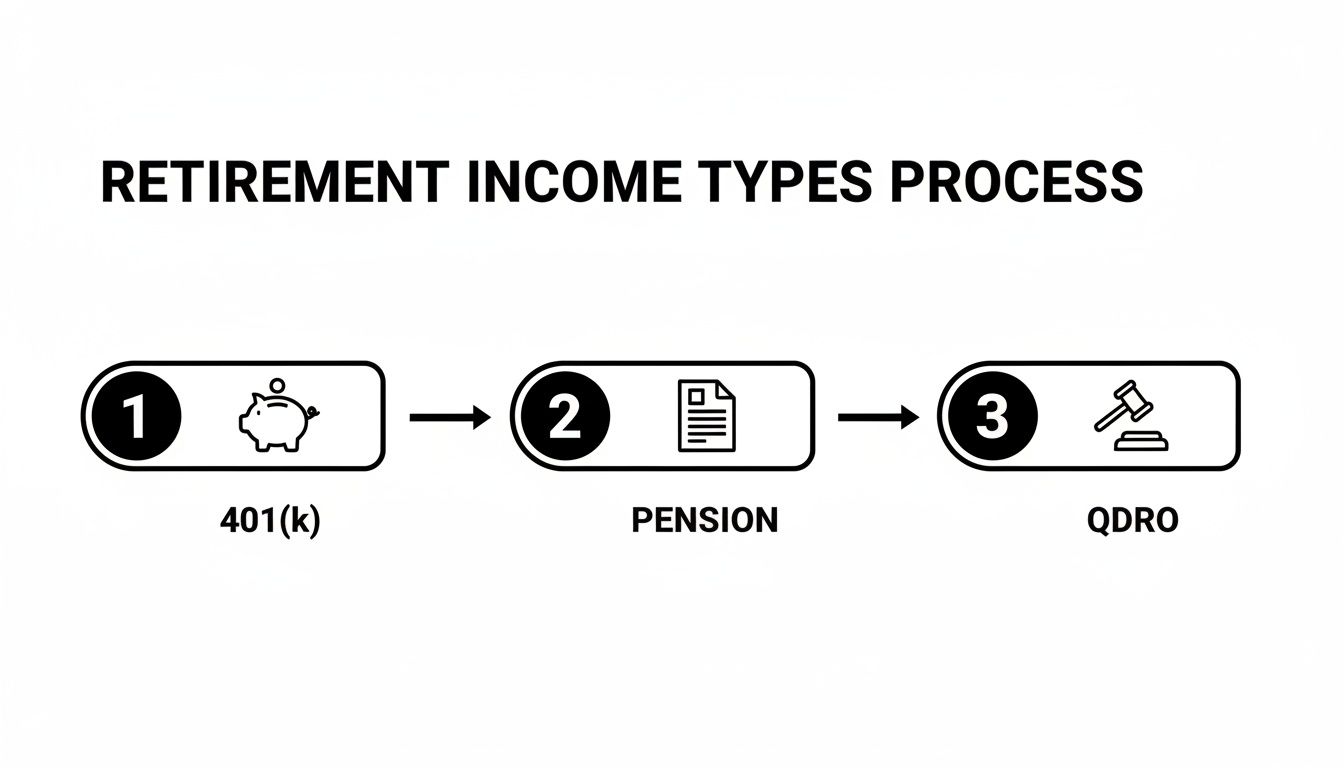
As you can see, assets like 401(k)s and pensions need the formal legal authority of a QDRO to be divided and distributed correctly.
Why You Need An Experienced Florida Attorney
The division of retirement assets has become more critical than ever, especially for couples in their 50s and 60s who must split their primary nest egg just when they need it most. This carries enormous financial consequences.
A QDRO is not a standard court form you can just download and fill out. It is a complex legal instrument that must be custom-drafted to meet the precise requirements of a specific retirement plan and the terms of your divorce decree.
Given these high stakes, trying to handle a QDRO without an experienced family law attorney is a huge risk. For anyone in Pasco, Pinellas, and Hillsborough Counties, having legal counsel familiar with Florida law and the specific procedures of local courts is absolutely essential. An attorney can help you understand the nuances and ensure your financial future is protected. Knowing the right questions to ask is the first step, and you can find out more in our guide on what you should ask an attorney during your divorce initial consultation. Our firm is committed to serving all members of our community, including our LGBTQ+ clients, with the skill and dedication needed to navigate these complex financial matters.
Common Mistakes To Avoid When Dividing Your Assets
Splitting up retirement accounts is a minefield. For many couples between 35 and 65, these accounts aren't just part of the picture—they are the picture, often representing the most valuable asset they own. One small misstep here can create devastating financial ripples for years to come. Getting this right is absolutely critical to protecting your future.
At our firm, we are committed to helping all families in Pasco, Pinellas, and Hillsborough Counties, including our LGBTQ+ clients, navigate these waters with clarity. We handle every divorce and family law matter with the expertise and genuine compassion you deserve.
Relying On Informal Agreements Instead Of A QDRO
One of the single most dangerous mistakes you can make is relying on a "handshake deal" or a simple sentence in your divorce decree to divide a 401(k) or pension. It’s a trap. Without a formal, court-approved Qualified Domestic Relations Order (QDRO), the person managing the retirement plan has zero legal authority to give you a dime.
An informal agreement is completely unenforceable. If your ex-spouse decides not to cooperate later or just cashes out the whole account, you could be left with nothing. Even worse, if they do pull money out for you without a QDRO, it can trigger massive income taxes and early withdrawal penalties, potentially torching a huge chunk of the asset you were counting on.
Using A Fixed Dollar Amount That Ignores Market Fluctuations
It’s tempting to agree on a specific dollar amount during negotiations—say, "$100,000 from the 401(k)." The problem? There's almost always a delay, sometimes months, between when you sign the agreement and when the money actually moves. In that time, the market can swing wildly.
If you agreed to a fixed dollar amount and the market skyrockets, you get none of that growth. On the flip side, if you're the one paying out and the market tanks, you could end up handing over a much bigger percentage of the account than you ever intended.
The smartest play is almost always to divide the account by a percentage. This ensures both of you share equally in any market gains or losses that happen before the final split, making the outcome far more equitable.
Forgetting About Survivor Benefits In Pension Plans
When you're dealing with a traditional pension or military retirement, those monthly checks aren't the only thing of value. These plans almost always include survivor benefits—a feature that can keep payments coming to a surviving spouse long after the employee has passed away.
Ignoring these benefits during the divorce is a massive oversight. In most cases, if the QDRO (or a similar dividing order) doesn't explicitly grant survivor benefits to the former spouse, they are lost forever upon divorce. This isn't a small detail; it could mean walking away from tens or even hundreds of thousands of dollars in future financial security.
Failing To Get An Accurate Valuation
Not all retirement accounts are easy to value. A 401(k) statement shows you a clear balance, but what about a pension? Its true worth is tied up in complex future calculations based on life expectancy and interest rates. Guessing at its value—or worse, ignoring it—can lead to a profoundly unfair division of assets.
You need a proper valuation, typically done by a financial expert like an actuary, to figure out the pension's present-day value. This is the only way to know what it's really worth and negotiate a fair trade. For instance, you can't decide if one spouse keeping the pension in exchange for the house equity is a fair deal without knowing what that future income stream is worth today.
The financial fallout from divorce can hit retirement savings hard, which underscores just how vital it is to get the division of these assets right. Avoiding these pitfalls is a huge step, but it's part of a much bigger strategy. For more expert insights, read our guide on other common mistakes to avoid during a Tampa divorce.
How An Experienced Attorney Can Protect Your Future
The choices you make right now about dividing retirement funds will define your financial life for years—maybe even decades. This isn't just one more piece of paperwork. It's one of the biggest and most complex financial decisions you will ever make. Trying to handle this alone under Florida law is a massive gamble with your future security.
An experienced attorney does so much more than fill out forms. They build a strategic plan to protect your assets.
They make sure every single retirement plan is found, valued correctly, and divided fairly based on Florida’s rules for equitable distribution. They are the ones who draft the critical legal documents, like a QDRO, that can save you from disastrous tax penalties down the road.
Building Your Strategic Plan
For professionals, business owners, and military service members in Hillsborough, Pinellas, and Pasco counties, the stakes are even higher. Your retirement is likely tied up in complex assets like pensions or military retirement benefits, and each one has its own maze of rules.
An attorney is your advocate, your negotiator, and your strategist. They ensure your rights are protected, whether you're sitting at a mediation table or standing in a courtroom. Their job is to bring clarity and calm during what is an incredibly stressful time.
We're committed to helping everyone in our community, including our LGBTQ+ clients, get through these challenges with skill and genuine compassion. The right legal help isn't a luxury—it's absolutely necessary for securing your future.
To take that first step, you need the right partner for this journey. For some guidance on this crucial decision, you can learn more about how to choose the right divorce lawyer for your needs.
Your financial future is far too important to leave to chance. We invite you to reach out for a consultation to start building the strategy that will protect everything you've worked so hard to build.
Common Questions About Dividing Retirement Accounts
When it comes to divorce, untangling finances is often the trickiest part, and retirement accounts top the list of complex assets. You're not alone if you have questions. Below are some of the most common questions we hear from clients in Pasco, Pinellas, and Hillsborough Counties, with clear, direct answers.
What If My Spouse Had The Retirement Account Before We Got Married?
This is a classic scenario. Under Florida law, only the growth of the account during the marriage is considered marital property and up for grabs. The value of the account on the day you got married is generally considered your spouse's separate, non-marital property.
But here's the catch: the burden of proof is on your spouse. They need to produce account statements from around the wedding date to clearly establish that pre-marital balance. If they can't find that proof, a court could potentially treat the entire account as marital.
Do We Have To Split Every Single Retirement Account 50/50?
No, not at all. Florida is an equitable distribution state, which means the goal is a fair outcome, not necessarily a mathematically perfect 50/50 split of every last asset. In fact, couples often negotiate a trade-off.
For instance, one spouse might keep their entire 401(k), and in exchange, the other spouse gets the full equity in the family home or another asset of similar value. This strategy, known as an offset, is a very common and effective way to get to a fair result without the headache of dividing every single account. It lets each person walk away with the assets that matter most to them.
What Happens To My Military Retirement In A Divorce?
Military retirement is a substantial asset, and it is absolutely divisible in a Florida divorce. The portion considered marital is calculated based on the number of years of military service that overlapped with the years of the marriage.
Dividing a military pension isn't done with a standard QDRO. It requires a specific court order that is sent to the Defense Finance and Accounting Service (DFAS) to direct payments to the former spouse. This is a highly specialized area of family law, and getting that order drafted perfectly is critical to ensuring it works as intended.
Will I Owe Taxes On The Retirement Money I Get From The Divorce?
If it's handled correctly, the answer is generally no—at least not immediately. A properly executed QDRO allows the funds to be moved from one spouse to the other without triggering any immediate income taxes or the dreaded early withdrawal penalties.
The funds are typically rolled over directly into an IRA in the receiving spouse's name. They stay tax-deferred until that spouse decides to take withdrawals in retirement. At that point, the money will be taxed as ordinary income, just like any other traditional retirement distribution.
Our firm is committed to serving all families with compassion and expertise, including our LGBTQ+ clients. We ensure that every client, regardless of their background, receives skilled legal guidance tailored to their unique circumstances. Proper handling of these complex financial instruments is key to protecting your future.
Navigating the division of retirement assets requires a strategic plan and a deep understanding of Florida law. At Foley Family Law, we are dedicated to protecting your rights and securing your financial future. Contact us today to build the plan that will give you a fresh start. https://wfoleylaw.com


