

In a Florida divorce, discovery is the formal, pre-trial process where you and your spouse are legally required to exchange all relevant financial information and facts under oath. It’s a mandatory and absolutely critical step designed to make sure both of you have a complete and honest understanding of all marital assets, debts, and income. Without this process, a fair and equitable property distribution would be impossible.
What Is Discovery In A Florida Divorce Case?
Imagine trying to put together a complex jigsaw puzzle, but your spouse is holding half the pieces. You can't see the full picture, and any attempt to finish it would be pure guesswork. The divorce discovery process in Florida is the rule that says you both have to empty your pockets and put all the puzzle pieces on the table. Its whole purpose is to eliminate surprises and ensure every decision is based on a complete and accurate financial picture.
This phase of your divorce usually kicks off right after the initial filings, like when you've figured out how to respond to a divorce petition. Let's be clear: this isn't optional. It's a fundamental requirement under Florida law to enforce transparency. It doesn't matter if your divorce is friendly or a knock-down, drag-out fight; this exchange of information has to happen so you can make informed decisions about your future.
The Goal Of Full Disclosure
The primary goal here is achieving full financial disclosure. This means both you and your spouse must provide a sworn Financial Affidavit, along with all the documents to back it up. The court needs this information to fairly divide your property and figure out issues like alimony or child support.
This is especially true for our clients in Pasco, Pinellas, and Hillsborough Counties, where judges strictly enforce these disclosure rules. The aims of discovery are pretty straightforward:
- Gather Evidence: Collect all the facts related to finances, property, and any issues related to your kids.
- Prevent Surprises: Make sure neither side is blindsided by unexpected information during negotiations or at trial.
- Uncover Hidden Assets: Find any inconsistencies or attempts to hide income or property from the court.
Discovery is the foundation upon which a fair divorce settlement is built. Without a thorough exchange of information, it's impossible to ensure that the division of your marital estate is equitable and just.
Why This Step Is Non-Negotiable
This process protects both of you. It ensures that a settlement agreement isn't based on incomplete or false information, which could be challenged and overturned in court down the road.
For anyone navigating a divorce—whether it involves complex assets, a family business, or questions about a spouse's real income—discovery is the mechanism that levels the playing field. We are committed to guiding all our clients, including members of the LGBTQ+ community facing divorce or name change issues, through this essential process with care and precision in Pasco, Pinellas, and Hillsborough Counties.
The Primary Tools Used in Divorce Discovery
In Florida, the divorce discovery process isn't some vague fishing expedition. It's a structured phase that relies on a specific set of legal tools, each designed to uncover different kinds of information.
Think of it like a contractor's toolbox; you wouldn't use a sledgehammer to drive a nail. In the same way, your attorney will select the right discovery tool for the right job, all with the goal of building a strong, fact-based case. These methods are all governed by general Florida family law procedures to make sure both sides can gather the evidence needed for a fair resolution.
For our clients in Pasco, Pinellas, and Hillsborough Counties, knowing what these tools are helps demystify the process and sets clear expectations. The most common instruments we use are Mandatory Disclosure, Interrogatories, Requests for Production, and Depositions.
Mandatory Disclosure The Foundation
The very first step—and the most essential tool—is Mandatory Disclosure. This is the automatic, foundational exchange of financial information that happens in almost every single Florida divorce. It requires both you and your spouse to complete and exchange a detailed Financial Affidavit, under oath, along with a specific checklist of supporting documents.
This initial back-and-forth includes paperwork like:
- Tax returns from the last three years
- Pay stubs or other proof of income for the last six months
- Deeds to any real estate
- Statements for all bank and investment accounts
- Credit card and loan statements
This step ensures that everyone starts with the same baseline financial picture. It's the bedrock upon which all other discovery is built.
Interrogatories Asking The Right Questions
Once mandatory disclosure is out of the way, your attorney might turn to Interrogatories. These are simply written questions sent to your spouse that they are required to answer in writing, under oath.
These aren't random questions. They are strategically crafted to fill in gaps, get more detail on something from the financial affidavit, or inquire about specific facts of the case. For instance, an interrogatory might ask your spouse to list every source of income they've had over the past two years or to explain a specific large financial transaction. This is a powerful tool for locking in your spouse's version of the facts, which can be invaluable later in negotiations or at trial.
Discovery is all about bringing the full picture into focus—gathering the facts, identifying all the assets, and clarifying all the debts.
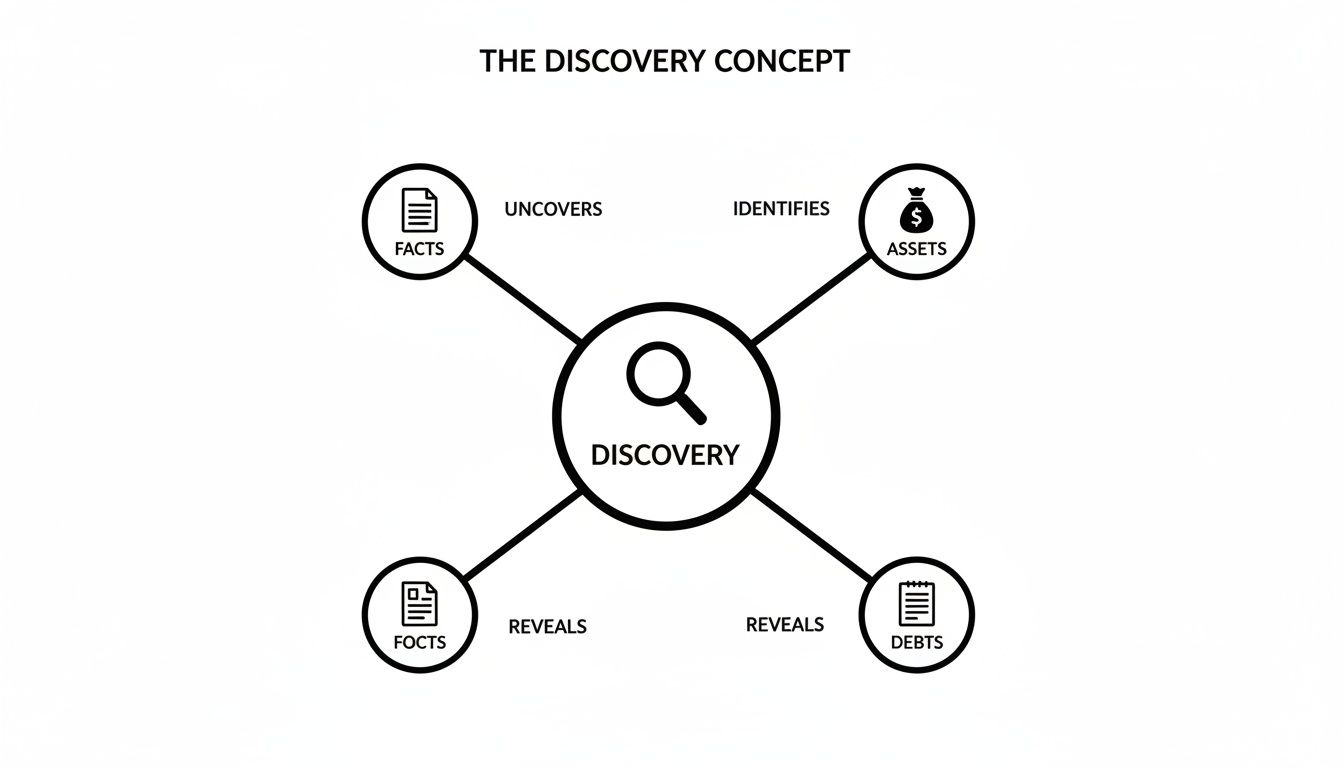
This process is designed to create complete financial transparency before any final decisions are made, leaving no stone unturned.
Requests For Production Getting The Documents
A Request for Production is a formal demand for your spouse to produce specific documents, records, or other tangible items. While mandatory disclosure provides a standard set of documents, this tool lets your attorney dig deeper.
We might request things like detailed business records if a company is involved, statements from a retirement account that wasn't previously disclosed, or even electronic data like emails or text messages. In today's world, it's also quite common to request social media records, as what people post online can sometimes directly contradict their sworn testimony. You can learn more about how social media and divorce intersect in our guide.
Depositions Testimony Under Oath
Finally, we have the deposition. This is out-of-court testimony given by your spouse (or another key witness) under oath. During a deposition, your attorney asks questions in person, and a court reporter transcribes every single word. This is the only discovery tool that allows for live, real-time questioning.
A deposition is a critical opportunity to see how a witness holds up under pressure, get detailed explanations on the record, and pin down their story before ever stepping into a courtroom. It's often one of the most revealing parts of the entire discovery process.
Depositions are fantastic for clearing up vague answers from interrogatories and exposing any inconsistencies in your spouse's story. It's a powerful way to understand exactly what they will say on the witness stand if your case goes to trial.
Florida's Divorce Discovery Tools Explained
Understanding these tools helps you see how a case is built piece by piece, ensuring that any final agreement or court order is based on a complete and accurate set of facts. Here is a quick summary of the four primary tools we've discussed.
- Mandatory Disclosure: This tool's purpose is to establish a baseline financial picture by automatically exchanging core documents. A common example is exchanging the last three years of tax returns and a sworn Financial Affidavit.
- Interrogatories: Their purpose is to ask specific written questions that must be answered under oath to clarify facts. An example would be: "List all assets you have acquired in the last 24 months with a value over $1,000."
- Request for Production: This is used to obtain specific documents or tangible evidence beyond what's in mandatory disclosure. A common example is requesting all business bank statements for the past five years for a family-owned company.
- Depositions: Their purpose is to take live, sworn testimony from a spouse or witness to assess credibility. An example is questioning a spouse about their knowledge of a hidden bank account or their current employment situation.
Navigating Discovery In Complex Divorce Cases

While the basic discovery tools work for every Florida divorce, some cases demand a much deeper, more strategic game. When you’re dealing with significant assets, a family business, or a contested custody battle, the process gets infinitely more complicated. The stakes are higher, the financial details are a tangled mess, and the need for a meticulous, investigative approach is absolute.
For our clients across Pasco, Pinellas, and Hillsborough Counties, we live and breathe these complexities. We have the experience to manage these intense discovery demands, whether you're a high-net-worth individual, a business owner, or a parent fighting for what’s best for your child. This includes our dedicated support for LGBTQ+ clients, ensuring every family receives the expert guidance they need to get through it.
High-Asset Divorce And The Search For Clarity
In a high-asset divorce, the financial picture is rarely what it seems on the surface. The discovery process has to move beyond just grabbing bank statements and pay stubs. It becomes a forensic investigation to uncover the true, complete value of the marital estate and ensure a genuinely equitable distribution.
The discovery for divorce in these situations often requires us to:
- Trace Hidden Assets: We dig for unexplained money transfers, secret accounts, or property deliberately titled in someone else’s name to keep it out of the divorce.
- Value Complex Investments: This means getting an accurate, real-world assessment of everything from stock options and retirement accounts to real estate portfolios and art collections.
- Conduct a Lifestyle Analysis: We often scrutinize spending habits and financial records to make sure the income claimed on a financial affidavit actually matches the lifestyle being lived.
In high-stakes cases, discovery isn't just about collecting documents; it’s an investigation aimed at forcing total financial transparency. Uncovering every last asset is critical to protecting your financial future.
This exhaustive approach is designed to stop one spouse from getting an unfair advantage by hiding or undervaluing assets. It’s all about making sure the final settlement is built on a complete and accurate financial foundation.
When A Business Is Part Of The Marital Estate
For business owners, divorce adds a massive layer of complexity. The business is frequently the most valuable marital asset, and its worth can be highly subjective and difficult to nail down. Proper discovery is absolutely essential to protect your interests, whether you're the one who runs the company or the spouse.
A cornerstone of this process is a business valuation. This is a formal appraisal done by a neutral financial expert who tears through the company's books, assets, and cash flow to determine its fair market value. We use discovery tools, like Requests for Production, to gather every single business record this expert needs for their review.
On top of that, we often bring in forensic accountants. These professionals are trained financial detectives who can spot discrepancies and are instrumental in uncovering hidden income or personal expenses being laundered through the business. To get a better handle on this specific challenge, check out our guide on how to protect your company during a divorce.
Discovery In Contested Child Custody Cases
When parents just can't agree on a timesharing plan, discovery's focus pivots away from finances and onto what is in the best interests of the child. The mission becomes gathering facts that paint a clear, undeniable picture of each parent’s capabilities, stability, and actual involvement in their child’s life.
Discovery in these incredibly sensitive cases can include requests for things like:
- Communications: Text messages, emails, and social media DMs between parents can reveal patterns of communication and cooperation—or the complete lack of it.
- Social Media Posts: A parent’s public online activity can offer powerful insight into their lifestyle, judgment, and priorities.
- School and Medical Records: These documents can prove which parent has historically been the one showing up for the child’s education and healthcare needs.
At the end of the day, in any complex divorce, a tough and targeted discovery strategy isn't just a nice-to-have—it's everything. It's the key to building a powerful case and securing a fair outcome for you and your family in Pasco, Pinellas, and Hillsborough Counties.
Common Mistakes To Avoid During The Discovery Process
The divorce discovery process is built on a simple foundation: honesty. It might feel invasive, sure, but playing by the rules is non-negotiable. Trying to sidestep your obligations or getting sloppy with your responses can have severe consequences that can sink your case, sometimes permanently.
To get through this phase, you need to know what not to do. In our years of work with clients across Pasco, Pinellas, and Hillsborough Counties, we've seen how simple errors in judgment can explode into major legal headaches. Knowing the common pitfalls is the first step to avoiding them.
Attempting To Hide Assets
This is one of the most serious mistakes you can make. It includes everything from transferring money to a secret bank account, "gifting" large sums to a friend to hold for you, or lowballing the value of your property. People try this to make the marital estate look smaller, but this strategy almost always backfires spectacularly.
Good divorce attorneys are experts at sniffing out financial paper trails. When those hidden assets are uncovered—and they almost always are—Florida law comes down hard.
- You Lose All Credibility: The judge will stop trusting a single word you say. Your credibility is shot for the rest of the case.
- You Pay for Their Search: The court can order you to pay every penny of your spouse's attorney's fees that were spent finding what you hid.
- You Lose More Than You Hid: As a penalty, the judge might award the entire hidden asset to your spouse, and sometimes even more on top of that.
Providing False Information
Your Financial Affidavit isn't just another form; it's a sworn legal document you sign under penalty of perjury. Lying on it—whether by understating your income, inflating your expenses, or just "forgetting" an asset—is the same as lying to the judge's face.
Honesty isn’t just the best policy during discovery; it’s the only policy. Any attempt to mislead the court or your spouse will undermine your entire case and can lead to severe legal and financial penalties.
Even small "fudges" can be easily exposed when your bank statements are reviewed or you're questioned in a deposition. The damage this does to your case is huge. It is absolutely critical to be meticulous and completely truthful when you and your attorney are preparing your discovery documents.
Failing To Meet Deadlines
Discovery runs on a strict clock, governed by general Florida procedural rules. When you get a Request for Production or Interrogatories, you generally have 30 days to respond. Blowing off these deadlines or just failing to hand over documents on time looks like you're trying to obstruct the process.
This usually leads to your spouse's attorney filing a Motion to Compel. That means you get hauled in front of a judge to explain why you're dragging your feet. It's a waste of time and money, and it makes you look uncooperative in the court's eyes—an impression that can hurt you down the line. For more on this, you can check out other common mistakes to avoid during a Tampa divorce.
Being Careless On Social Media
Let's be clear: in today's world, your social media profiles are fair game in discovery. That photo you post from a lavish vacation or of a fancy new purchase can directly contradict the claims of financial hardship you're making in your Financial Affidavit.
Likewise, venting online about your spouse or the divorce can be twisted into evidence of your poor character or inability to co-parent. We tell every single one of our clients to assume that anything they post online will be printed out and handed to their spouse's attorney and the judge. The safest bet? Just stay off social media completely until your divorce is final.
How An Experienced Attorney Protects You During Discovery

Trying to navigate discovery for divorce on your own is like wandering through a dense legal forest without a map. The path is littered with procedural deadlines, complex rules, and hidden traps that can jeopardize your entire case. An experienced family law attorney isn't just a guide; they are your strategic advocate, shielding you from missteps and using the discovery tools to build the strongest possible case for your future.
For our clients in Pasco, Pinellas, and Hillsborough Counties, we turn discovery from a confusing chore into a powerful advantage. Our job is to manage every detail, from asking the right questions to defending you against the other side's unfair tactics. We handle the legal heavy lifting so you can focus on what matters most—moving forward.
Drafting Precise and Strategic Requests
A skilled attorney doesn't just send out generic forms and hope for the best. We draft discovery requests—like Interrogatories and Requests for Production—that are strategically designed to uncover the specific information needed for your unique situation. This isn't a random fishing expedition; it's a targeted investigation.
We know what to ask for, how to phrase questions to eliminate loopholes, and which documents are most likely to reveal the complete financial picture. This precision ensures we gather the evidence needed to back up your claims about assets, debts, and income, leaving no stone unturned.
Meticulously Analyzing Your Spouse's Disclosures
Getting a mountain of documents from your spouse is only half the battle. The real work is in the analysis. An experienced attorney knows exactly what to look for in those financial statements, tax returns, and business records. We’re trained to spot the red flags and inconsistencies an untrained eye would easily miss.
Our meticulous review process is designed to:
- Identify Undisclosed Assets: We hunt for unusual transactions or accounts that don't quite line up with their sworn Financial Affidavit.
- Uncover Hidden Income: We scrutinize business records and spending habits to make sure the income they've reported is accurate.
- Verify Asset Valuations: We dig into appraisals and financial data to confirm that assets aren't being deliberately undervalued.
This detailed examination is absolutely critical for holding your spouse accountable and ensuring the marital estate is divided fairly.
Preparing You for Depositions and Testimony
A deposition can be the most intimidating part of discovery. You'll be answering questions from your spouse's attorney, under oath, with a court reporter typing every word. A key part of our role is to prepare you thoroughly for this experience so you feel confident and protected.
We'll go over potential questions, help you formulate clear and concise answers, and teach you how to remain calm under pressure. During the deposition itself, we are right by your side, ready to object to improper questions and shield you from being harassed or misled. Our preparation turns a stressful event into a controlled opportunity to establish your side of the story on the record.
An attorney’s true value in discovery is their ability to act as both a sword and a shield. They proactively seek the truth while aggressively defending you against overreach and intimidation from the opposing side.
Objecting to Improper or Harassing Requests
Just as we use discovery to gather information, your spouse's attorney will do the same. But that doesn't mean their requests are always appropriate. They might ask for information that is completely irrelevant, privileged, or designed purely to harass you.
Your attorney acts as a crucial filter, reviewing every single request that comes your way. We will formally object to any demands that cross legal boundaries, protecting your privacy and preventing the process from becoming a tool for intimidation. Keeping all shared information confidential is paramount, which is why modern practices for secure file sharing with clients are now an indispensable part of the process.
Frequently Asked Questions About Divorce Discovery In Florida
When we get to the discovery for divorce part of a case, the questions start flying. It's a phase that can feel intimidating and overly technical, but getting a handle on the basics can bring a lot of peace of mind. Here are the answers to some of the most common concerns we hear from our clients across Pasco, Pinellas, and Hillsborough Counties.
Our job is to give you clear, straightforward answers so you can move forward with confidence. Every family's situation is unique, and that includes our LGBTQ+ clients navigating divorce or custody issues. You deserve to understand your rights and what's expected of you during this critical stage.
How Long Does The Discovery Process Usually Take?
There’s no magic number here. The timeline for discovery in a Florida divorce depends almost entirely on two things: the complexity of your finances and how well you and your spouse cooperate.
In a straightforward case where both people are open and quick to respond, discovery might wrap up in a couple of months. But if you're dealing with a high-asset divorce, a business valuation, or a spouse who is dragging their feet, the process can easily stretch from six months to over a year. The biggest delays happen when one spouse refuses to hand over documents, forcing us to go to court and get a judge involved.
What Happens If My Spouse Lies Or Hides Assets?
Let's be very clear: Florida law demands full and honest financial disclosure. It's not optional. If your spouse intentionally hides assets, fudges the numbers on their financial affidavit, or just ignores legitimate discovery requests, they are playing with fire.
We don't just take their word for it. If we suspect foul play, we can file what's called a Motion to Compel. This is a formal request asking the judge to order your spouse to comply. If they still refuse, the court has some serious tools to bring the hammer down:
- It can force your spouse to pay every penny of your attorney's fees for the time spent chasing them down.
- It can strike their legal arguments, meaning the judge won't even listen to what they have to say.
- Most powerfully, the court can punish them by awarding you a larger, unequal share of the marital property.
Is Discovery Required For An Amicable Divorce?
Yes, absolutely. Even in the friendliest, most collaborative divorces in Florida, a complete and fair exchange of financial information is mandatory. You might not be fighting, but both of you must still complete and exchange sworn Financial Affidavits and the required disclosure documents.
This isn't just bureaucratic red tape; it's a rule that protects both of you. It guarantees that any settlement you reach is based on a true and accurate financial picture. This step validates your agreement, makes it legally binding, and confirms that you both gave informed consent—a key requirement for the judge to sign off on your divorce. Many people ask how to divorce without a lawyer, and while it's possible in simple situations, skipping discovery or doing it improperly is one of the biggest mistakes you can make.
Can My Social Media Be Used During Discovery?
You bet it can. Your social media profiles are a goldmine of potential evidence. Every post, picture, comment, direct message, and even location "check-in" can be formally requested during discovery and shown to a judge.
Assume that anything you post online will be seen by your spouse's attorney and the judge. A single careless post can undermine your legal position on finances, parenting, or personal conduct.
Think about it: posting pictures from an expensive vacation doesn't look great when you're claiming you can't afford support. Ranting about your ex could be used to argue you can't co-parent effectively. Our advice to every client is simple: be extremely careful with your social media, or better yet, just shut it down completely until your divorce is final.
Navigating the complexities of discovery requires strategic guidance and a deep understanding of Florida family law. At Foley Family Law, we are committed to protecting your rights and ensuring a fair process from start to finish. If you have more questions or need help with your divorce in the Tampa Bay area, contact us to schedule a consultation and create a plan of action for your future. We serve clients in Pasco, Pinellas, and Hillsborough Counties. Learn more at https://wfoleylaw.com.


