

The biggest difference between a marriage and a domestic partnership in Florida boils down to one word: recognition. Marriage is a state-sanctioned union, automatically triggering a whole host of statewide and federal rights. A domestic partnership, on the other hand, offers limited protections that exist only where local city or county laws allow them.
This means a marriage license from Pasco County is valid and recognized everywhere. But a domestic partnership registered in Hillsborough County might offer zero legal standing just one county over, creating a confusing and risky legal patchwork. We handle all LGBTQ issues, family and divorce issues, and do not discriminate.
Key Differences Marriage Vs Domestic Partnership In Florida
Choosing how to formalize your relationship is a major life decision with very real legal consequences. For many couples, including those in the LGBTQ community we proudly serve, the choice between marriage and a domestic partnership can feel murky. Here in Florida, these two paths offer vastly different levels of security.
Marriage is a formal contract governed by state law, granting a broad set of automatic rights and responsibilities. It’s a well-defined legal status.
Florida, however, has no statewide domestic partnership registry. Any rights or benefits you might get come from specific city or county ordinances. This means a couple’s legal status can literally change just by crossing a county line, impacting everything from emergency medical decisions to property rights. This inconsistency is a critical factor for anyone living in Pinellas, Pasco, and Hillsborough Counties to think about.
At A Glance Comparing Legal Status in Florida
Understanding these core distinctions is the first step toward making a choice that truly protects your future and aligns with your long-term goals. Here are the fundamental legal differences in Florida:
- Recognition: Marriage is recognized statewide in Florida and by the federal government. A domestic partnership is recognized only in the specific cities or counties that have a registry.
- Legal Rights: Marriage grants automatic and comprehensive rights, including inheritance, tax benefits, and healthcare decision-making. A domestic partnership provides only the limited rights granted by local ordinances and offers no federal rights.
- Termination: Ending a marriage requires a formal, court-supervised divorce process. Ending a domestic partnership has no standardized process and depends on local rules or any prior agreements made between the partners.
As you can see, the legal frameworks are worlds apart. A domestic partnership can offer some helpful, localized benefits, but it simply doesn't provide the comprehensive legal armor that marriage does.
This infographic gives you a quick visual summary of the core differences.
Here's the bottom line:
- State vs. Local Recognition: Marriage is recognized in all Florida counties and by the federal government. A domestic partnership is only recognized where it was registered, offering no legal weight elsewhere.
- Automatic Rights: A marriage license automatically grants hundreds of rights, including inheritance, hospital visitation, and the power to make medical decisions for a spouse. Domestic partners usually have to create separate legal documents—like wills and healthcare directives—to try and secure similar protections.
- Dissolution Process: Ending a marriage requires a formal divorce, a court process that equitably divides assets and addresses potential support. For more on this, you can learn about alimony in Florida. Dissolving a domestic partnership has no standardized legal process and often falls back on the terms of a pre-existing agreement, if one even exists.
The visualization makes it clear: marriage offers comprehensive, legally embedded rights, while a partnership provides a much more limited and localized set of benefits.
How Florida Law Recognizes (or Doesn't Recognize) Your Relationship
When you're deciding between marriage and a domestic partnership in Florida, the biggest difference comes down to one thing: legal recognition. It’s not just a piece of paper; it’s the foundation of your rights as a couple, and the two options couldn't be more different.
Marriage is a formal legal contract, defined and governed by state law. That contract automatically unlocks hundreds of federal rights and is recognized everywhere you go. It’s a uniform status with immense legal weight.
Florida, on the other hand, offers no statewide recognition or registry for domestic partnerships. This is a critical point to grasp. Without state-level laws, the legal standing of a domestic partnership is completely fragmented, depending entirely on which city or county you happen to be in.
A Patchwork of Local Laws
Several cities and counties across Florida, like Pinellas and Hillsborough, did establish their own domestic partnership registries. These were created years ago, often to give some measure of protection to couples—including LGBTQ partners—before marriage equality became the law of the land. They were a step forward then, but now they create a legally precarious situation.
Here's the problem: the rights granted by these local registries are not portable.
A couple registered as domestic partners in Pinellas County could have their legal status completely disregarded if they have a medical emergency one county over in Pasco, which doesn't have a registry.
This lack of portability is perhaps the single greatest risk associated with domestic partnerships in Florida. A relationship's legal standing should not vanish when you cross a county line, but that is the reality for domestic partners.
This inconsistency creates huge uncertainty. Simple but essential rights, like hospital visitation or making emergency healthcare decisions for your partner, can be challenged or flat-out denied depending on where you are.
Marriage: A Uniform Status at the State and Federal Level
Marriage provides a stark contrast. When you get legally married in Florida, your union is recognized in all counties, every single U.S. state, and by the federal government. Period. This universal recognition ensures your rights as a spouse are protected no matter where you travel or live.
This uniform legal status creates a solid foundation for building a life together, offering real security in key areas:
- Automatic Rights: Marriage automatically gives spouses legal authority in healthcare, inheritance, and financial matters. You don't need a stack of extra, complex legal documents just to prove your relationship.
- Federal Benefits: It is the only way to access federal benefits like Social Security spousal and survivor benefits, file federal taxes jointly, or claim military spousal rights.
- Legal Clarity: The rights and duties of marriage are clearly spelled out in Florida statutes. This provides a predictable legal framework for everything from owning property to dissolving the relationship.
For anyone in the Tampa Bay area—including Pasco, Pinellas, and Hillsborough Counties—understanding this fundamental difference is crucial. Marriage offers a comprehensive shield of legal protections that is both broad and consistent. A domestic partnership, while personally meaningful and offering limited local benefits, leaves you and your partner exposed to significant legal gaps.
Our firm handles all LGBTQ family and divorce issues without discrimination, including gay divorce and gay or transgender name changes. We frequently advise clients on how to secure their futures by choosing the legal structure that actually protects their goals.
Comparing Financial Rights and Responsibilities
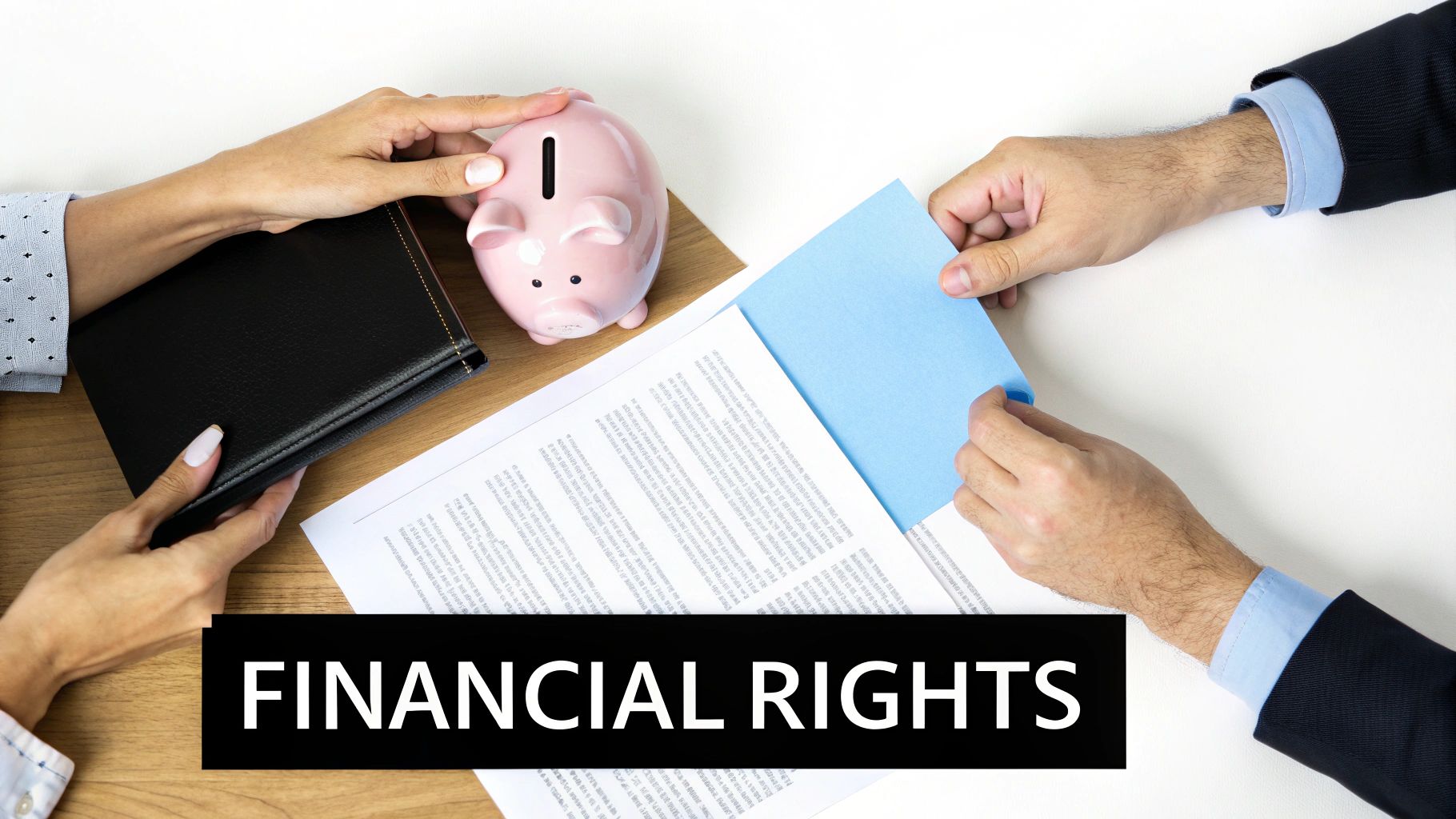
When you're deciding between marriage and a domestic partnership, the financial side of things is a massive piece of the puzzle. This choice has real-world consequences for your economic future, touching everything from your tax bill to your property rights. The bottom line is that marriage offers a suite of automatic financial protections under federal and state law that domestic partnerships just can't match.
For starters, married couples can file joint federal tax returns, which often lightens their tax load. They also unlock key federal benefits, like Social Security spousal and survivor benefits. This is a big one: a surviving spouse can claim a part of their deceased partner's benefits, a critical financial backstop that is completely off the table for domestic partners.
How Property Is Handled Differently
One of the sharpest financial distinctions is how your assets are treated. In a marriage, anything you and your spouse acquire during the union is considered marital property. If the marriage dissolves, Florida law kicks in with a process called equitable distribution, aiming for a fair—though not always 50/50—split of that property.
Domestic partnerships operate on a completely different playing field. There’s no automatic framework. Any property you buy is typically owned separately unless you have an ironclad, meticulously drafted partnership agreement. Without that legal document, one partner could pour money into an asset—like a house titled only in the other partner's name—and walk away with nothing if the relationship ends. If you want to dig deeper into Florida’s approach, you can check out our guide on whether Florida is a community property state.
The financial stability marriage provides isn't just a legal theory; it often ties directly to higher personal wellbeing. The legal commitments involved can create a more secure environment, which is a key factor for clients we help in Pasco, Pinellas, and Hillsborough Counties as they navigate major life changes.
Retirement, Pensions, and Long-Term Security
Long-term financial security is another area where marriage offers far more robust protection. A spouse has automatic rights to a portion of their partner’s retirement accounts and pensions earned during the marriage. These aren't just suggestions; they are powerful, legally embedded rights designed to ensure both partners share in the wealth they built together.
Domestic partners, on the other hand, have no automatic claim to each other's retirement funds. To create similar rights, they have to rely on complex legal agreements. If those documents are flawed or simply don't exist, a partner could find themselves cut off from retirement funds they were counting on, which can lead to severe financial hardship down the road.
At our firm, serving Pasco, Pinellas, and Hillsborough Counties, we handle all family and divorce matters, including for our LGBTQ clients, without discrimination. Understanding these financial realities is the first step toward making a smart choice that protects your financial health for years to come.
Navigating Healthcare And Inheritance Rights
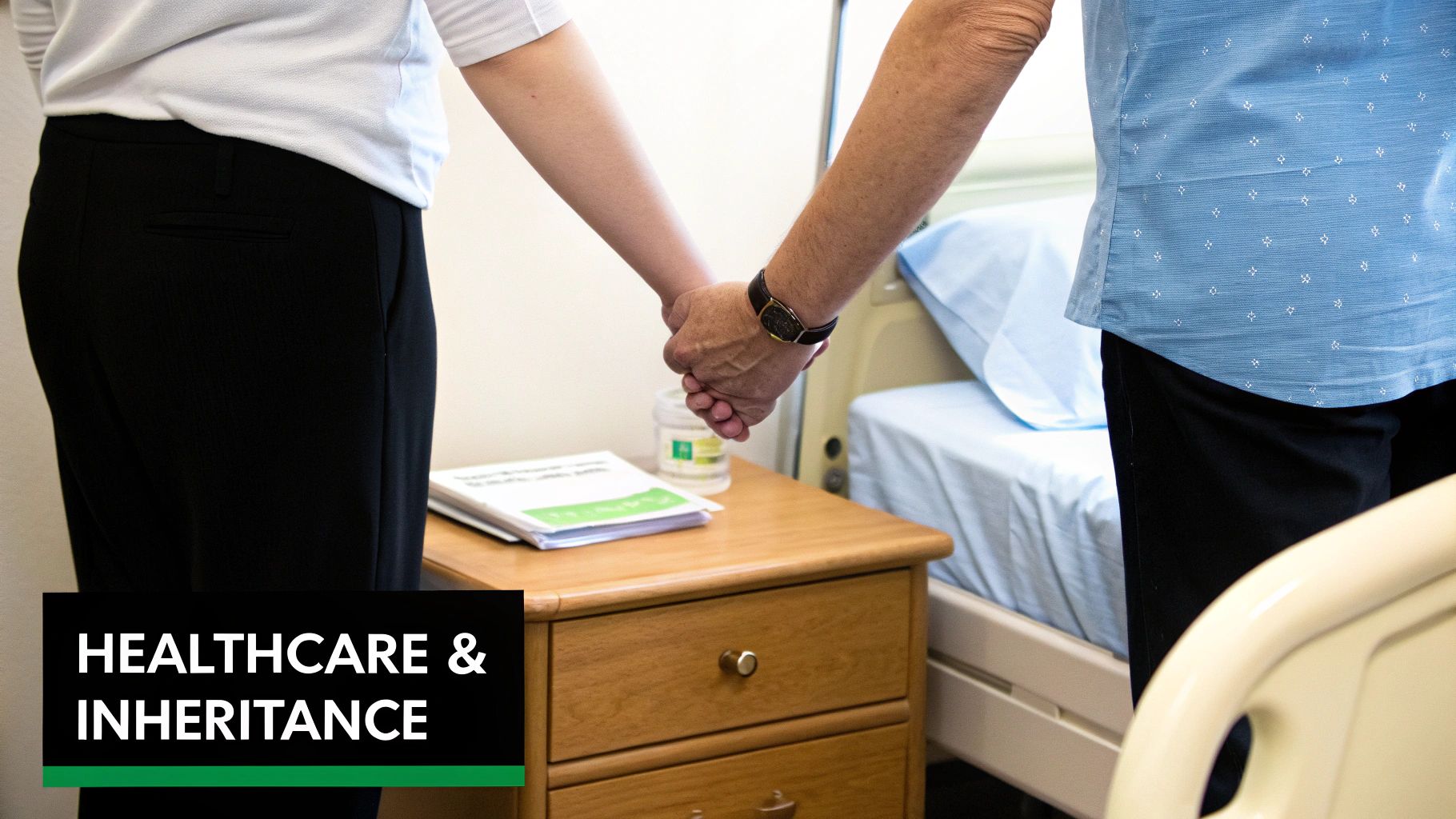
When a crisis hits, the legal status of your relationship suddenly becomes critically important. The difference between marriage and domestic partnership is never more apparent than in a hospital room or when you're planning for the future. These two areas—healthcare access and inheritance rights—reveal some of the deepest legal gaps that domestic partners face in Florida.
For married couples, the law provides a powerful, automatic safety net. A spouse is legally recognized as next-of-kin. This means they have the immediate authority to make life-or-death medical decisions if their partner becomes incapacitated, and they have an undeniable right to visitation in a hospital or care facility.
Medical Decision-Making and Health Insurance
Married individuals can typically add their spouse to their employer-sponsored health insurance plan with ease. The process is standardized and widely accepted.
In stark contrast, domestic partners have no automatic legal authority to make medical decisions for each other. Without specific legal documents like a healthcare surrogate designation or a durable power of attorney, a partner could be shut out of the decision-making process entirely. That power would instead fall to a blood relative.
A domestic partnership registration from Hillsborough or Pinellas County may not be enough to grant you access to your partner's bedside in an emergency. Hospitals are not always required to recognize these local registries, highlighting the absolute necessity for separate, comprehensive legal planning.
This distinction is crucial for our clients in Pasco, Pinellas, and Hillsborough Counties. We handle all LGBTQ family law issues and know how vital it is to have legally sound documents in place to protect these fundamental rights—rights that marriage provides automatically.
Inheritance and Estate Rights
The difference is just as jarring when it comes to inheritance. Under Florida law, a surviving spouse has powerful, automatic inheritance rights. Even if a deceased spouse leaves them out of the will, the surviving spouse is entitled to a portion of the estate known as the "elective share."
If there is no will at all, a surviving spouse is first in line to inherit the estate’s assets. This protection is a cornerstone of marital rights, designed to prevent a spouse from being left with nothing.
Domestic partners receive no such automatic protection. A surviving domestic partner has zero inheritance rights under Florida law without a will. If a partner dies intestate (without a will), their entire estate could go to their biological family, leaving the surviving partner with nothing, regardless of how many years they spent together.
To protect each other, domestic partners must engage in meticulous estate planning, including:
- Drafting a detailed will that clearly outlines who inherits what.
- Creating trusts to manage and transfer assets outside of the probate process.
- Designating beneficiaries on all financial accounts, like bank accounts and life insurance policies.
When considering long-term planning, particularly for inheritance, it's wise to consult with estate planning services to ensure all documents are legally sound and properly executed. For domestic partners, this proactive planning is not just advisable; it is absolutely essential to protect each other’s futures.
Understanding How Each Union Is Dissolved
When a relationship breaks down, the legal path you have to walk is one of the biggest differences between a marriage and a domestic partnership. How a union is legally unwound shows its underlying structure—or the lack of one—and that process has huge financial and emotional consequences. For married couples, the road is clearly paved. For domestic partners, it’s often a confusing and uncertain maze.
In Florida, ending a marriage means going through a formal, court-supervised process called a dissolution of marriage, though most people just call it a divorce. This is a well-established legal procedure with a clear set of rules designed to address every piece of a couple’s shared life in a structured way.
The divorce process makes sure all assets and debts acquired during the marriage are identified and divided according to Florida's equitable distribution laws. It also provides a formal system for figuring out potential alimony and resolving all matters related to any minor children. While getting divorced can be complicated, at least it happens within a predictable legal framework. If you're heading down this road, understanding the difference between an annulment vs divorce is a critical first step.
The Ambiguity of Ending a Domestic Partnership
Ending a domestic partnership in Florida is a much murkier affair. Since there’s no statewide recognition, there’s also no formal, state-level “divorce” process for domestic partners. Instead, how the relationship ends is usually governed by the terms of a partnership agreement—if one was ever created—and general principles of contract law.
This lack of a defined process can create massive headaches. If you don't have a comprehensive agreement spelling out how to split everything up, you and your partner could be forced into complex and expensive litigation. You’d have to try untangling your finances without the clear guidance of divorce statutes, which can lead to completely unpredictable results.
For couples in Hillsborough, Pinellas, and Pasco Counties, grasping these vastly different paths is crucial for protecting your financial future. The structured process of divorce provides legal clarity that is simply absent when a domestic partnership ends.
This legal distinction is clear even in global trends. Divorce rates are well-documented, but the dissolution of less formal partnerships isn't. Statistics on marriages and divorces worldwide show how formally recognized unions are tracked, creating clear data that informal arrangements lack. Because marriages require a legal process to end, they create a clear paper trail.
Key Differences in the Dissolution Process
Looking at the practical side of ending each type of union really highlights their core differences. The legal system provides a safety net for married couples that domestic partners have to build for themselves through private contracts.
- Legal Framework: Ending a marriage is guided by Florida’s extensive family law statutes. Ending a domestic partnership relies on contract law and the specific terms you put in a private agreement.
- Property Division: In a divorce, a judge divides all marital property based on equitable distribution. For domestic partners, who gets what depends on how assets are titled and what a partnership agreement says, which often leads to fights over what’s even considered "joint" property.
- Financial Support: Alimony, or spousal support, is a possibility in a divorce, based on factors like one spouse's need and the other's ability to pay. There is no such thing as "partner support" after a domestic partnership ends unless you specifically wrote it into a legal agreement.
Ultimately, the process of dissolving a marriage is designed to provide a final, legally enforceable resolution. The path for domestic partners is far less certain, which underscores just how important proactive legal planning is from the very beginning. As a firm that handles all LGBTQ family and divorce matters, we are committed to helping clients in Pasco, Pinellas, and Hillsborough Counties understand these critical distinctions.
Making An Informed Choice For Your Future
Choosing between marriage and a domestic partnership in Florida isn't just a personal decision—it's one with massive, long-term legal consequences. The bottom line is this: marriage provides automatic, comprehensive, and legally recognized protections across the state. In contrast, domestic partnerships offer a limited, localized, and far less secure alternative.
Making the right choice is really about proactively protecting your future, both for the life you build together and for navigating its potential end.
For residents of Pasco, Pinellas, and Hillsborough Counties, the most direct way to understand which path best secures your interests is to get professional legal counsel. Our firm provides clear, straightforward guidance for all individuals and couples, including the LGBTQ community, and we handle all family law issues without discrimination.
Securing Your Relationship Legally
Every couple's situation is different, and the best legal structure for your relationship hinges on your specific financial landscape and personal goals. Taking the time now to formalize your relationship with the right legal tools is one of the most critical steps you can take.
Making an informed decision with an experienced attorney is the most powerful step you can take to protect your assets, your rights, and your future. Don't leave your security to chance.
Whether you need a prenuptial agreement before getting married or a robust partnership agreement to spell out your rights as domestic partners, legal foresight is essential. Likewise, if you're already committed, you may need to learn more about a postnuptial agreement in Florida to protect assets acquired during the union.
As you weigh these options, it's also helpful to understand how to manage important personal and family contracts. A clear legal strategy ensures you stay in control, whether you are forming a union, facing a complex divorce, or establishing rights through a private agreement.
Frequently Asked Questions About Florida Partnerships
Trying to figure out the legal landscape of relationships in Florida can raise a lot of questions, especially when you start digging into the major differences between marriage and a domestic partnership. For anyone living in Pasco, Pinellas, and Hillsborough Counties, getting clear answers is the first step toward making a choice that actually protects your future.
Here are a few of the most common questions we hear from clients.
Can A Domestic Partnership Provide The Same Rights As Marriage In Florida?
No, a domestic partnership in Florida simply cannot replicate the full legal weight of marriage. While you can create a stack of legal documents—partnership agreements, wills, healthcare directives—to build some similar protections, they will always fall short in a few critical areas.
Most importantly, these private agreements can't grant you access to federal benefits. This is a huge gap. It means no Social Security spousal or survivor rights, no federal tax advantages from filing jointly, and no federal estate tax marital deduction. Plus, any protections you create aren't automatic; they depend entirely on the strength of your privately drafted documents, which can always be challenged in court.
If My City Recognizes Domestic Partnerships, Am I Protected Throughout Florida?
Unfortunately, no. This is one of the biggest misconceptions about domestic partnerships in our state. Recognition is almost always limited to the specific city or county where you registered.
This creates a serious "portability" problem. For instance, a domestic partnership registered in Hillsborough or Pinellas County might give you certain local benefits, but those rights could vanish if you travel or move to another part of Florida that doesn't have its own registry. This can lead to significant legal headaches during a medical emergency or if you decide to relocate within the state.
The legal standing of your relationship should not depend on what side of the county line you are on. Marriage provides uniform, statewide protection that local domestic partnership registries simply cannot offer.
Is It Harder To End A Domestic Partnership Than A Marriage?
It can be far more complicated and legally unpredictable. Ending a marriage follows a defined legal process called dissolution of marriage, or divorce. Florida has established laws that give everyone a clear road map for dividing assets and figuring out alimony. It's an emotionally draining process, but at least it's a structured one.
Ending a domestic partnership, on the other hand, often falls under contract law and the specific terms of a partnership agreement. If you don't have one, or if it's poorly written, any disputes over property and debts can spiral into complex and costly litigation without the clear guidance of family law statutes. That ambiguity can turn a separation into a prolonged legal battle.
As An LGBTQ Couple, Does Marriage Offer More Protection Than A Domestic Partnership In Florida?
Yes, absolutely. Since marriage equality became the law of the land, marriage offers LGBTQ+ couples the exact same extensive state and federal protections that all other married couples enjoy. This is a monumental difference.
These protections include automatic, nationwide recognition of your rights related to inheritance, healthcare decisions, filing joint taxes, and the fair division of property if you divorce. As a firm that handles all LGBTQ family law issues, including gay divorce, gay custody issues, and gay or transgender name changes, we can say with confidence that marriage provides a much more secure and comprehensive legal foundation. Domestic partnerships, even in the few places that offer them, provide a narrower and less reliable set of rights that don't travel with you.
Navigating the complexities of Florida family law requires clear, experienced guidance. At Foley Family Law, we are dedicated to helping clients across Pasco, Pinellas, and Hillsborough Counties understand their options and make informed decisions that protect their rights and secure their futures. Whether you are considering marriage, forming a partnership, or facing a separation, contact us to create a plan of action.


