

The core distinction between a custodial and non-custodial parent comes down to two separate questions: where does the child live, and who makes major decisions? Florida law answers these with two distinct legal concepts. Parental responsibility covers decision-making authority over education, healthcare, and religion. Time-sharing covers where the child physically lives and how parenting time is divided. Under Florida Statute §61.13, the state’s default is shared parental responsibility and a rebuttable presumption favoring equal time-sharing. Before any court date or negotiation, your first step is to assemble concrete evidence:
- Parenting schedules and calendars showing your involvement
- School records, medical records, and communications with the other parent
- Any documentation of safety concerns (police reports, medical records, witness statements)
- Proof of your home stability and daily caregiving routine
Foley Family Law works with parents across Hillsborough, Pinellas, and Pasco counties to build exactly this kind of evidence-based case from day one.
What’s the difference between a custodial and non-custodial parent?
Florida officially replaced the word “custody” with two separate terms: parental responsibility and time-sharing. That said, the older labels still appear in federal child support forms and everyday conversation, so understanding both frameworks matters.

| Dimension | Custodial / Primary Residence Parent | Non-Custodial / Secondary Residence Parent |
|---|---|---|
| Definition | Child’s primary residence; more overnight time | Child lives elsewhere; scheduled parenting time |
| Parenting time | Majority of overnights or equal 50/50 split | Scheduled visits, overnights, holidays |
| Decision-making | Shared unless court orders sole responsibility | Shared unless court orders sole responsibility |
| Child support | Typically receives support when time is unequal | Typically pays support when time is unequal |
| Temporary orders | Can be set quickly; differ from final plan | Same; temporary status can shift at final hearing |
| Key evidence courts want | Stability, involvement, communication records | Same factors; willingness to facilitate contact |
Two real-world examples show how this plays out. In a 50/50 week-on/week-off arrangement, neither parent is technically “non-custodial” in the traditional sense. Both share equal time and, usually, shared parental responsibility. In a primary-residence arrangement, one parent has the child most nights while the other follows a set visitation schedule, often every other weekend plus one weeknight.
Florida courts use “parental responsibility” and “time-sharing” as the controlling legal terms. Knowing this distinction helps you read your parenting plan and court orders accurately.
What do “parental responsibility” and “time-sharing” actually mean?
Physical custody / time-sharing refers to where the child sleeps and how parenting time is allocated across the week, holidays, and school breaks. A parenting plan documents this schedule in detail and is enforceable as a court order.
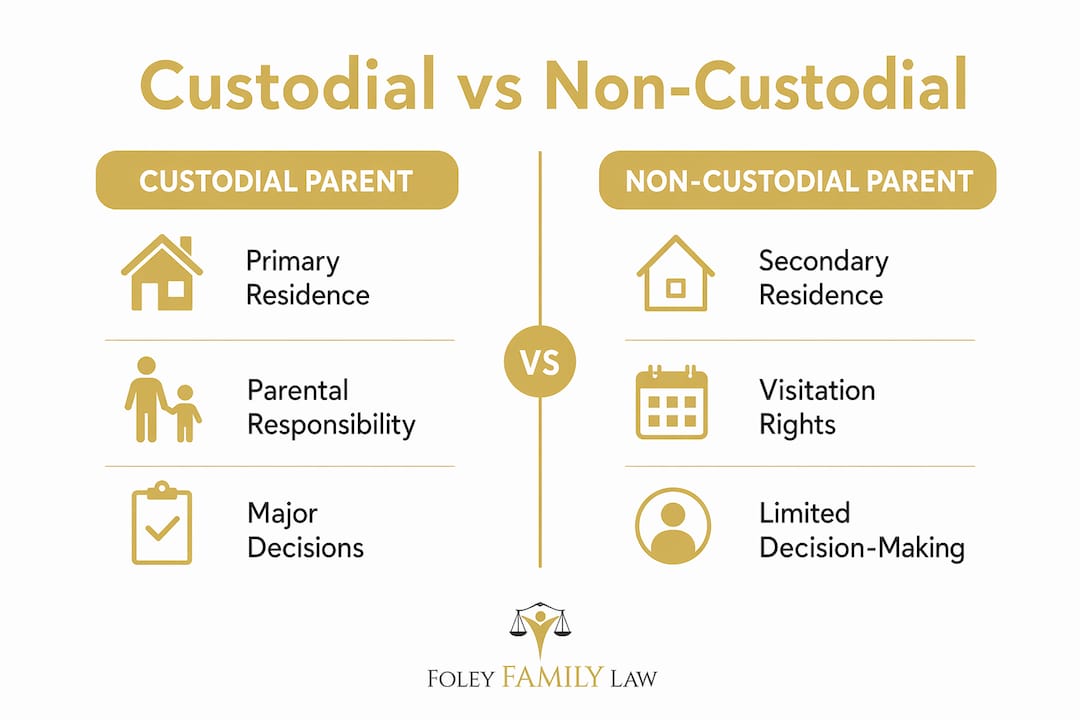
Legal custody / parental responsibility is the authority to make major decisions about the child’s life. Florida law sets shared parental responsibility as the default: both parents retain full rights and must jointly decide on education, healthcare, and religion. Sole parental responsibility, where one parent decides alone, is reserved for situations where shared decision-making would be harmful to the child.
Key terms you will see in Florida forms and orders:
- Shared parental responsibility: Both parents collaborate on major decisions; neither can act unilaterally on significant matters.
- Sole parental responsibility: One parent holds all decision-making authority, typically due to domestic violence, abuse, or documented detriment to the child.
- Time-sharing schedule: The specific timetable, including overnights and holidays, that each parent follows.
- Parenting plan: The court-approved document covering both time-sharing and decision-making allocations.
Pro Tip: Document every school enrollment, doctor visit, and extracurricular decision you make. Courts want to see a pattern of active parenting, not just your word that you are involved.
How does custody status affect your day-to-day parenting?
The parenting plan governs nearly every routine. Common time-sharing models in Florida include:
- Week-on/week-off (50/50): Child alternates full weeks between homes.
- 2-2-3 rotation: Child spends two days with one parent, two with the other, then three with the first, rotating weekly.
- Primary residence with alternating weekends: Child lives primarily with one parent; the other has every other weekend plus one weeknight.
Under Florida law, access to records such as medical, dental, and school records is preserved for both parents unless a court order specifically restricts it for safety reasons. That means a non-primary parent can still attend school conferences, receive medical updates, and participate in extracurricular activities.
A short documentation checklist to maintain throughout co-parenting:
- Keep a shared or personal calendar logging every parenting exchange.
- Save all written communications with the other parent (texts, emails, apps).
- Retain copies of school progress reports, medical visit summaries, and activity registrations.
- Note any missed exchanges or schedule violations with dates and details.
How does time-sharing affect child support?
Child support in Florida is not simply about who has “custody.” The court applies child support guidelines that factor in both parents’ incomes, the number of overnights each parent has, childcare costs, and health insurance premiums. More overnights with a parent generally reduce that parent’s support obligation and increase the other’s.
Typical financial factors courts weigh:
- Each parent’s gross income and earning capacity
- Number of overnights per year with each parent
- Cost of health insurance for the child
- Childcare or after-school care expenses
- Any extraordinary medical or educational costs
A parent who moves from every-other-weekend to a 50/50 schedule can see a meaningful shift in their support obligation. For a realistic estimate, Florida’s Department of Revenue provides a child support calculator, and Foley Family Law can walk you through how your specific time-sharing proposal affects the numbers during an initial consultation.
Pro Tip: Prepare a one-year calendar showing your actual parenting time before any support hearing. Judges rely on overnight counts, and an accurate tally can make a real difference in the calculation.
What do Florida courts look for when deciding parental responsibility?
Courts decide under the “best interests of the child” standard and begin with a presumption of shared parental responsibility and frequent, continuing contact with both parents. To rebut the equal time-sharing presumption, the moving party must prove by a preponderance of the evidence that equal time-sharing is not in the child’s best interest.
Florida Statute §61.13(3) lists the factors judges evaluate:
- Each parent’s demonstrated capacity to encourage and support the child’s relationship with the other parent
- Home stability and the child’s established school, community, and social record
- Geographic viability of the proposed parenting plan
- Each parent’s moral fitness, mental health, and physical health
- The child’s preference, when the child is of sufficient age and maturity
- Evidence of domestic violence, child abuse, or neglect
A conviction for certain domestic violence offenses creates a rebuttable presumption against granting shared parental responsibility or time-sharing to that parent. Even without a conviction, credible evidence of abuse or an active injunction weighs heavily toward sole parental responsibility or restricted time-sharing.
Evidence checklist for court:
- Dated text messages and emails showing communication patterns
- School records and attendance logs
- Medical records and appointment histories
- Police reports or injunction documentation
- Witness statements from teachers, coaches, or family members
Pro Tip: Organize your evidence chronologically and tie each item directly to a statutory factor. A judge reading a well-organized binder moves faster and retains more than one sifting through a pile of unrelated documents.
Florida-specific rules every parent should know
Florida’s public policy is explicit: the state favors frequent and continuing contact with both parents and a rebuttable presumption supporting equal time-sharing. Courts start from that position and deviate only when evidence compels it.
Situations that commonly lead courts away from equal time-sharing:
- A documented history of domestic violence or a qualifying conviction
- Credible evidence of child abuse or neglect, even without a criminal conviction
- One parent’s inability to maintain a stable home or consistent schedule
- Significant geographic distance making equal time-sharing impractical
For parents researching equal custody in Florida, the presumption does not mean every case ends at 50/50. It means the court starts there and requires real evidence to move away from it. Access to records remains protected for both parents unless a specific court order says otherwise.
What happens with temporary and emergency custody orders?
Temporary orders can be issued quickly after separation and may look very different from the final parenting plan. They are designed to protect a child or parent while the case works toward resolution.
- File an emergency petition if there is imminent danger, active domestic violence, or an immediate safety threat to the child.
- Attend the emergency hearing, typically scheduled within days of filing.
- Present focused evidence: police reports, medical records, witness affidavits, and any existing injunctions.
- Receive a temporary order that governs time-sharing and parental responsibility until the final hearing.
- Prepare for the 30–90 day window that follows: discovery, mediation, and additional hearings leading to a final parenting plan.
For situations involving extended family, temporary custody options exist outside the typical parent-versus-parent framework as well.
Key documents to bring to an emergency hearing:
- Police reports or protective order filings
- Medical records documenting injuries or neglect
- Sworn witness affidavits
- Photographs or digital evidence with timestamps
How can you modify a custody order later?
Modifications require two showings: a substantial and material change in circumstances since the last order, and that the proposed change is in the child’s best interests. Courts do not revisit custody arrangements simply because a parent is unhappy with the outcome.
Common qualifying changes include:
- A parent relocating more than 50 miles away
- A significant change in a parent’s work schedule or availability
- New safety concerns such as substance abuse or domestic violence
- A child’s changing needs due to age, health, or educational requirements
Steps to file a modification:
- Gather documentation supporting the claimed change (school records, relocation notice, police reports).
- File a motion to modify custody with the circuit court.
- Attend mediation or work with a parenting coordinator if required.
- Present evidence at a modification hearing.
Timeline and cost vary by complexity. Uncontested modifications resolved through mediation typically move faster and cost less than contested hearings. Retaining an attorney early helps you assess whether your circumstances actually meet the legal threshold before investing in litigation.
What should you prepare before filing or going to a hearing?
A well-organized parent is a credible parent. Courts notice the difference between someone who arrives with documentation and someone who arrives with general complaints.
Document checklist:
- School enrollment records, report cards, and attendance logs
- Medical and dental visit summaries
- Parenting calendars and exchange logs
- All written communications with the other parent
- Financial records relevant to child support calculations
Co-parenting behaviors that help your case:
- Maintain consistent routines and follow the current parenting plan exactly
- Communicate in writing and keep a respectful, child-focused tone
- Facilitate the other parent’s contact rather than creating obstacles
- Use a co-parenting app (such as OurFamilyWizard or TalkingParents) to create a timestamped communication record
Behaviors that hurt your case: withholding the child, making unilateral decisions on major issues, or speaking negatively about the other parent in front of the child. Courts evaluate the parent-child relationship holistically, and judges are experienced at reading patterns of behavior over time.
Pro Tip: Foley Family Law recommends organizing your documents into a court folder with tabs for each statutory factor. When your attorney can point directly to evidence for each factor, your case is stronger and your hearing time is shorter.
Key Takeaways
In Florida, the custodial vs non-custodial parent distinction turns on time-sharing and parental responsibility, both governed by Florida Statute §61.13, with equal time-sharing as the rebuttable starting presumption.
| Point | Details |
|---|---|
| Two separate concepts | Time-sharing (where the child lives) and parental responsibility (who decides) are legally distinct in Florida. |
| Equal time-sharing presumption | Florida law starts with a presumption favoring 50/50 time-sharing; rebutting it requires a preponderance of evidence. |
| Shared responsibility is the default | Courts order sole parental responsibility only when shared decision-making would be detrimental to the child. |
| Evidence wins cases | Dated records, communications, and school and medical documents are more persuasive than general claims of unfitness. |
| Foley Family Law | Foley Family Law helps parents in Hillsborough, Pinellas, and Pasco counties build evidence-based custody cases and navigate modifications. |
What Foley Family Law sees in every custody case
Custody cases rarely fail because a parent lacked love for their child. They fail because that parent could not translate their involvement into the kind of documented, organized evidence a court can act on. That gap, between what a parent knows about their own parenting and what they can prove in a hearing, is where most cases are won or lost.
The parents who fare best are not always the ones with the most time or money. They are the ones who kept records, communicated in writing, and showed up consistently. Courts evaluating the best-interest factors under §61.13 are looking for patterns, not performances. A single impressive hearing rarely overcomes months of documented inconsistency, and a modest hearing rarely undermines months of documented reliability.
The other thing worth saying plainly: the equal time-sharing presumption is real, but it is not automatic. Parents sometimes assume that because Florida favors 50/50, they will get it without effort. The presumption shifts the burden; it does not eliminate the need to make your case. If safety concerns exist, the evidentiary bar to deviate from equal time-sharing is lower than many parents expect, but it still requires specific, credible documentation.
Foley Family Law is ready to help you prepare your custody case
Custody disputes are among the most consequential legal matters a family faces, and the outcome depends heavily on preparation. Foley Family Law focuses exclusively on family law in Hillsborough, Pinellas, and Pasco counties, handling custody consultations, contested time-sharing hearings, emergency petitions, modifications, mediation, and collaborative divorce.

At an initial consultation, the team reviews your documents, gives you a realistic picture of likely outcomes, and helps you build an evidence plan suited to your specific circumstances. Billing is structured as hourly representation, retainers for contested matters, and flat fees for certain uncontested filings. Understanding what a family law attorney does for your case, from drafting parenting plans to representing you at hearings, is the clearest way to decide whether legal counsel fits your situation. Schedule your consultation with Foley Family Law today at wfoleylaw.com.
This article provides general legal information about Florida family law and is not a substitute for advice from a licensed attorney about your specific situation. Consult a qualified family law professional or review the current statutes directly for guidance on your case.
Useful sources
- Florida Statute §61.13 (2025 Florida Senate): The primary statute governing time-sharing, parental responsibility, best-interest factors, and the equal time-sharing presumption.
- Florida Statute §61.046 Definitions: Statutory definitions of “custodial parent” and “noncustodial parent” as used in Florida law.
- Custody & Parenting, Florida Law Help: Plain-language guide to parenting plans, time-sharing schedules, and how courts handle disputes.
- WomensLaw.org, Florida Custody: Accessible explanation of parental responsibility, sole vs. shared arrangements, and how domestic violence affects custody.
- Foley Family Law, Equal Custody in Florida: Firm-specific guidance on how the equal time-sharing presumption works in practice for Florida parents.
FAQ
What does “custodial parent” mean in Florida?
Florida Statute §61.046 defines the custodial parent as the parent with whom the child maintains their primary residence. Florida courts more commonly use the terms “time-sharing” and “parental responsibility” in current orders and parenting plans.
Who is the custodial parent in a 50/50 custody arrangement?
In a true 50/50 time-sharing arrangement, neither parent is technically the custodial parent in the traditional sense. Both share equal parenting time, and courts typically order shared parental responsibility for major decisions as well.
Can a non-custodial parent access school and medical records?
Yes. Florida law preserves each parent’s right to access medical, dental, and school records unless a court order specifically restricts that access, usually only when safety concerns justify the restriction.
What triggers a change from shared to sole parental responsibility?
A court orders sole parental responsibility when shared decision-making would be detrimental to the child. A conviction for certain domestic violence offenses creates a statutory presumption against shared parental responsibility under Florida Statute §61.13.
When should you hire a family law attorney for a custody dispute?
Consult an attorney as early as possible, especially when safety concerns exist, a parent plans to relocate, or the other party has already retained counsel. Foley Family Law offers initial consultations to help parents in Hillsborough, Pinellas, and Pasco counties assess their situation and build a realistic strategy.


