

"What is this actually going to cost me?"
It's almost always the first question on someone's mind when they start thinking about divorce. And it's a fair one. In Florida, the total cost can swing wildly—from a few thousand dollars for a simple, straightforward case to tens of thousands (or more) for a high-conflict, complex battle.
The bottom line? Your final bill is directly tied to two things: the level of conflict between you and your spouse, and the complexity of your financial life.
The Financial Reality Of Divorce In The Tampa Bay Area

Ending a marriage is emotionally exhausting. Piling financial uncertainty on top of that can feel completely overwhelming. At Foley Family Law, our job is to pull back the curtain on these costs and give our clients in Pasco, Pinellas, and Hillsborough Counties a clear, honest financial roadmap. Understanding what you might be facing is the first real step toward getting a handle on it.
This guide isn't meant to scare you; it's designed to prepare you. When you have a realistic picture of the finances, you can move forward without getting blindsided by expenses you never saw coming. We are here to help everyone in our community, including our LGBTQ clients, and we do not discriminate. We handle all LGBTQ issues, including gay divorce and custody matters.
Setting Realistic Expectations
To get a sense of where Tampa Bay fits in, it helps to look at the national picture first. Across the United States, the average divorce tends to cost somewhere between $11,300 and $15,000.
But that's just an average. If you and your spouse are on the same page about everything—what we call a "no-contest" divorce—the total fees for attorney costs and basic court filings can be as low as $4,100. The path you and your spouse choose makes all the difference.
Estimated Divorce Cost Ranges In Florida
Every divorce is unique, but here are general estimates of the potential costs for different types of divorce proceedings here in the Tampa Bay area, which includes Pasco, Pinellas, and Hillsborough Counties. This can help you get a quick snapshot of where your situation might land.
- Uncontested Divorce: Typically ranges from $2,500 – $5,000. This applies when spouses agree on all terms and have minimal attorney involvement.
- Mediation: Often falls between $4,000 – $8,000. This involves a neutral third-party mediator who helps facilitate agreements.
- Collaborative Divorce: Can range from $7,500 – $15,000. This is a team-based approach with attorneys focused on reaching a settlement.
- Litigated Divorce: Usually costs $15,000 – $30,000+. This is necessary when court intervention is required to resolve disputes.
- High-Asset/Complex Divorce: Can range from $30,000 – $100,000+. This type involves business valuations, extensive assets, and the need for financial experts.
These figures are estimates, of course. The final cost will always depend on the specifics of your case, but this gives you a solid starting point for what to expect.
What Drives the Final Bill?
The path you take will be the biggest factor in your total investment. Here are the key things that really shape the final cost:
- Level of Agreement: An uncontested divorce, where you and your spouse see eye-to-eye on all major issues, is by far the most affordable way to go.
- Presence of Minor Children: As soon as custody, time-sharing, and child support enter the picture, the complexity—and the time needed to resolve it—goes up.
- Complexity of Assets: High-value assets, retirement accounts, or owning a business all require much more detailed legal work and often the input of financial experts. For business owners, it's critical to understand how to protect your company during a divorce.
- Degree of Conflict: This is the big one. The more you and your spouse dig in your heels and disagree, the more time, energy, and resources it will take to reach a resolution. High conflict is what often leads directly to expensive litigation.
Decoding Legal Fees And Mandatory Court Expenses
When you start to map out the financial side of a divorce, the two biggest variables are almost always your legal fees and the mandatory court costs. Getting a handle on how these work is the first step toward managing the total expense of your divorce.
Think of it this way: your attorney's time is a valuable, finite resource. The more efficiently it's used, the more you save. The way you and your spouse choose to approach the divorce directly controls how much of that resource gets used. A lot of conflict, back-and-forth over assets, or fights about the kids will naturally demand more legal work. On the flip side, cooperation and getting organized from the start can seriously cut down on billable hours.
Understanding Attorney Billing Structures
Here in Florida, family law attorneys generally use a couple of standard billing models. The most common is the hourly rate. This is where you’re billed for the actual time your legal team spends on your case, often broken down into small increments. This covers everything—phone calls, emails, drafting documents, court appearances, and strategy sessions.
Working hand-in-hand with the hourly rate is the retainer. It's important to understand this isn't a flat fee for your entire divorce. Instead, it’s an up-front deposit you pay to the law firm to get started.
- How a Retainer Works: Your retainer is held in a special trust account. As your legal team works, their hourly fees are billed against that balance.
- Replenishing the Retainer: If the work required on your case uses up the initial retainer, you’ll likely be asked to add more funds to it.
- Remaining Funds: If there’s any money left in your retainer at the end of your case, it’s returned to you.
This system ensures your legal team can keep working on your case without interruption. We believe in total transparency and provide clear, detailed invoices so you always know exactly where your money is going. For a deeper look at this, check out our detailed guide on how Florida family law attorneys' fees are structured.
Non-Negotiable Court Costs In The Tampa Bay Area
Beyond what you pay your attorney, every single divorce case in Florida involves certain mandatory administrative and court fees. These are fixed costs set by the state and local courts to process your paperwork. They are the same for everyone, no matter which lawyer you hire.
In Pasco, Pinellas, and Hillsborough Counties, you can expect to pay these baseline costs just to get your case started and finalized. These are not part of your legal fees but are separate expenses paid directly to the court or other service providers.
These common mandatory costs include:
- Initial Filing Fee: This is what the county clerk's office charges to officially open your divorce case file. In the Tampa Bay area, this is typically around $400, though it can vary slightly by county.
- Service of Process Fee: After filing, the law requires that your spouse be formally "served" with the divorce papers. This is usually handled by a private process server or the local Sheriff's department, and the cost generally runs between $40 and $100.
- Parenting Class Fees: If you and your spouse have minor children, Florida law mandates that both of you complete an approved parenting course. The cost for these is usually under $50 per person.
While these fees might look small next to potential legal bills, they're an unavoidable part of the process and they add up. An experienced attorney doesn't just help you with the big legal strategy; they also make sure all these procedural steps are handled correctly. This prevents costly delays or case dismissals that could force you to pay these fees all over again. Hiring skilled legal counsel is an investment in getting it right the first time.
Uncovering The Hidden And Indirect Costs Of Divorce
When the final invoices from your attorney and the court arrive, it’s easy to think you’ve crossed the financial finish line of your divorce. But that's rarely the full story. The direct legal expenses are just one piece of the puzzle. Beneath the surface lies a whole other layer of secondary, often surprising, costs.
These "hidden" expenses are the true cost of divorce, and being ready for them is absolutely critical for building a stable financial future. For many families right here in Pasco, Pinellas, and Hillsborough Counties, these indirect costs end up having a bigger impact than the initial legal fees. They are the practical, real-world price of untangling one shared life into two separate ones.
Our goal is to shine a light on these costs so you can build a budget that reflects reality, not just the legal bills.
The Need For Third-Party Experts
In many divorces, especially those with significant assets or complex custody issues, your attorney is going to need to call in reinforcements. These outside professionals provide specialized analysis and testimony that a judge can lean on to make fair, informed decisions. While their fees are separate from your legal bills, they're a necessary investment to protect what's yours.
Common experts you might encounter include:
- Property Appraisers: To figure out the fair market value of the marital home or other real estate. This isn't a guess; it's a professional valuation that ensures an equitable split.
- Forensic Accountants: If you have a nagging feeling your spouse is hiding assets or playing games with their income, a forensic accountant is your financial detective. They dig through records to uncover the truth.
- Vocational Experts: When alimony is on the table, a vocational expert can assess a non-working or underemployed spouse's real earning potential and their ability to get back into the workforce. This provides the court with an objective opinion, not just speculation.
For our clients in Pasco, Pinellas, and Hillsborough Counties, valuing complex pensions and retirement benefits is a huge deal. It often requires a specialized financial analyst. These benefits are frequently one of the largest marital assets, and getting the valuation right is non-negotiable for a fair outcome.
A huge mistake we see is people trying to cut corners by skipping expert evaluations. It might save a few dollars upfront, but it can lead to a lopsided division of assets that costs you far, far more in the long run. Think of it as an investment in accuracy and fairness.
The Practical Costs Of Starting Over
The financial reset doesn't end with dividing up what you already own. The simple logistics of setting up a new household come with their own steep price tag. One of the first and biggest hits is securing a new place to live. That means coming up with a security deposit, first and last month's rent, utility connection fees, and then furnishing the place from scratch.
And don't forget the move itself. Beyond the legal and court fees, you have to account for the logistical challenge of moving out. It’s crucial to factor in the potential costs of professional movers as you budget for this transition, an expense that can easily run into the thousands.
Long-Term Financial Adjustments
Your financial life is going to look completely different after the divorce is final. Several long-term shifts will hit your budget directly, and you need to plan for them now.
- Health Insurance: If you were covered under your spouse's plan, you'll have to find your own coverage. That often means paying a much higher individual rate through COBRA or the healthcare marketplace.
- Tax Status: Your filing status will change from "married filing jointly" to "single" or "head of household." This can have a major impact on your tax liability, and it's something many people don't think about until April 15th.
- Updating Estate Plans: This is non-negotiable. You absolutely must update your will, trusts, and all beneficiary designations on things like life insurance and retirement accounts. If you don't, your ex-spouse could unintentionally inherit your assets—a nightmare scenario for your loved ones.
The division of retirement funds is another massive post-divorce financial reality. As you dig into this, you can learn more about dividing retirement accounts in divorce to understand the specific rules and potential tax hits.
Acknowledging all these hidden costs gives you a complete, realistic picture. It allows you to plan effectively and avoid those nasty financial surprises on your path forward.
How Your Chosen Divorce Path Dictates The Final Cost
The single biggest factor driving your total divorce cost is the legal path you and your spouse decide to take. Think of it like choosing between a direct flight and one with multiple, painful layovers. Both eventually get you to your destination, but the time, stress, and final bill will be worlds apart.
In Florida, you have several routes available. The one you pick at the very beginning will have a bigger impact on your wallet than almost any other decision you make. From streamlined, cooperative processes to intense courtroom battles, your initial choices set the financial tone for the entire journey.
The Uncontested Divorce: The Most Cost-Effective Route
An uncontested divorce is, without a doubt, the fastest and cheapest option. It’s built for couples who are in complete agreement on every single issue—from splitting up property and debts to figuring out child custody, time-sharing, and support. No arguments means no fighting.
Because there are no disputes to resolve, your attorney’s role shrinks. They simply focus on drafting the legal paperwork correctly and filing it properly with the court. This requires far fewer billable hours, which translates directly to a lower overall cost for clients in Pasco, Pinellas, and Hillsborough Counties.
Mediation: Finding Common Ground Outside Of Court
Mediation offers a smart middle path for couples who have some disagreements but want to avoid the expense and public drama of a court battle. In this process, a neutral third-party mediator facilitates a structured conversation, guiding you and your spouse toward a resolution you can both live with.
This approach is incredibly effective at cutting costs for a few key reasons:
- It keeps you out of the courtroom, steering clear of the hefty fees tied to preparing for and attending hearings.
- It promotes direct communication, often resolving issues in a few sessions that could take months of lawyers sending letters back and forth.
- You stay in control of the outcome, rather than handing that power over to a judge who doesn't know you or your family.
Mediation almost always saves thousands of dollars compared to traditional litigation. It's a powerful tool for reaching a fair settlement without breaking the bank.
The moment your case requires specialized financial analysis or property valuations, you introduce a whole new set of professional fees that must be factored into your budget.
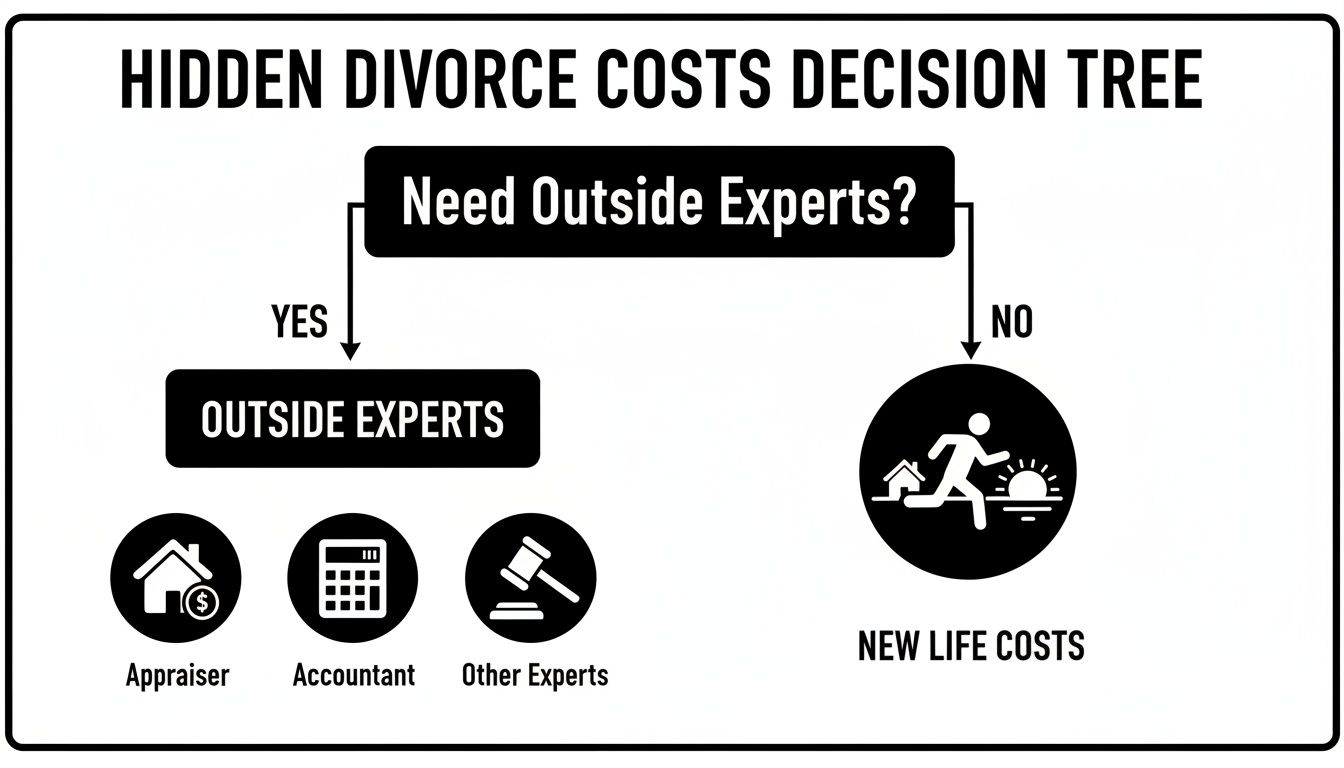
As you can see, needing outside experts—a common reality in more complex divorce paths—can add another significant layer to your total costs.
The Collaborative Divorce: A Team-Based Approach To Settlement
Collaborative divorce is another highly effective alternative to court. In this structured process, you, your spouse, and your respective attorneys all sign an agreement pledging to work together to reach a settlement without going to court. You might also bring in other neutral professionals, like a financial expert or a mental health professional, to round out the settlement team.
This method is built on transparency and good-faith negotiation. It’s often more expensive than mediation but remains significantly cheaper than taking your fight to a judge. The real benefit is the supportive, team-based environment that is laser-focused on finding creative, respectful solutions. We can help you understand the key differences between collaborative divorce vs. mediation to see which might be the better fit for your situation.
Traditional Litigation: The Most Expensive Path
When every other attempt at resolution fails, litigation is the only option left. This is the traditional court-based process where each side presents their case to a judge, who then makes all the final decisions. It is, without question, the most expensive, time-consuming, and emotionally draining path you can take.
The numbers don't lie. Across the U.S., the average divorce costs between $11,300 and $20,000, an average heavily skewed by high-conflict cases. A contested case involving alimony can easily hit $15,900, while a simple no-contest case averages closer to $4,100. This shows exactly how conflict directly fuels higher legal bills.
Litigation costs escalate quickly. The process requires extensive work, including formal discovery, depositions, multiple court hearings, and trial preparation. It should always be considered the last resort, reserved only for those intense situations where no other path to resolution is possible.
Comparing Divorce Methods: Cost Vs. Control
To put it all in perspective, here’s how the four main paths stack up against each other. The more you work together, the more you save and the more say you have in the final outcome.
- Uncontested Divorce: This is the lowest cost option, typically from $1,500 – $5,000, and has the shortest timeline of 2-4 months. It offers the highest level of personal control and privacy.
- Mediation: This has a low to moderate cost, usually between $5,000 – $9,000, with a timeline of 4-8 months. It also provides a high degree of control and privacy.
- Collaborative Divorce: This is a moderate cost approach, often ranging from $9,000 – $25,000+, and can take 6-12 months. Like mediation, it keeps control and privacy high.
- Litigation: This is the highest cost path, frequently $15,000 – $50,000 or more, and has the longest timeline of 12-24+ months. It results in the lowest personal control as decisions are made by a judge, and the proceedings are a matter of public record.
As you can see, avoiding the courtroom not only saves you a significant amount of money but also keeps your personal affairs private and leaves the final decisions in your hands, not a judge's.
At Foley Family Law, we're dedicated to finding the most efficient and cost-effective path for every client. We tailor our strategy to your unique circumstances, always aiming to protect your financial future by avoiding unnecessary conflict and expense in Pasco, Pinellas, and Hillsborough Counties.
Planning For Your Financial Future After The Divorce
The judge’s signature on the final divorce decree isn’t the end of the story—in many ways, it’s just the beginning of a new one. While the immediate costs of divorce feel like the biggest hurdle, it’s the long-term economic shifts that will truly shape your new life for years to come. Shifting your focus from the expenses of the moment to a strategic plan for the future is the most critical step you can take toward building a stable, secure new beginning.
Think of your divorce settlement less as an ending and more as the blueprint for your financial independence. It demands a clear-eyed look at how your income, expenses, and assets will function within a completely new framework.
Navigating Florida's Equitable Distribution
Florida is an equitable distribution state. This means marital assets and debts are divided fairly—but “fairly” doesn’t always mean a perfect 50/50 split. The way this principle gets applied to your unique situation will have a ripple effect on your financial health for years, especially when you're dealing with complex assets that hold long-term value.
We work tirelessly for our clients across Pasco, Pinellas, and Hillsborough Counties to make sure this division is truly fair, especially with major assets like:
- The Family Home: Do you sell it, or does one spouse buy out the other? This decision involves appraisals, mortgage refinancing, and a whole lot of careful financial planning.
- Retirement Accounts: You can’t just split a 401(k) or IRA down the middle. Dividing these accounts properly requires specific legal orders to sidestep massive tax penalties.
- Pensions: Dividing pension plans is a uniquely complex process governed by its own set of rules that have to be followed to the letter.
The Ongoing Reality Of Support Obligations
Beyond the one-time division of property, ongoing financial commitments like alimony and child support often become a permanent fixture in your new monthly budget. These aren't just numbers on a spreadsheet; they represent a long-term financial reality for both the person paying and the person receiving.
For the paying spouse, it’s a recurring expense that has to be factored into every financial decision. For the receiving spouse, it's often essential income needed to maintain stability for themselves and the kids. Getting these numbers wrong or failing to plan for them can lead to years of financial strain on both sides.
Adjusting To A New Economic Reality
For many people, the most jarring change is the sudden shift from a two-income household to a single one. The financial impact can hit hard. While the average U.S. divorce costs around $15,000, the real sting comes later. Research shows that many parents with children face significant financial hardship after the divorce is finalized. You can find more insights on these divorce statistics and facts on wf-lawyers.com.
Planning for this new reality isn't about being pessimistic; it's about being empowered. Acknowledging that your budget will be tighter lets you make proactive, smart financial decisions from day one of your new life, setting you up for success instead of surprise.
As you map out your post-divorce finances, it's also vital to understand the tax implications of major life changes like divorce. This is an area many people overlook, but it can have a huge impact on your bottom line. We serve a diverse community, including gay and transgender individuals, and handle all LGBTQ+ family and divorce issues with the sensitivity and expertise they deserve. We proudly serve our clients in Pasco, Pinellas, and Hillsborough Counties.
Practical Strategies To Reduce Your Divorce Costs

While the previous sections laid out all the factors that can drive up the cost of divorce, this is where you start to regain some control. You have more power over that final bill than you might realize. By being proactive, organized, and strategic, you can actively shrink your legal expenses and protect your financial future.
Many of the biggest cost drivers in a divorce aren't legal issues at all—they're emotional reactions, disorganization, and unnecessary conflict. Simply making a conscious decision to manage these things can save you a surprising amount in billable hours. Think of us as your partners in finding the most cost-effective resolution possible for your case in Pasco, Pinellas, or Hillsborough Counties.
Get Organized Before You Act
One of the single most effective ways to lower your attorney’s fees is to do your homework upfront. Your lawyer will eventually need a complete picture of your marital finances. The more time they have to spend chasing down bank statements, tracking down property deeds, or untangling financial records, the more it costs you.
Start by gathering and organizing these key documents:
- Financial Statements: Pull at least one year’s worth of statements for every bank account, credit card, and investment portfolio.
- Tax Returns: Have the last three to five years of your joint tax returns ready to go.
- Property Documents: Collect the deeds for any real estate you own, titles for vehicles, and recent mortgage statements.
- Debt Information: Make a comprehensive list of all outstanding loans, from car and student loans to personal loans.
When you walk in with this information clearly organized, it lets your attorney get straight to work on strategy instead of billing you for administrative legwork.
Prioritize Productive Communication
Conflict is the single biggest expense in any divorce. Period. Every angry phone call, hostile email, or drawn-out argument over minor personal items translates directly into billable hours. While some disagreements are inevitable, making a real effort to communicate productively can lead to massive savings.
Choosing your battles is a critical cost-saving strategy. Fighting over a $200 piece of furniture can easily cost you $1,000 in legal fees. You have to ask yourself: is it truly worth it? Focusing on the big-ticket items—the house, retirement, custody—and letting go of the small stuff will keep your overall costs from spiraling.
If direct communication with your spouse is just too difficult, seriously consider Alternative Dispute Resolution (ADR) methods like mediation. A good mediator can facilitate a constructive conversation, helping you find common ground and avoid the courtroom altogether. This is almost always a more affordable path than litigation. For those considering this route, you can explore our insights on how to divorce without a lawyer to better understand all the options available to you.
Use Your Attorney Wisely
Your attorney is your most valuable strategic advisor—so use their time for what truly matters. Save routine questions for a paralegal if you can, as their hourly rate is significantly lower. Try to consolidate your non-urgent questions into a single, organized email instead of sending multiple messages throughout the day.
Being a good partner to your legal team helps control the cost of divorce. Be responsive, provide requested documents promptly, and be honest about your goals and priorities from the very start. This kind of efficiency allows us to focus our energy on securing the best possible outcome for you in Pasco, Pinellas, and Hillsborough Counties, protecting both your rights and your wallet.
Got Questions About Divorce Costs? We’ve Got Answers.
When you’re thinking about divorce, the financial side of things can feel like a maze. We get it. To help clear things up, here are some straight answers to the questions we hear most often from clients in Pasco, Pinellas, and Hillsborough Counties. Our goal is to give you the clarity you need to move forward.
Is It Really Cheaper to File for Divorce Myself?
Going it alone—or "pro se," as it's officially called—looks like a money-saver on the surface. But in our experience, it often ends up being a classic case of "penny wise, pound foolish."
Without an experienced guide, it's incredibly easy to make costly mistakes. You might undervalue a complex asset, completely overlook a pension plan, or get locked into a parenting plan that’s just not workable. Trying to fix those errors down the road can cost you far more in legal fees—not to mention stress—than it would have to get it right the first time.
Think of a good family law attorney as your safeguard. We make sure the paperwork is flawless, your rights are protected, and the final agreement is solid and enforceable. For any situation that involves kids or shared assets, professional guidance isn't a luxury; it's a critical investment in your future.
Who Pays for the Lawyers in a Florida Divorce?
The starting point in Florida is that each person pays for their own lawyer. Simple enough, right? But the law also recognizes that's not always fair, especially when there's a big gap in what each spouse earns.
If one person has the financial means and the other doesn't, a judge can order the higher-earning spouse to contribute to the other's legal fees. This isn't about punishment—it's about leveling the playing field so both people have a fair shot at quality legal representation. The decision comes down to one spouse’s proven financial need and the other’s ability to pay.
Does Cheating Affect Who Pays for the Divorce?
Florida is a “no-fault” divorce state. That means you don’t need to prove someone did something wrong, like having an affair, to end the marriage.
Because of this, cheating usually has zero impact on who pays for the attorneys or how assets get split. The court is focused on dividing marital property fairly, not on penalizing a spouse for their behavior.
The one big exception? When marital money was spent on the affair. If a spouse blew thousands of dollars on lavish gifts, secret trips, or rent for their affair partner, a judge might step in. They could adjust the asset division to pay back the other spouse for that wasted money. Even then, it typically doesn’t change who is responsible for the lawyer's bills.
Making sense of divorce costs requires a clear head and an experienced guide. The team at Foley Family Law is here to give you honest advice and strategic representation to protect your financial well-being.
If you’re facing a divorce in Hillsborough, Pinellas, or Pasco County, give us a call. Let's schedule a consultation and start building a plan for your future.
Learn more and schedule your consultation with Foley Family Law


