

Most Florida couples pay several thousand dollars total for private mediation, while court-connected programs under Florida Statute § 44.108 charge per person per session fees that vary based on household income. Those two numbers define the range you are working with. Where your case lands depends on how many issues you need to resolve and how prepared both parties arrive.
Quick-reference cost ranges:
- Court-connected mediation: per person per session fees are set by Florida Statute § 44.108: $60 per person per session if combined household income is under $50,000, $120 per person per session if combined income is between $50,000 and $100,000; indigent parties may not pay with court approval
- Private mediator hourly rate: varies widely, with many Florida mediators charging rates typical for urban areas
- Private mediation total (both parties combined): can range from $3,000–$6,000 for most couples, and $3,000–$8,000+ in complex cases
- Court filing fees: separate from mediation costs; vary by county
Budgeting rule of thumb by complexity:
- Low complexity (uncontested, no minor children, limited assets): expect $3,000–$6,000 total for private mediation (both parties combined)
- Medium complexity (children, marital home, retirement accounts): expect $3,000–$8,000 total
- High complexity (business interests, contested custody, high net worth): expect $8,000 or more, including ancillary experts
Mediation settles a large majority of Florida cases before trial, which means most people who budget carefully for mediation avoid the far steeper cost of litigation entirely.
How much does private mediation cost in Florida?
Private mediators in Florida use several billing models, and understanding which one applies to your case is the first step toward an accurate budget.
Common billing structures:
- Hourly billing: the most flexible model; you pay for actual time used, including prep calls, the session itself, and any follow-up. Rates vary widely among mediators.
- Per-session fees: a flat charge for a defined session block (often two to three hours), regardless of whether the full time is used. Prices vary based on the mediator.
- Half-day or full-day blocks: common for complex cases; prices differ depending on mediator and case complexity.
- Flat-fee packages: a fixed total covering a set number of sessions plus drafting the settlement agreement. These packages offer cost predictability but usually work best when the issues are well-defined upfront.
Drafting the marital settlement agreement is where billing surprises often appear. Some mediators include drafting in the session rate; others bill additional hours for paperwork or charge a separate drafting fee, often several hundred dollars. Always ask before you start whether drafting, phone calls between sessions, and administrative follow-up are included or billed separately.
Pro Tip: A flat-fee package makes sense when you and your spouse have already narrowed the contested issues to two or three items. If major questions are still unresolved, hourly billing is safer because you will not be penalized for the extra time the complexity requires. Confirm in writing exactly what the flat fee covers before signing any agreement.

What do court-sponsored mediation programs cost in Florida?
Florida’s court-connected mediation programs offer a lower-cost path for eligible couples with fees set by Florida Statute § 44.108 and collected by the clerk of court.
Statutory fee schedule for family cases:
- Lower-income combined households pay less per person per session
- Higher combined incomes pay a higher fee per person per session
- Indigent parties may be exempt from fees upon court approval
- Sessions are scheduled for a few hours; additional fees may apply if sessions exceed that time
Under the Florida Supreme Court’s standards of operation, court programs typically schedule one session per case initially unless both parties agree otherwise. That means a couple with combined income under $50,000 could complete mediation for as little as $120 total (both parties combined for one session). That is a fraction of private mediation costs.
Key statutory rule: Fees are owed once mediation is scheduled and noticed, whether or not both parties appear. If one party fails to show, the appearing party pays their assessed fee, and the absent party is assessed for the missed session. If the court orders a second session, the no-show party may be assessed both parties’ fees for that rescheduled session.
Eligibility for court programs generally requires a court referral, which happens automatically in many contested family cases under Florida Family Law Rules of Procedure Rule 12.740. However, court programs have practical limitations. Session scheduling can take weeks, the mediator is assigned rather than chosen, and the scope of services is narrower than what a private mediator typically provides. For cases involving a business valuation, significant real estate, or complex retirement accounts, most attorneys recommend private mediation for the added flexibility and depth it allows.
What factors drive mediation costs up or down?
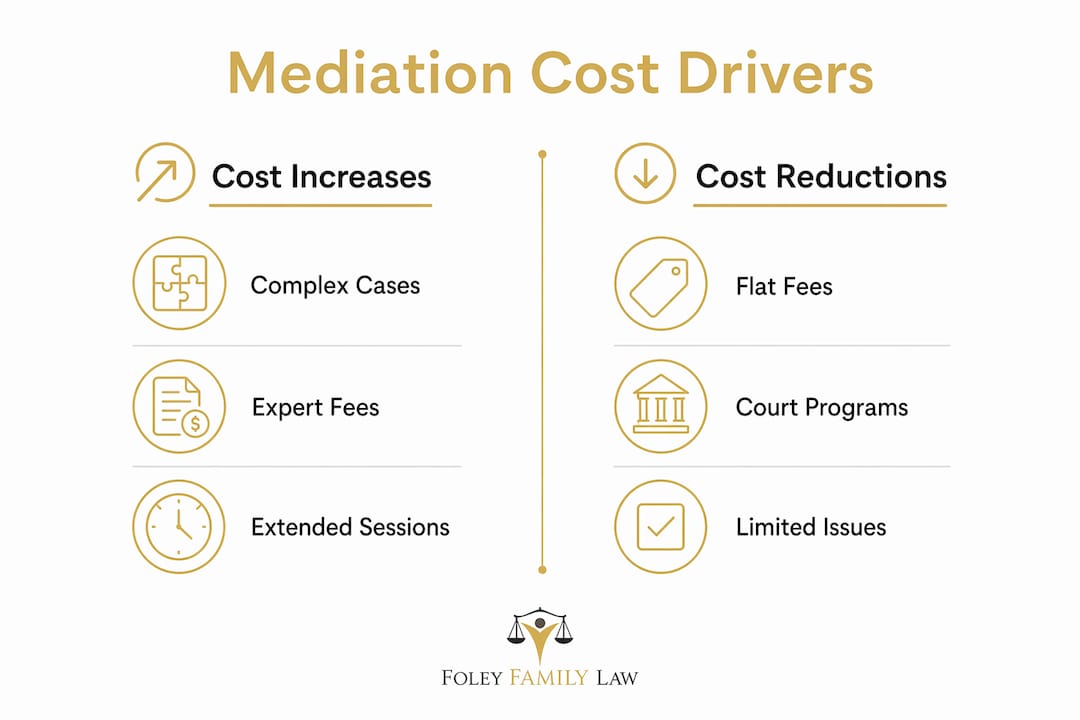
The single biggest driver of total mediation cost is hours. More hours mean more money, regardless of the hourly rate. Here is what adds hours to a case:
- Number of contested issues. Each unresolved issue (property division, alimony, time-sharing, child support) requires discussion time. A couple with one contested item may finish in two hours; a couple with five may need multiple sessions.
- Financial complexity. Business ownership, stock options, deferred compensation, and multiple real estate holdings each require documentation, review, and often third-party valuation. A forensic accountant or business appraiser adds both their own fees and mediator time to discuss their findings.
- Parenting and time-sharing disputes. Contested parenting plans are among the most time-intensive issues in Florida family mediation. Parenting coordinators or custody evaluators may be needed, adding both their fees and additional mediation hours.
- Party behavior and conflict level. High-conflict dynamics, frequent interruptions, or one party arriving unprepared can double the time required. Poor preparation is a particularly fast way to burn billable hours.
- Discovery needs. If financial records are incomplete or disputed, mediation may pause while documents are gathered. That delay costs money in rescheduling and additional attorney time.
- Mediator experience and geographic market. A highly credentialed mediator in a major metro market charges more per hour, but often resolves issues faster. The net cost difference is sometimes smaller than the rate difference suggests.
- Attorney involvement. Attorneys attending sessions in person add their own hourly fees on top of the mediator’s rate. Some parties use attorneys only for document review, which is less expensive.
For high net worth divorces, the combination of business valuation, pension division, and contested real estate can push total mediation-related costs well above the typical range even before ancillary experts are counted.
What other costs should you budget beyond the mediator’s fee?
The mediator’s invoice is only part of the picture. A realistic mediation budget includes several ancillary costs that can add hundreds or thousands of dollars depending on case complexity.
- Court filing fees: required to finalize a Florida divorce; vary by county and are separate from any mediation fee
- Attorney document review: even in uncontested cases, having an attorney review the marital settlement agreement before you sign is low-cost protection; flat-fee reviews often run $300–$800
- Forensic accountant: needed when business income, hidden assets, or complex tax issues are present; fees commonly run several thousand dollars
- Real estate appraisal: required when the marital home or investment property is being divided; typically $300–$600 per property
- Pension and QDRO preparation: a Qualified Domestic Relations Order is required to divide most retirement accounts; QDRO drafting fees often run $500–$1,500 depending on plan complexity
- Parenting coordinator or custody evaluator: used in high-conflict parenting disputes; fees vary widely but can reach several thousand dollars for a full evaluation
- Notary and document processing fees: minor but real; budget $50–$150 for notarization and certified copies
For cases involving financial complexity in mediation, the ancillary expert costs can rival or exceed the mediator’s own fees. Budget for them as line items, not afterthoughts.
Who pays for mediation, and how does billing work?
The default in Florida is an equal split: each party pays half the mediator’s fees. That norm holds for both private and court-connected mediation in most cases.
How billing is typically handled:
- Retainer or advance payment: private mediators usually require a retainer before the first session; funds are drawn down as hours are billed, with a refund or additional invoice at the end
- Session-by-session invoices: some mediators bill after each session rather than requiring a large upfront retainer
- No-show fees: once a session is scheduled, fees are generally owed whether or not both parties appear; under Florida’s court program rules, the absent party can be assessed the full cost of a rescheduled session
- Court-ordered reallocation: judges have discretion to order one spouse to pay a larger share or all mediation costs when there is a significant income disparity or when one party acts in bad faith
Who pays? In most cases, both parties split the cost equally. If your income is significantly lower than your spouse’s, or if your spouse refuses to participate in good faith, you can ask the court to reallocate costs. Check your county’s court mediation program page for local procedures, as some circuits have specific rules about fee collection and reallocation requests.
Mediation vs. litigation: how do the costs compare?
The cost difference between mediation and litigation is substantial. The table below shows typical ranges for both paths across simple and complex Florida divorces.
| Mediation | Litigation (to trial) | |
|---|---|---|
| Session length / rate | 2–8 hours total; $150–$500/hr mediator | Ongoing; attorney rates vary widely |
| Simple case total | $3,000–$6,000 (both parties) | $6,000–$12,000+ (both parties) |
| Complex case total | $3,000–$8,000+ (both parties) | — |
| What the fee covers | Sessions, drafting, follow-up | Discovery, motions, hearings, trial prep |
| Attorney involvement | Optional (review only) | Required throughout |
| Payment structure | Retainer or per-session | Ongoing retainer, hourly billing |
Key non-financial trade-offs:
- Mediation is private; court proceedings are public record
- Mediation gives both parties control over the outcome; a judge decides in litigation
- Mediation typically resolves in weeks to a few months; litigation can take one to three years
- Mediation agreements tend to have higher compliance rates because both parties shaped the terms
The 70%–80% settlement rate in Florida mediation reflects something real: most couples, even in contested cases, find it cheaper and faster to negotiate than to litigate. The key benefits of mediation extend beyond cost savings to include reduced stress and greater flexibility in crafting parenting and financial arrangements.
How can you lower your mediation costs?
Preparation is the most powerful cost-reduction tool available to you. Hours saved in the session room translate directly into dollars saved on the invoice.
Practical cost-reduction checklist:
- Gather financial documents before the first session: bank statements, tax returns, retirement account statements, mortgage documents, and business records. Missing documents force adjournments and add hours.
- Use remote sessions when possible. Online mediation eliminates travel time and often allows shorter, more focused sessions. Many Florida mediators offer video-conference options at the same rate.
- Narrow the issues in advance. Agree with your spouse on the items you already agree on before mediation begins. Every issue resolved before the session is one less hour billed.
- Limit attorney attendance to document review. Having your attorney attend every session is expensive. A more cost-effective approach is to use limited-scope counsel: the attorney reviews the draft agreement and advises you, but does not attend the session itself.
- Choose a flat-fee package for simple cases. When the issues are clear and limited, a package deal prevents billing surprises.
- Avoid introducing new issues mid-session. Surprise topics introduced during mediation derail progress and add billable time. Bring your full list of concerns to the first session.
Pro Tip: Ask your mediator upfront for a written scope of services that specifies what is included in the rate, how drafting is billed, and what happens if a second session is needed. That one conversation can prevent the most common billing disputes.
For a broader preparation checklist, preparing financially for divorce covers the documents and steps that help limit both mediation and attorney costs.
How long does mediation take, and what does that mean for your budget?
Session count is the variable that most directly converts into a dollar figure. Here is how timelines typically break down in Florida:
- Simple uncontested cases: one session of two to three hours; total mediator time including drafting often runs four to six hours
- Moderate cases (children, one property, retirement accounts): two to three sessions of two to three hours each; total mediator time often eight to twelve hours
- Complex cases (business, contested custody, multiple assets): three to five sessions or more; total time can exceed fifteen to twenty hours before drafting is complete
Example calculation for a moderate case:
Two sessions at three hours each (six hours) plus two hours of drafting at $300/hour = eight hours × $300 = $2,400 per party, or $4,800 combined. Add a flat-fee attorney review at $500 per party and you reach $5,800 total for both parties. That sits squarely in the typical $3,000–$6,000 range.
Scheduling delays add cost in a less obvious way. When sessions are spread out over months, parties often need to re-review documents and re-brief the mediator, which adds time. Scheduling sessions close together, when both parties are prepared, keeps the process moving and the total hours down.
Red flags that cause mediation costs to spike
Some situations predictably multiply mediator hours and ancillary bills. Knowing them in advance lets you either avoid them or budget for them.
Warning: The most expensive mediation sessions are the ones where one party arrives without documents, introduces a new financial claim mid-session, or refuses to engage in good faith. Each of those situations can add two to four billable hours in a single day and may require a full additional session.
Common cost spikes and how to limit them:
- Hidden assets or undisclosed income: triggers forensic accounting, which adds thousands in expert fees and extends mediation. Immediate step: request full financial disclosure early and flag discrepancies to your attorney before mediation begins.
- Business valuation disputes: a contested business value requires a formal appraisal and often a second opinion. Immediate step: agree on a joint appraiser before mediation to avoid dueling valuations.
- Frequent no-shows or last-minute cancellations: under Florida’s court program rules, the absent party may be assessed both parties’ fees for a rescheduled session. Immediate step: confirm attendance 48 hours before each session.
- Escalating hostility between parties: high-conflict dynamics slow every discussion and may require the mediator to conduct separate caucuses, doubling session time. Immediate step: agree with your attorney on communication ground rules before the first session.
- Unresolved discovery fights: if one party is withholding financial records, mediation stalls. Immediate step: complete document exchange before scheduling the first session.
Sample budgets for low-, medium-, and high-complexity divorces
The three budgets below use sourced rate ranges and typical session counts. Adjust the mediator hourly rate to match your local market.
| Line Item | Low Complexity | Medium Complexity | High Complexity |
|---|---|---|---|
| Mediator sessions | $900 (3 hrs × $300/hr) | $2,400 (8 hrs × $300/hr) | $6,000 (20 hrs × $300/hr) |
| Drafting / follow-up | Included | $600 (2 hrs) | $600 (2 hrs) |
| Attorney review (per party) | — | $600 | — |
| Real estate appraisal | — | $500 | — |
| Forensic accountant | — | — | $3,500 |
| QDRO preparation | — | — | $1,500 |
Assumptions and adjustments:
- All mediator hours above are billed at $300/hour per party; if your mediator charges $200/hour, reduce the mediator line proportionally
- Attorney review costs assume limited-scope counsel, not full representation
- Ancillary expert costs for forensic accountants and appraisers reflect typical practitioner-cited ranges and will vary by provider
- Court filing fees vary by county; confirm the current amount with your local clerk of court
Low-complexity cases often qualify for court-connected mediation, which reduces mediator fees substantially under the statutory fee schedule.
Key Takeaways
Florida divorce mediation typically costs $3,000–$6,000 combined for private mediation in most cases, or $3,000–$8,000+ if complex. Court-connected mediation costs only $60–$120 per person per session under the income-based fee schedule in Florida Statute § 44.108; indigent parties may pay nothing with court approval.
| Point | Details |
|---|---|
| Private mediation cost range | Most Florida couples pay $3,000–$6,000 combined; complex cases can cost $3,000–$8,000 or more. |
| Court program fees | Court-connected mediation costs $60 per person per session (combined income under $50,000), $120 per person per session (combined income $50,000–$100,000), and indigent parties may be exempt under Fla. Stat. § 44.108. |
| Biggest cost driver | Total hours, not hourly rate; poor preparation adds billable hours faster than a higher rate does. |
| Top cost-reduction action | Gather all financial documents before the first session and narrow contested issues in advance. |
| Foley Family Law | Foley Family Law helps clients in Hillsborough, Pinellas, and Pasco counties prepare for mediation and limit costs through strategic legal guidance. |
When is mediation the right financial choice?
Mediation is the right financial choice for most Florida divorces, and the numbers support that clearly. When both parties are willing to negotiate, mediation typically costs a fraction of what contested litigation runs, and it resolves cases in weeks rather than years. The 70%–80% settlement rate is not an accident; it reflects the reality that most couples, once they sit down with a neutral mediator, find more common ground than they expected.
That said, mediation is not the right path for every case. When one spouse is concealing assets, when there is a history of domestic violence or coercive control, or when one party refuses to engage honestly, mediation can become an expensive delay rather than a resolution. In those situations, litigation or a hybrid approach, such as collaborative divorce, may be more appropriate and ultimately less costly than prolonged failed mediation sessions.
The honest framing is this: mediation saves money when both parties come prepared and in good faith. When those conditions are absent, the cost advantage shrinks quickly. Knowing which category your case falls into before you schedule the first session is one of the most valuable things a family law attorney can help you determine.
Foley Family Law guides you through mediation with clarity and purpose
Mediation can save you significant money compared to litigation, but only when you go in prepared and with a clear strategy. Foley Family Law works with clients in Hillsborough, Pinellas, and Pasco counties to do exactly that: assess whether mediation is the right path, prepare the financial documentation that keeps sessions focused, and provide the legal guidance that prevents costly surprises.

Whether you are facing a straightforward uncontested divorce or a high-asset case with contested custody and business interests, the firm’s exclusive focus on family law means you get counsel built around your specific situation, not a generic checklist. Foley Family Law handles divorce, custody, paternity, high net worth cases, and the full range of family law matters that often intersect with mediation. Understanding what a family law attorney does in the mediation context, from reviewing settlement terms to advising on strategy, can make the difference between a cost-effective resolution and an expensive stalemate. Contact Foley Family Law to schedule a consultation and get a realistic picture of what your mediation will likely cost and how to keep it on track.
Useful sources and further reading
- Florida Statute § 44.108: the primary statutory authority for court-connected mediation fee schedules; use this to verify current income thresholds and per-session amounts
- Florida Supreme Court Standards of Operation: sets session length rules, fee collection procedures, and no-show cost allocation for all Florida trial courts
- Florida Courts ADR/Mediation Services: the official Florida Courts portal for alternative dispute resolution resources and circuit-level program information
- Florida 12th Judicial Circuit Family Mediation: example county program page showing local procedures, scheduling, and no-show fee rules; check your own circuit’s equivalent page for local specifics
- Private mediator rate and total cost ranges: sourced from practitioner guides covering Florida-specific data on hourly rates ($150–$500/hr) and typical combined totals ($3,000–$8,000)
- Foley Family Law: Foley Family Law’s family law mediation services page provides additional guidance on the firm’s approach to mediation preparation and representation in Hillsborough, Pinellas, and Pasco counties
This article provides general information about divorce mediation costs in Florida and is not legal advice. Fee rules, court procedures, and local practices change; confirm current figures with your county clerk’s office or a qualified Florida family law attorney before making financial decisions.
FAQ
Who pays the costs of mediation in Florida?
In most Florida cases, both parties split mediation fees equally. A judge can order a different allocation when there is a significant income disparity or one party acts in bad faith.
What are the downsides of mediation?
Mediation requires both parties to participate honestly; if one spouse conceals assets or refuses to negotiate in good faith, sessions can become costly without producing a resolution. It is also not appropriate in cases involving domestic violence or serious power imbalances.
What is a wife entitled to in a divorce in Florida?
Florida follows equitable distribution, meaning marital assets and debts are divided fairly, though not necessarily equally. Entitlements depend on factors including the length of the marriage, each spouse’s financial contributions, and any prenuptial agreement.
How long does divorce mediation take in Florida?
Simple cases often resolve in a single two-to-three-hour session; moderate cases typically require two to three sessions spread over several weeks. Complex cases with contested custody or significant assets can take three to five sessions or more.
Can I use court-sponsored mediation if my income is too high for the lowest fee tier?
Yes. Under Florida Statute § 44.108, parties with combined income between $50,000 and $100,000 pay $120 per person per session through the court program, which is still far below typical private mediation rates.


