

When a Florida judge issues an order for child support, alimony, or a parenting plan, it’s not a suggestion—it's the law. But what happens when the other party just… ignores it?
This is where a motion for contempt of court in family law becomes your most powerful tool.
The Court's Powerful Enforcement Tool
Think of a final judgment as the official rulebook for your family's new structure. Whether it lays out who pays what or exactly when timesharing occurs, everyone involved is legally required to follow it.
When someone deliberately breaks those rules, they aren't just disrespecting you; they are defying a direct command from a judge. This act of willful defiance is the very definition of contempt. It's the court’s way of stepping in to enforce its own authority and make sure the rules are followed.
Our firm is committed to helping everyone, including LGBTQ+ individuals and families in Pasco, Pinellas, and Hillsborough Counties, navigate these tough situations with clarity. We handle all family and divorce issues without discrimination.
Understanding Willful Violations
The word willful is everything in a contempt case. An honest mistake or a true inability to comply usually won't be considered contempt. There’s a big difference between the two.
For instance:
- A one-time, accidental late child support payment because of a bank error is not the same as a consistent pattern of refusing to pay.
- Getting stuck in traffic and being 15 minutes late for a child exchange is worlds away from repeatedly denying scheduled visitation.
To find someone in contempt, a Florida court needs to see clear proof that the person knew about the order, had the ability to follow it, and intentionally chose not to. This distinction is at the heart of every contempt case we handle for families across Pasco, Pinellas, and Hillsborough Counties.
It’s no surprise that high-conflict cases are often the breeding ground for contempt filings. These numbers really highlight why contempt is such a critical tool for Tampa Bay families.
Of course, a law firm's work isn't just in the courtroom; it's also about making sure clients can find the help they need through effective family law marketing strategies. Sometimes, a party's refusal to follow an order can create immediate risks, which might require learning how to file for an emergency custody order in Florida.
Civil vs. Criminal Contempt: What You Need To Know
When a court order is ignored in a Florida family law case, "contempt of court" isn't a one-size-fits-all response. The court actually has two very different tools it can use, depending on what it wants to achieve: civil contempt and criminal contempt. For anyone in Pasco, Pinellas, or Hillsborough Counties dealing with an enforcement issue, knowing the difference is the first step toward a solution.
Let's use an analogy. Think of civil contempt as the tow truck that shows up when your car is illegally parked. The main goal isn't to punish you for parking there; it's to fix the immediate problem by getting your car out of the no-parking zone.
Criminal contempt, on the other hand, is the parking ticket itself. It’s a punishment for the act of breaking the rule, plain and simple.

The Goal Of Civil Contempt Is To Compel Action
Civil contempt is the workhorse of family law enforcement. Its purpose is coercive, which is a legal way of saying it’s designed to force someone to follow an existing court order. The key thing to remember is that the person found in contempt literally holds the keys to their own freedom.
For instance, if a judge finds a parent in civil contempt for not paying child support, they might order that parent to be incarcerated. This isn't a fixed jail sentence. The moment they pay the overdue support (known as the "purge" amount), they walk out the door.
The core idea behind civil contempt is forward-looking. The court isn't just punishing a past mistake; it's using penalties to secure future compliance with its orders, ensuring that support is paid or timesharing schedules are followed.
The Goal Of Criminal Contempt Is To Punish Disrespect
Criminal contempt is a completely different animal. It’s punitive and backward-looking, meant to punish someone for a past act that showed a willful disrespect for the court's authority. Unlike its civil counterpart, just following the original order won't automatically get you off the hook.
This type of contempt is reserved for actions that show a blatant disregard for the judicial process itself.
Here’s what sets criminal contempt apart:
- Punishment for a Past Act: The penalty, whether a fine or a fixed jail sentence, is for an offense that has already happened.
- No "Keys to the Jail Cell": The person can't simply comply with an order to undo the punishment.
- Higher Burden of Proof: Since the consequences are punitive, the legal standard to prove criminal contempt is much higher, much like in other criminal proceedings.
To help you see the differences more clearly, here’s a quick breakdown.
Civil Contempt vs Criminal Contempt at a Glance
Civil Contempt (To Coerce)
- Purpose: To compel future compliance with a court order.
- Focus: Forward-looking: "Do what the order says."
- Penalty: Conditional. Typically involves jail time until the person complies (e.g., pays the purge amount).
- "The Keys": The person in contempt holds the "keys to the jail cell" and can get out by complying.
- Common Use: Failure to pay child support/alimony, refusal to follow timesharing schedules.
Criminal Contempt (To Punish)
- Purpose: To punish a past act of disrespect to the court.
- Focus: Backward-looking: "You disrespected the court."
- Penalty: A fixed sentence (jail time) or a fine.
- "The Keys": There are no "keys." The sentence is fixed and must be served.
- Common Use: Disrupting court, violating an injunction in a flagrant way, perjury.
Understanding which type of action fits your situation is a critical first step. It dictates the entire legal strategy, from the evidence you need to gather to the potential outcomes of your case.
Common Reasons To File For Contempt In Florida Family Law
In the daily lives of families across Hillsborough, Pinellas, and Pasco Counties, a court order is supposed to be the final word on critical issues. But when that word is ignored, it doesn't just create conflict—it creates instability. A contempt of court action in family law is what happens when those real-world violations turn a personal dispute into a serious legal matter.
While every family's situation is different, most contempt motions boil down to a few common areas of non-compliance. These aren't minor disagreements. We're talking about a willful refusal to follow a judge's direct and unambiguous command.
This flow chart shows the three main categories where contempt issues pop up most often.
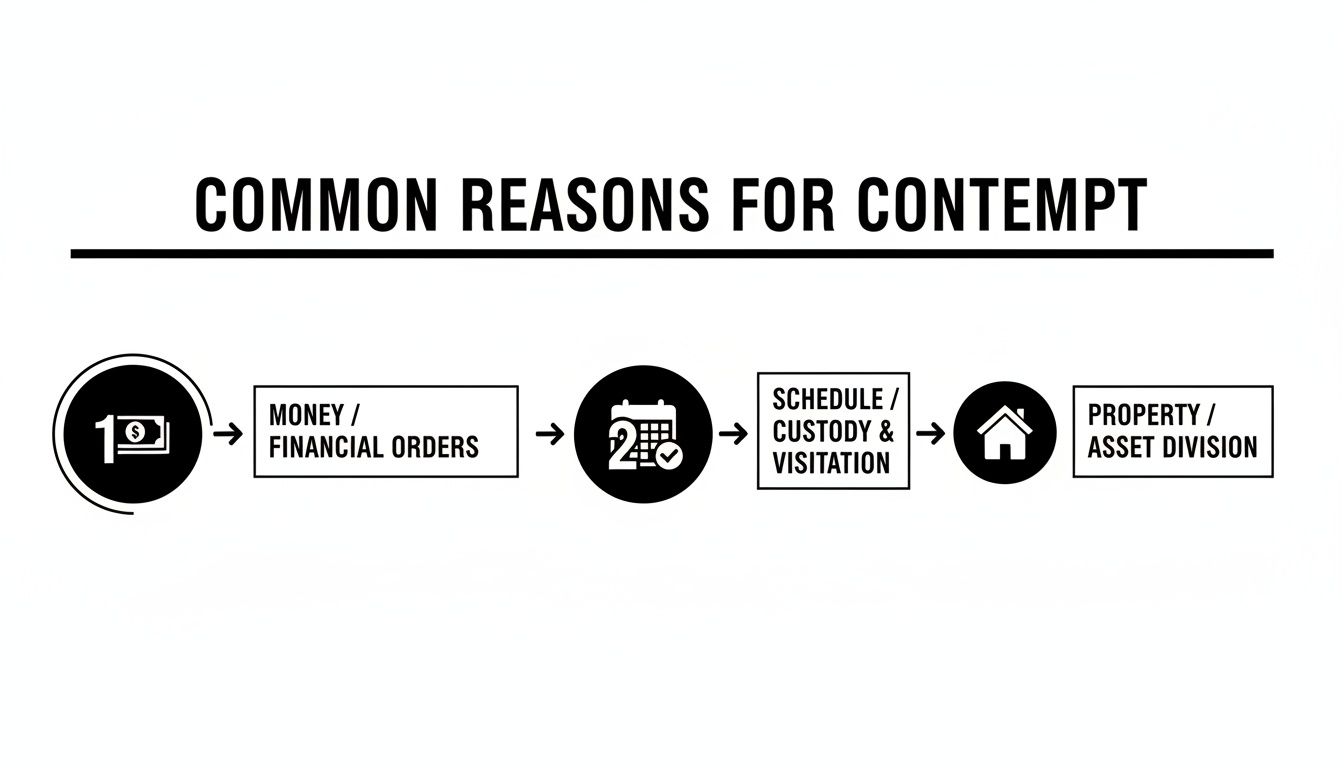
As you can see, fights over money, parenting schedules, and property are what usually drive someone to file for contempt in Florida.
Failure To Pay Support
This is probably the most frequent reason for filing a contempt motion: the failure to pay court-ordered child support or alimony. These payments are not optional suggestions. They are legally mandated obligations designed to provide for a child's basic needs or help a former spouse stay financially stable.
When someone who has the ability to pay simply decides not to, the consequences for the family on the receiving end can be immediate and severe. It's a direct violation that courts take very seriously.
Sure, a sudden job loss can be a legitimate defense, but the right way to handle that is to formally ask the court for a change—not to just stop paying. You can learn more about how to modify child support here.
Violating The Parenting Plan
Think of a parenting plan and its timesharing schedule as a detailed roadmap for co-parenting. When one parent constantly interferes with the other's court-ordered time with the kids, it can be grounds for contempt.
Common examples we see all the time in Pasco, Pinellas, and Hillsborough Counties include:
- Repeatedly denying scheduled visitation for no good reason.
- Refusing to allow phone calls or other communication between the child and the other parent.
- Making one-sided decisions about the child's school or healthcare, going against what the parenting plan says.
- Failing to bring the child back at the designated time and place.
These actions don't just violate a court order; they disrupt a child's stability and damage their relationship with the other parent.
Ignoring Property Division Orders
A final divorce judgment clearly spells out how marital assets and debts are supposed to be divided. Ignoring these financial directives is another well-trodden path to a contempt finding.
This could mean a party refusing to sign over a car title, failing to refinance and get a spouse's name off a mortgage, or not handing over a specific share of a retirement account. These aren't just money squabbles; they are violations of a court's binding financial ruling.
Navigating The Contempt Of Court Process
Filing a motion for contempt—or finding yourself on the receiving end of one—is a serious and often stressful experience. The process isn’t as simple as just telling a judge what happened; it involves a series of precise legal steps that have to be followed to the letter. Whether your case is in Pasco, Pinellas, or Hillsborough County, understanding this procedure is the first move in protecting your rights.
The whole thing kicks off when one person, known as the “moving party,” files a formal, sworn document with the court. This isn't just a simple complaint letter. It’s a detailed motion that must clearly lay out what the original court order required and exactly how the other person willfully ignored it.
Initiating A Contempt Action
If you're the one filing the motion, the burden of proof is squarely on your shoulders. You have to meticulously follow the proper procedure to even get the case off the ground.
The key steps include:
- Drafting a Sworn Motion for Contempt: This document has to be signed under oath. It must spell out the specific part of the court order that was violated, when the violation occurred, and how the other party had the ability to follow the order but intentionally chose not to.
- Filing with the Clerk of Court: The motion must be filed in the very same court that issued the original family law order.
- Properly Serving the Other Party: You can't just send the motion in an email or a text. The other party has to be formally served with the paperwork, which gives them official notice of the allegations and the date of the upcoming hearing.
Failure to follow these steps can get your case thrown out before it even starts. The court is strict about this to protect the other party’s due process rights, which is why having an experienced legal guide is so crucial.
Responding To A Contempt Motion
If you've been served with a motion for contempt, the single worst thing you can do is ignore it. If you don't show up for the hearing, the judge can issue a writ of bodily attachment—which is essentially a civil arrest warrant.
Instead of sticking your head in the sand, you need to prepare a defense for the hearing. This means gathering any and all evidence that supports your side of the story. For example, if you're accused of not paying support, you might bring bank statements or proof of an unexpected job loss to show you simply didn't have the ability to pay.
Keeping meticulous records is critical. When navigating the complexities of a contempt of court process, accurate record-keeping of proceedings and depositions is crucial, often supported by specialized and highly accurate offerings from various providers of legal transcription services.
Contempt proceedings, especially those involving parenting plans, are serious legal battles. You can read more about these findings on court enforcement of child contact orders.
This tells us that courts see contempt motions as a last resort and demand solid proof of willful defiance. For anyone facing this situation, you can learn more about how a Tampa contempt lawyer can help prepare a strategic defense.
Potential Penalties and Court-Ordered Remedies
When a Florida judge finds someone in contempt of court, it’s not just a slap on the wrist. They have a wide array of tools to enforce the order, punish the defiance, and make things right for the person who was wronged. The consequences are serious, and the court will tailor the penalty to fit the specific violation, ensuring a just outcome for families in Pasco, Pinellas, and Hillsborough Counties.
The main goal, especially in civil contempt cases, is pretty simple: get the other person to follow the order. A judge’s first move is often to compel the non-compliant person to do what they were supposed to do in the first place.

Common Court-Ordered Remedies
What a judge orders depends entirely on the nature of the violation. The court has broad discretion to craft a solution that directly addresses the harm caused by the defiance.
Some of the most common remedies we see in Florida courts include:
- Payment of Arrears: If child support or alimony has gone unpaid, the judge will order the immediate payment of everything owed, often with statutory interest tacked on.
- Make-Up Timesharing: When one parent has been wrongfully denied their court-ordered time with a child, the judge can order a schedule of make-up visitation to compensate for that lost time.
- Performance of a Specific Act: If the contempt involves property, the court can order the person to sign over a car title, refinance a mortgage, or take whatever other step is needed to comply with the property division order.
A judge’s power isn't limited to just fixing the original problem. The court can also impose additional sanctions to underscore the seriousness of ignoring its orders and to compensate you for the trouble you had to go through.
Financial Sanctions and Other Penalties
Beyond forcing compliance, a judge can hit the party in contempt with significant financial penalties. These are designed to both punish the past behavior and make them think twice before doing it again.
These sanctions often involve:
- Attorney's Fees and Costs: This is a big one. The judge can—and very often will—order the non-compliant party to pay all of the attorney's fees and court costs you had to spend to bring the contempt motion. It's a powerful tool that makes the person who caused the problem bear its financial burden.
- Fines: The court has the authority to levy fines purely as a punishment for the contemptuous act.
- Incarceration: In civil contempt cases, a judge can order the person to be jailed until they comply. This is the ultimate tool to compel action. The person in contempt essentially holds the "keys to the jail cell"—they can secure their own release by finally doing what the court ordered.
Understanding the potential fallout from a contempt of court in family law matter is critical. You can learn more about our approach as a Tampa enforcement lawyer and see how we help clients stand up for their rights.
A Few Common Questions About Contempt Of Court
When you're dealing with a contempt of court action in family law, a lot of questions pop up. It’s a stressful situation, so to bring some clarity, we’ve put together answers to the most common questions we hear from clients across Pasco, Pinellas, and Hillsborough Counties. This is a quick guide to the practical side of things.
Our firm is committed to serving everyone in our community. That includes members of the LGBTQ+ community who might be facing divorce, custody battles, or name change proceedings. We bring the same dedication and professionalism to every single family law case and do not discriminate.
What Evidence Do I Need To Prove Contempt Of Court?
To convince a Florida judge that someone is in contempt, you can't just make an accusation. You have to prove three very specific things with clear evidence. First, that a court order exists and its instructions are crystal clear. Second, that the other person knew about the order and was perfectly capable of following it. And third, you have to prove they willfully decided not to.
The evidence you'll need really depends on what rule was broken:
- Money Violations: Bank statements, pay stubs that show they had the income, and a clear record of missed payments are your best friends here. They tell a powerful story.
- Timesharing Violations: A text message or email where they flat-out refuse your visitation is gold. Testimony from a neutral witness who saw what happened can also be incredibly effective.
Just showing they didn't comply isn't enough. The real key is proving it was a deliberate choice, not some unavoidable accident or because it was impossible for them to do it.
Can I Be Held In Contempt If I Genuinely Cannot Afford To Pay?
A genuine, proven inability to pay is a legitimate defense against a contempt charge. Life throws curveballs, and Florida courts get that. Unexpected events can make it truly impossible to meet a financial obligation. If you lost your job without warning, had a serious medical crisis, or faced another financial emergency completely out of your control, you have to present that evidence to the judge.
But here’s the critical part: choosing to pay other bills before your court-ordered support is not a valid defense. The court expects its orders to be your number one financial priority, period. If you’re facing a long-term change in your finances, the right move isn’t to just stop paying. You need to formally file a Petition for Modification with the court to get your obligation legally adjusted.
How Can A Family Law Attorney Help Me?
Going into a contempt action without a lawyer is a huge risk. The rules for evidence and court procedure are complex and unforgiving. Whether you're filing the motion or defending yourself against one, an experienced family law attorney is your best protection.
If you’re the one filing, we make sure the motion is drafted perfectly, filed correctly, and that your evidence is organized into a compelling story for the judge. If you’re on the receiving end, we’ll pinpoint every valid defense you have, like an inability to comply, and fight to shield you from unfair penalties. For anyone in Pasco, Pinellas, or Hillsborough County, having a pro in your corner is the surest way to protect your interests. It’s also good to know that not all court decisions are the last word; you can learn more about how to appeal a family court decision if you think a mistake was made.
How Long Does A Contempt Case Take In Florida?
The timeline for a contempt case can really vary. The two biggest factors are how busy the local court’s calendar is and how complicated your specific issue is. Generally, you can expect a hearing to be scheduled within a few weeks to a couple of months after the motion is properly filed and served.
A simple case—like a clear failure to pay support where the evidence is black and white—might get wrapped up in a single hearing. But if the case needs deep financial digging, subpoenas for bank records, or testimony from several witnesses, it's naturally going to take more time. An attorney can help push the process along and give you a realistic idea of what to expect in Pasco, Pinellas, or Hillsborough Counties.
When a court order gets ignored, you need a strong advocate to make things right. The team at Foley Family Law has the experience to walk you through the contempt process and fight for the result you and your family deserve. Contact us today to set up a consultation and build a plan.


