

When you're facing a divorce in Florida, the path you choose will set the tone for your family's future. It really boils down to this: a collaborative divorce brings in a dedicated team of professionals to guide you and your spouse, while mediation uses a single neutral facilitator to help you negotiate directly with each other. Both are powerful, private alternatives designed to keep you out of the courtroom.
Understanding Your Divorce Options In Florida
Deciding to end a marriage is one of life's most challenging transitions. For most people, the thought of a public, drawn-out courtroom battle just adds another layer of stress to an already difficult time.
Fortunately, Florida law provides better options. Two of the most effective alternatives, collaborative divorce and mediation, empower you to keep control over the outcome, protect your family’s privacy, and move forward with respect. These approaches are especially valuable for families here in Pasco, Pinellas, and Hillsborough Counties who want to resolve things with dignity.
At Foley Family Law, our goal is to help every family find the right path forward. That includes members of the LGBTQ community navigating a gay divorce or unique custody situations. We provide clear, practical guidance so you can make an informed choice that actually fits your life—whether you're a first responder, a military service member, or a business owner.
Hearing directly about the process can also be helpful. Reading insights from Alternative Dispute Resolution (ADR) experiences from others who have walked a similar path can offer some valuable perspective.

Key Differences At A Glance
Before we get into the weeds, a side-by-side look can make things clearer. Each method has a distinct feel based on who is in the room, how the process is structured, and the overall dynamic of the negotiations. This quick overview should help you start to see which approach might align better with your family's needs.
Collaborative Divorce
- Professional Support: Each spouse has their own collaboratively trained attorney, plus a team of neutral experts (financial, mental health).
- Attorney's Role: Attorneys act as advisors and advocates within the collaborative meetings, and they are bound by a no-court agreement.
- Process Structure: A series of structured team meetings with a formal agenda, designed to tackle issues systematically.
- Handling Disagreements: The team uses interest-based negotiation and creative problem-solving to work through tough spots. The structure is built for this.
- If No Agreement Is Reached: The process ends. Both spouses must hire new litigation attorneys if they decide to go to court. This creates a powerful incentive to settle.
Mediation
- Professional Support: A single, neutral mediator guides the conversation between both spouses.
- Attorney's Role: Attorneys typically advise their clients outside of the mediation sessions and review the final agreement. They may or may not attend the sessions themselves.
- Process Structure: Flexible sessions are scheduled as needed, driven by the conversation between the spouses and the mediator.
- Handling Disagreements: The mediator helps identify common ground and facilitates compromise but can't force a decision or provide legal advice.
- If No Agreement Is Reached: If talks break down, the parties can proceed to court with their existing attorneys. The stakes are lower if mediation fails.
The Collaborative Divorce Process: A Team-Based Approach
Think of collaborative divorce as a structured, team-based way to resolve your separation respectfully and privately, completely outside of a courtroom. It all starts with a foundational commitment. Both you and your spouse, along with your respective attorneys, agree in writing to settle everything without ever asking a judge to make decisions for you.
This "no-court" pledge is the heart of the collaborative model, and it's a game-changer. It creates a powerful incentive for everyone at the table to negotiate in good faith, communicate honestly, and find creative solutions that work for your family. If the process breaks down, the attorneys involved are disqualified from representing either of you in court. This means you'd have to start over with new lawyers, which motivates everyone to see it through. To get into the nuts and bolts of this critical document, you can learn more about what a collaborative divorce participation agreement entails.
Assembling Your Professional Team
The collaborative process isn’t just about dodging court battles; it’s about building a dedicated team to help you navigate every angle of your divorce—the legal, the financial, and the emotional. This structure provides comprehensive support tailored to what your family actually needs.
Your professional team is usually made up of:
- Two Collaboratively Trained Attorneys: You each have your own attorney, but they are specially trained in the collaborative method. Their job is to provide legal advice and advocate for you within the cooperative framework of the meetings, not to act like an aggressive courtroom opponent.
- A Neutral Financial Professional: This is an expert, typically a Certified Public Accountant (CPA) or a Certified Divorce Financial Analyst (CDFA), who works for both of you. They gather all the financial information, create budget projections, and help you explore fair options for dividing assets and debts with total transparency.
- A Neutral Facilitator or Divorce Coach: Often a licensed mental health professional, this expert helps manage the emotional side of the divorce. They improve communication between you and your spouse, teach effective co-parenting skills, and keep meetings productive and focused.
How The Process Unfolds
The collaborative process moves forward through a series of structured team meetings. In these private, confidential sessions, everyone works together to identify shared goals, collect the necessary information, and brainstorm potential solutions. The focus is always on meeting the needs of the entire family, especially the children. This model is particularly powerful for complex situations involving things like business valuations or sensitive parenting issues we often see with families in Pasco, Pinellas, and Hillsborough Counties.
The core philosophy here is to preserve family relationships and create durable, custom-fit agreements. By tackling the legal, financial, and emotional parts of divorce all at once, the collaborative process helps families build a healthier foundation for the future.
Recent data really highlights how well this works. A study of Florida cases found that collaborative divorce achieves a high full agreement rate, a success largely credited to its supportive team structure. The same study showed that many of these cases were wrapped up in six months or less—a world away from the drawn-out timelines of court battles. For our clients here in Tampa Bay, this means a more efficient and emotionally healthier path to a fresh start.
How Divorce Mediation Works With a Neutral Facilitator
While collaborative divorce brings a whole team to the table, mediation is a more direct, streamlined negotiation process. It all revolves around one person: a single, impartial professional.
In Florida, divorce mediation is built around a neutral third-party—the mediator. Their entire job is to help you and your spouse have a productive conversation and find a way forward.
It's critical to understand what a mediator is not. They are not a judge, and they can’t give legal advice to either of you. Their role is strictly to manage the dialogue, help you both find common ground, and keep the negotiations on track.
The Mediation Session Unpacked
The process usually involves one or more sessions where you and your spouse sit down to talk through the core issues of your divorce. These aren't free-for-all arguments; the mediator guides the conversation to cover everything from property division and alimony to creating a parenting plan that actually works for your kids.
A good mediator makes sure both of you get to speak and be heard, stopping discussions from spiraling into old arguments. They have specific techniques to reframe problems, explore creative compromises, and help you arrive at your own solutions. This structure is what makes mediation such an effective and cost-efficient option for many couples in Pasco, Pinellas, and Hillsborough counties who can still communicate reasonably well.
Mediation puts the decision-making power squarely in your hands. Instead of a judge dictating the terms of your future, you and your spouse work together to craft an agreement that you both can live with.
The Role Of Attorneys In Mediation
Even with a mediator running the show, having your own independent attorney isn't just a good idea—it’s essential. While your attorneys might not attend every mediation session, their role behind the scenes is vital.
Here’s what your attorney does:
- Advises You Beforehand: We prepare you for what's coming, helping you nail down your goals and your non-negotiables before you even walk into the room.
- Protects Your Rights: We make sure you understand the real-world legal consequences of any proposed deal and that your rights under Florida law are fully protected.
- Reviews the Final Agreement: Before you sign anything, we meticulously review the final Marital Settlement Agreement to ensure it's fair, complete, and legally sound.
This separate legal counsel ensures you're making fully informed decisions at every turn.
Ultimately, mediation is an excellent path for couples who are motivated to settle things on their own terms. It offers a private, less formal, and often faster way to get divorced, giving you control over the outcome. The whole process is designed to foster cooperation and find practical solutions that fit your family’s unique situation.
Comparing The Core Differences in Process and Structure
Figuring out the practical differences between collaborative divorce and mediation is the first step toward choosing the right path for your family. Both are designed to keep you out of the courtroom, but that's where the similarities often end. Their structures, the professionals involved, and the emotional safeguards they offer are fundamentally different.
Let's get straight to the point. The biggest difference is the professional support system built into each process.
In mediation, you and your spouse sit down with one neutral third party—the mediator. Their job is to guide the conversation and help you find common ground. They can't give legal advice or advocate for either side. Think of them as a skilled facilitator.
Collaborative divorce, on the other hand, is built around a dedicated team. Each of you has your own collaboratively-trained attorney in the room for every meeting. This means you get real-time legal advice and advocacy, but within a framework that's committed to cooperation. The team often includes neutral financial and mental health professionals to support the entire family through the process.
Professional Involvement and Roles
The team approach in the collaborative model is designed to be comprehensive. For a military family in Hillsborough County, a neutral financial professional can analyze complex assets like a military pension to ensure it's divided fairly. For an LGBTQ couple in Pinellas County navigating a parenting plan, a neutral facilitator can help create a sensitive and effective agreement. This structure brings in targeted expertise right when you need it.
Mediation is a more streamlined, self-directed process. The mediator's main role is to keep the conversation productive and identify where you can agree. While you absolutely should have your own attorney for legal advice, they usually work behind the scenes—prepping you for sessions and reviewing the final agreement—rather than sitting in on the negotiations themselves.
This infographic gives you a quick visual of how divorce mediation is structured.
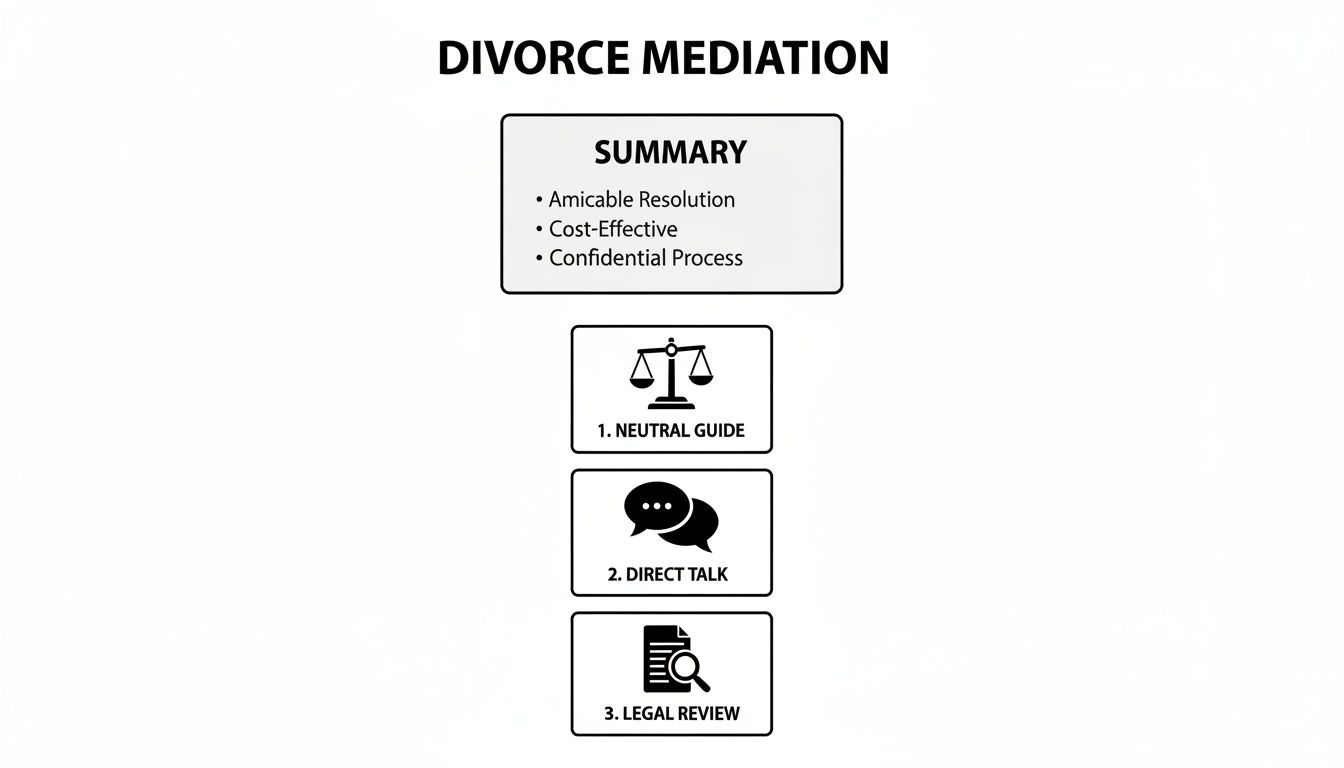
As you can see, the process hinges on direct communication between the two of you, with the mediator as a guide and a final legal review as a crucial last step.
At a Glance Comparing Collaborative Divorce and Mediation
Here is a summary of the key differences between collaborative divorce and mediation, helping you quickly understand the distinct features of each approach.
Professional Team
- Collaborative Divorce: Each spouse has their own attorney present at all meetings. A team of neutral experts (financial, mental health) supports both.
- Mediation: One neutral mediator facilitates discussions between spouses. Attorneys typically advise behind the scenes.
"No-Court" Agreement
- Collaborative Divorce: Yes. A formal pledge is signed. If the process fails, the attorneys must withdraw and cannot represent you in court.
- Mediation: No. If mediation fails, you can proceed to court with the same attorneys.
Legal Advice
- Collaborative Divorce: Provided in real-time by your attorney during all negotiation sessions.
- Mediation: The mediator cannot give legal advice. You must consult your own attorney outside of mediation sessions.
Cost Structure
- Collaborative Divorce: Higher upfront cost due to the team of professionals. Can be more cost-effective than litigation for complex cases.
- Mediation: Generally lower cost, as you are only paying for one neutral professional's time.
Best Suited For
- Collaborative Divorce: Complex financial situations, high-conflict couples needing structure, cases with power imbalances, or those wanting deep support.
- Mediation: Couples who can communicate reasonably well, have less complex finances, and want to drive the process themselves.
Ultimately, your choice depends on the level of support you need, the complexity of your situation, and your ability to communicate effectively with your spouse.
The Critical "No-Court" Pledge
Another defining feature of collaborative divorce is the formal commitment to staying out of court. The process kicks off when everyone involved—both spouses and their attorneys—signs a participation agreement, often called a "no-court" pledge.
This agreement states that if the process fails to produce a settlement, the attorneys for both spouses must withdraw and cannot represent their clients in any future court litigation. This creates a powerful shared investment in reaching a resolution.
Mediation doesn't have this requirement. If you and your spouse can't reach an agreement, you can walk away and head to court with the same lawyers who've been advising you. While mediation is often successful, the looming possibility of litigation can sometimes shift the dynamic in the room. For some couples, especially where conflict is high, understanding the option of being in separate rooms during mediation can be beneficial.
Cost Structure and Emotional Support
Cost is always a major consideration. Mediation is typically less expensive because you're splitting the cost of one neutral professional, and it can be faster for straightforward cases. Collaborative divorce has higher upfront costs because you're paying for a multidisciplinary team, but that investment can provide tremendous value in complex situations.
In Florida, many collaborative cases can be a significant investment. While that sounds like a lot, it's often a fraction of what a litigated divorce costs, especially for high-net-worth families in Tampa Bay who could otherwise face extensive legal bills. Exploring different powerful contract negotiation strategies can also help manage outcomes in either process. For complicated divorces in Pasco, Pinellas, and Hillsborough Counties, the holistic support of the collaborative process often justifies the cost by producing more durable, customized agreements.
Which Divorce Process Is Right for You?
Choosing between collaborative divorce and mediation isn't about finding the "better" option—it's about finding the right fit for your family. The best path for you depends on very real factors: the level of trust between you and your spouse, the complexity of your finances, and frankly, how well you two can communicate right now. These aren't just abstract legal concepts; they are the practical realities we navigate with our clients every day across Hillsborough, Pinellas, and Pasco Counties.
To make a choice you can feel good about, it helps to see how these processes play out in the real world. By looking at scenarios that might feel familiar, you can get a better sense of which structure will support you best.
When Collaborative Divorce Makes Sense
The collaborative model brings a full team to the table, providing a level of structure and support that is absolutely essential in certain situations. It’s often the most effective route when there are significant financial complexities or when communication has hit a wall.
Think about the collaborative process if your situation involves:
- High-Conflict Dynamics: If talking to your spouse feels impossible or always ends in a fight, the structured meetings and neutral facilitator are a game-changer. This professional keeps discussions on track and manages the emotional temperature, stopping old arguments from derailing progress.
- Complex Financial Portfolios: For a Tampa business owner or a high-net-worth couple with complicated investments, the neutral financial professional is invaluable. Their job is to make sure every asset—from stock options and business interests to deferred compensation—is valued correctly and transparently, which shuts down future disputes before they start.
- A Significant Power Imbalance: In marriages where one spouse handled all the money or made all the big decisions, the other can feel completely overwhelmed. The collaborative team, especially your own attorney and the neutral experts, is designed to level that playing field, ensuring both of you have an equal voice.
The collaborative process is designed to build a container of safety and expertise around your family. It provides the necessary guardrails for couples who need more than just a neutral referee to reach a fair and lasting agreement.
When Mediation Is The Ideal Choice
Mediation has a more direct and flexible feel, making it an excellent fit for couples who are already on the same page about wanting to separate amicably. It really shines when the foundation of respect and trust, while maybe strained, is still there.
Mediation is probably the right choice if you and your spouse:
- Can Communicate Effectively: If you can sit in a room together and talk through tough subjects without things blowing up, mediation is a great option. It empowers you to be in the driver's seat of the negotiations, with the mediator there to guide you, not direct you.
- Have Already Reached a General Understanding: Lots of couples come to us after they’ve already sketched out the big picture—who will stay in the house, a basic idea for a parenting schedule. Mediation is the perfect place to iron out the fine print and turn those informal agreements into a solid, legally binding document.
- Have Uncomplicated Finances: If your financial world is pretty straightforward—a house, some retirement accounts, and typical debts—you probably don’t need an entire financial team. Mediation provides a more streamlined and cost-effective path to dividing assets when there aren't complex valuations to worry about.
Ultimately, the decision comes down to an honest look at your unique situation. The right process is the one that creates the most supportive and natural environment for you to make these critical decisions. Of course, a huge part of that is learning how to choose a divorce attorney who is truly skilled in the specific process you're considering.
Finding Your Way to a Dignified Resolution
Divorce doesn't have to be a battle. The goal is always to find a resolution that lets you step into your future with stability, respect, and a sense of peace. Both collaborative divorce and mediation are powerful, private alternatives to a public court fight, putting you in control of the outcome. You have choices that prioritize dignity over destruction.
At Foley Family Law, we've walked alongside countless clients in Pasco, Pinellas, and Hillsborough Counties through these very processes. We know that no two families are the same. Whether you're working through a gay divorce, untangling complex business assets, or creating a sensitive parenting plan, our focus is on building a strategy that protects what matters most: your rights, your finances, and your family’s future. We are proud to serve everyone in our community, including our dedicated first responders and military families, with the tailored support they deserve.
Taking the First Step
The path to a healthy post-divorce life starts with understanding your options. The question isn't whether collaborative divorce or mediation is "better." It's about which one is the right fit for you. One process gives you a dedicated team for complex situations; the other offers a direct path for couples who can still communicate effectively.
Our job is to give you the legal clarity you need to make that decision with confidence. We’re here to help you understand the pros and cons, step by step, with honest communication and unwavering support.
Choosing a path like mediation or collaborative divorce is an investment in a healthier post-divorce future. It sets a tone of cooperation and respect that can benefit your family for years to come, especially when children are involved.
We invite you to schedule a consultation to talk through your specific situation. Think of it as a strategy session—an opportunity to see which approach truly aligns with your goals and how we can help you build a positive new beginning. Your future is too important to leave to chance. Let's work together to build it on a foundation of respect and stability.
Common Questions About Florida Divorce Options
Going through a divorce naturally brings up a lot of questions. As you weigh your options—like collaborative divorce versus mediation—you need clear, practical answers to feel confident about the path you choose. Here are some of the most common questions we hear from clients across Pasco, Pinellas, and Hillsborough Counties.
Can We Switch From Mediation to Collaborative Divorce if We Disagree?
While you technically can, it's rarely a good idea. Think of it this way: the collaborative process is like building a house with a specific blueprint and a dedicated team from day one. It starts with a formal "no-court" pledge and the careful assembly of your professional team. Mediation is more like a series of focused meetings that you can start and stop with far less formal structure.
If mediation falls apart, the default next step is usually litigation with the lawyers you already have. To start a collaborative divorce after a failed mediation would mean hitting the reset button completely—hiring new, collaboratively-trained attorneys and signing the participation agreement. It’s almost always more efficient and effective to choose the right process from the beginning, based on your family’s communication style and the complexity of your finances.
Is the Agreement From One Process More Legally Binding?
This is a very common misconception. An agreement reached through either collaborative divorce or mediation becomes legally binding in the exact same way. The journey to the agreement is different, but the destination is identical.
In both processes, the goal is to create a detailed Marital Settlement Agreement. Once that document is drafted, signed by both of you, and entered as a final judgment by a Florida court, it becomes a legally enforceable order. Our job is to make sure that no matter which path you take, your final agreement is properly drafted and filed so it's legally sound.
What if My Spouse Hides Assets During the Process?
The collaborative process has powerful, built-in safeguards against this. It kicks off with a formal, signed pledge from both spouses promising full and voluntary financial transparency. The neutral financial professional then works for both of you to gather and verify all the information, making it extremely difficult to conceal assets.
Mediation also requires financial disclosure under Florida law, but it relies more on the good faith of each person. If you have serious concerns that your spouse might be dishonest about finances, the collaborative model provides much more robust, built-in tools for verification and accountability. Suspecting hidden assets in mediation often grinds the process to a halt and pushes you toward formal discovery, which is a big step closer to a courtroom battle.
Both processes aim for fairness, but the collaborative model's structure is specifically designed to enforce transparency from the very beginning, providing an extra layer of financial security.
Do I Still Need My Own Lawyer if We Use a Mediator?
Yes, absolutely. It is crucial for each of you to have your own independent legal counsel. A mediator’s job is to be completely neutral; they are legally prohibited from giving legal advice to either person. Their role is to facilitate the negotiation, not to protect your individual interests.
Your attorney is your advocate. We advise you on your rights under Florida law, help you see the long-term consequences of different settlement options, and carefully review any proposed agreement before you ever sign it. Going it alone risks agreeing to a settlement that isn't fair or in your best interest. The cost of experienced legal advice is a critical investment. You can get a better sense of what to expect by reviewing information on how much a Florida divorce can cost.
At Foley Family Law, we're committed to helping you find the most dignified and effective path forward. Whether you're considering a collaborative divorce or mediation, our team has the experience to guide you through every step. Contact us to schedule a consultation and start building a clear strategy for your future.


