

When you’re working through a divorce or separation, the financial questions can feel overwhelming. For parents in Pasco, Pinellas, and Hillsborough Counties, one of the most common points of confusion is how child support payments are handled at tax time.
Let’s clear this up right away: child support is not taxable income in Florida. It’s that simple. If you receive child support, you don’t report it as income. If you pay it, you can’t deduct it.
Is Child Support Taxable In Florida? A Parent’s Guide

The rules are straightforward, but understanding the “why” behind them can bring much-needed peace of mind during a stressful time.
Think of it this way: child support isn’t a payment to a parent; it’s a parent’s obligation to their child. The IRS sees it the same way. These payments aren’t treated as income for the receiving parent or as a deductible expense for the paying parent. Instead, the law views it as a parent simply fulfilling their fundamental duty to provide for their child, just as they would if the family were still living under one roof.
This approach ensures that every dollar designated for the child’s well-being is available for just that—raising the child.
A Clear Federal Standard
This isn’t just a Florida quirk; it’s a solid, long-standing federal tax principle. Across the United States, child support payments are not taxable to the person who receives them and are not deductible by the person who pays them.
This standard has been in place for decades, providing consistency for families nationwide. The same guidelines apply to all families, including LGBTQ+ couples. As a firm that proudly serves a diverse clientele in Pasco, Pinellas, and Hillsborough Counties, we make sure every client understands these non-negotiable tax rules from day one. We handle all LGBTQ issues, family and divorce issues, and do not discriminate.
How This Differs From Alimony
It’s crucial not to mix up the tax rules for child support with those for alimony (also known as spousal support). For a long time, alimony was treated differently, which created a lot of confusion.
However, the federal tax laws have changed. For any divorce or separation agreements made after 2018, alimony is now treated the same way as child support: it’s not deductible for the person paying it and not considered taxable income for the person receiving it.
To help you keep it straight, here’s a quick summary of the current tax rules for child support.
Child Support Tax Rules At A Glance
- Paying Parent: Child support payments are not tax-deductible. You cannot lower your taxable income by the amount of child support you pay.
- Receiving Parent: Child support payments are not considered taxable income. You do not need to report the child support you receive on your tax return.
The bottom line is that the tax system is designed to keep things simple and ensure the money flows from one parent to the other for the child’s benefit without the IRS taking a cut.
The most important takeaway for parents is that child support is tax-neutral. It does not increase the recipient’s tax liability, nor does it provide a tax break for the person paying it.
Getting a firm grasp on this concept is a vital first step in creating a stable financial future after a divorce. For parents across Pasco, Pinellas, and Hillsborough Counties, it removes one more piece of uncertainty from the process, helping with budgeting and long-term planning. Many parents also have questions about how support obligations are determined; for instance, you might be interested in learning more about whether women pay child support in Florida.
How The IRS Views Child Support For Each Parent
To really get why child support isn’t taxable in Florida, it helps to see it through the eyes of the Internal Revenue Service (IRS). The government’s logic is actually pretty straightforward and gets right to the heart of what child support is for. This isn’t a business deal; it’s about a parent’s fundamental duty to their child.
For the parent who receives the payments, the IRS is clear: child support is not income. It’s treated as a transfer of funds meant specifically for the care and well-being of a child. Think of it less like a paycheck and more like a direct pass-through to cover your child’s needs—everything from a roof over their head and food on the table to school supplies and doctor visits.
Because these funds are only there to fulfill a child’s right to be supported by both parents, they are considered completely tax-neutral. This makes sure the full amount the court orders is available for raising the child, without the government taking a cut for income taxes. This rule applies to every family we work with in Pasco, Pinellas, and Hillsborough Counties.
The Viewpoint For The Paying Parent
Now, let’s flip the coin. The parent who pays child support cannot deduct those payments from their taxes. The IRS sees these payments as a personal family expense, just like buying groceries, clothes, or paying the mortgage would be if the family were still living under one roof.
You’re simply fulfilling your financial obligation to your child, but through a structured, court-ordered payment. This is a key distinction. You can’t deduct your kid’s grocery bill or soccer fees on your tax return, and the IRS applies that same logic to child support.
The core concept here is that child support is paid with after-tax dollars. This means the paying parent makes these payments from their net income—the money left over after federal, state, and payroll taxes have already been taken out. Since taxes have already been paid on that income, the payment itself can’t be deducted again.
This setup prevents “double-dipping,” where the same money would go untaxed for both parents. The government makes sure taxes are paid once—by the person who earned the money—before it’s transferred for the child’s care.
Consistent Rules For Every Family
It’s critical to understand that these tax rules are the same for everyone, with no exceptions. The IRS and Florida law don’t care about marital status, sexual orientation, or gender identity when it comes to child support.
Our firm is proud to serve all members of our community in Pasco, Pinellas, and Hillsborough Counties, including those in the LGBTQ+ community who are navigating a gay divorce or complex custody matters. We handle all LGBTQ issues, family and divorce issues, and do not discriminate. The tax treatment of child support is always the same:
- For the recipient: It is never taxable income.
- For the payor: It is never a tax-deductible expense.
This clear, unwavering standard gives parents across the Tampa Bay area financial predictability. Whether you’re a high-net-worth individual dealing with a complex estate or a first responder managing a unique financial picture, this framework is the first step toward building a stable plan for you and your kids. It removes any guesswork and lets you budget with confidence.
Child Support Versus Alimony Tax Rules Explained
When families in Pasco, Pinellas, and Hillsborough Counties go through a divorce, one of the biggest financial curveballs is the difference between child support and alimony. They both involve payments from one former partner to another, but that’s where the similarities end. The IRS and Florida law see them in completely different lights, especially when it comes to taxes.
Getting this distinction right is crucial. It impacts your financial planning and helps you avoid a surprise bill from the IRS down the road.
Historically, the tax rules for alimony were the polar opposite of child support. This old system created a ton of confusion, with one payment being tax-deductible and the other not. For years, people just assumed any support payment must have some kind of tax consequence.
The Big Change in Alimony Tax Law
Everything changed with the federal Tax Cuts and Jobs Act of 2017 (TCJA). This law flipped the script on alimony, bringing its tax treatment in line with the long-standing rules for child support.
For any divorce or separation agreement finalized on or after January 1, 2019, the new rules are simple:
- Alimony payments are no longer deductible by the person paying.
- Alimony payments are no longer considered taxable income for the person receiving them.
Essentially, this change made both alimony and child support “tax-neutral.” The money gets taxed once—when the paying spouse earns it. After that, it’s transferred to the receiving spouse without either side having to worry about taxes on that specific payment.
If you want to dive deeper into this topic, you can learn more about alimony in Florida in our article.
Why This Change Matters for Your Divorce Strategy
This alignment of the tax rules completely changed the game for divorce negotiations. Before, the alimony tax deduction was a huge bargaining chip. The paying spouse, often in a higher tax bracket, could agree to pay more in alimony because they knew they’d get a nice tax break.
That strategic tool is now off the table for any agreement made after 2018.
Now, all negotiations have to be about the actual dollars being exchanged, period. There are no tax deductions or income liabilities on alimony to factor in anymore. This forces a much more direct and honest approach to budgeting for both sides. Our firm helps all families in Pasco, Pinellas, and Hillsborough Counties, including LGBTQ+ couples, build financial plans that account for these modern tax realities. We handle all LGBTQ issues, family and divorce issues, and do not discriminate.
This diagram is a great way to visualize how the IRS views child support—a model that now also applies to modern alimony agreements.
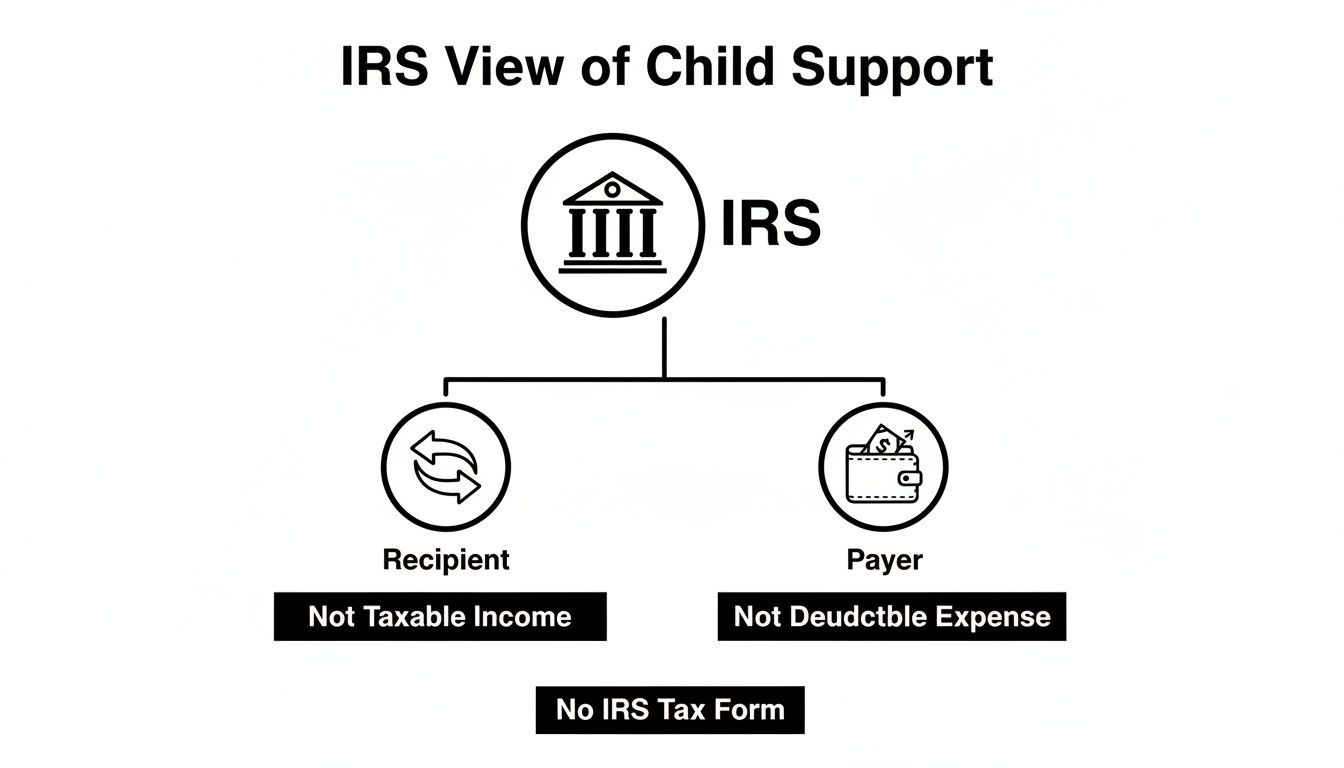
The bottom line is simple: The IRS sees these funds as a non-taxable transfer for the person receiving them and a non-deductible personal expense for the person paying them.
The Danger of “Family Support” and Vague Agreements
With these changes, some people might get creative and try to use vague terms like “family support” or “unallocated support” in their agreements, hoping to find a tax loophole. This is a bad idea and can lead to serious trouble with the IRS.
If your agreement doesn’t clearly separate child support from alimony, the IRS has the power to reclassify all of it. Any payment that is scheduled to decrease or end when a child hits a milestone (like turning 18 or graduating) is almost always going to be treated as child support by the IRS, no matter what you call it.
For example, say an agreement calls for a single “family support” payment of $3,000 per month. But it also says that payment drops to $2,000 once the child graduates high school. The IRS will almost certainly look at that and decide the first $1,000 was child support all along.
To protect yourself, your marital settlement agreement needs to be crystal clear. It must have separate, explicitly labeled sections for “Child Support” and “Alimony,” each with its own specific payment amounts and terms. For families in Pasco, Pinellas, and Hillsborough Counties, this isn’t just a best practice—it’s essential financial protection.
How Florida’s Income Shares Model Affects Your Taxes
The reason child support isn’t taxable in Florida isn’t just some arbitrary rule—it’s woven directly into the fabric of how the state calculates the payment in the first place. Florida uses a specific framework called the Income Shares Model, which is the foundation for figuring out a fair support obligation for parents in Pasco, Pinellas, and Hillsborough Counties.
Grasping this model is the key to understanding why taxes don’t enter the picture. The core idea is simple: estimate the total amount of money both parents would likely spend on their children if the family were still living under one roof. The court then splits this financial responsibility between the parents based on what each of them earns.
The most critical detail here is that the entire calculation starts with each parent’s gross income—that’s their income before any taxes are taken out. By using pre-tax numbers from the very beginning, the formula inherently treats the final child support payment as a tax-neutral transfer of funds.
Building The Calculation Block By Block
Think of the Income Shares Model like a recipe. The court combines several key ingredients to arrive at a final child support figure that is fair and properly meets the child’s needs.
The main components that go into this calculation are:
- Each Parent’s Gross Monthly Income: This is the starting point. It includes everything from wages and salaries to bonuses, self-employment income, and other earnings.
- The Number of Children: Naturally, the total support obligation goes up with each additional child.
- Timesharing Schedule: The number of overnights each parent has with the children is a major factor that can significantly adjust the final payment amount.
- Additional Costs: Big-ticket expenses like health insurance premiums and daycare costs are added to the basic obligation before being divided between the parents.
Because the system starts with gross income, it completely sidesteps the question of whether child support is taxable. The tax-free nature is already built into the math, ensuring the full amount intended for the child actually gets there.
The Income Shares Model is designed for fairness. By basing the calculation on pre-tax income, it ensures that the parent paying support has already accounted for their own tax burden before the child support amount is even determined.
This approach has become the standard in many places. The shift from using net income to gross income has reshaped tax considerations across the country and even globally, cementing child support’s non-taxable status.
A Practical Example In The Tampa Bay Area
Let’s make this real with a hypothetical scenario for a separating couple right here in our area. Imagine a mother living in Hillsborough County and a father who lives over in Pinellas County.
The mother earns $4,000 in gross income per month, and the father earns $6,000 gross per month. Their combined gross monthly income is $10,000. Based on Florida’s guidelines, let’s say the basic child support obligation for their two children comes out to $2,000 per month.
Since the father earns 60% of their combined income, his initial share of that obligation would be $1,200 (60% of $2,000). The mother’s share is $800 (40% of $2,000). If childcare costs $500 per month and the mother is the one paying for it, that cost gets added and prorated. The father would then be responsible for an extra $300 (60% of $500), which would increase his total potential payment.
Finally, the court would adjust this amount based on their specific timesharing schedule. This detailed process ensures the final, non-taxable payment accurately reflects both parents’ financial situations and the time they spend with their children. To get a rough idea of how these numbers might look for you, try using our Florida child support calculator for a preliminary estimate.
Deciding Who Claims The Child On Taxes After Divorce
While the question “is child support taxable” has a simple ‘no’ for an answer, things get a lot more interesting when we talk about who gets to claim the child as a dependent. This decision isn’t just a box to check on a tax form; it carries real financial weight, directly hitting your tax credits and what you ultimately owe Uncle Sam.
For parents here in Pasco, Pinellas, and Hillsborough Counties, this is a critical negotiation point. The IRS has a default “tie-breaker” rule to stop both parents from claiming the same child. The general rule of thumb is that the custodial parent—the one the child lives with for more nights during the year—gets the claim. But that’s just the starting point.
Strategic Negotiation And IRS Form 8332
Florida law gives parents the power to negotiate this tax benefit as part of their divorce or parenting plan. The custodial parent can legally sign over the right to claim the child to the non-custodial parent. Think of it as a powerful financial planning tool that, when used correctly, can put more money back into the family’s pocket.
To make it official, the custodial parent signs IRS Form 8332, Release/Revocation of Release of Claim to Exemption for Child by Custodial Parent. The non-custodial parent then attaches this signed form to their tax return for each year they claim the child. It’s a clean, formal process that puts you in control. Of course, agreeing on financial matters is just one piece of the puzzle; it all begins with first understanding the process of establishing paternity in Florida.
Why Would A Custodial Parent Give Up The Exemption?
It might sound strange. Why would the parent with custody give away a valuable tax break? The answer is simple: smart strategy.
This move makes the most sense when there’s a big income gap between the parents. If the non-custodial parent is in a much higher tax bracket, the dependency exemption is simply worth more to them in dollars and cents.
By letting the higher-earning parent take the deduction, the family as a whole maximizes its total tax savings. That parent gets a larger refund or owes less in taxes, which frees up cash.
This extra money doesn’t just disappear. It can be shared with the other parent, often by agreeing to a higher child support amount or having the non-custodial parent cover specific costs like extracurriculars or private school. It becomes a win-win, maximizing the total financial resources available for the children.
The principle that child support should be tax-free is common in many developed countries. This ensures the full amount is available for the child. This policy results in U.S. mothers receiving an average of $5,000-$7,000 annually, completely tax-free. In high-net-worth cases, that figure can easily top $10,000.
While navigating the financial aspects of co-parenting is vital, it’s also important to remember the human side of divorce. Considering the impact of divorce on a child’s mental health can help you make sound co-parenting decisions that create a more stable and supportive environment for your kids. Our firm proudly handles all LGBTQ issues, family and divorce issues in Pasco, Pinellas, and Hillsborough Counties, and does not discriminate.
Protecting Your Finances With Clear Legal Agreements
When you’re navigating a Florida divorce, the precision of your legal documents is your best financial shield. We’ve established that child support isn’t taxable, but that’s only true if your payments are unmistakably identified for what they are. Any gray area can create expensive, frustrating problems down the line.
This is why your Marital Settlement Agreement and final court orders have to be absolutely crystal clear. These documents must explicitly label payments as “child support,” leaving zero room for interpretation by the IRS or a former spouse. It’s a simple but critical step that creates a clean record and shuts down future tax challenges before they can even start.
The Power Of Precise Language
Vague terms like “family support” are a major red flag and should be avoided at all costs. Phrasing like that is practically an invitation for the IRS to reclassify your payments, which could lead to a surprise tax bill you never saw coming. We are meticulous about drafting agreements with this level of detail, safeguarding the financial futures of our clients in Pasco, Pinellas, and Hillsborough Counties. You can learn more about what a marital settlement agreement entails in our detailed guide.
A well-drafted legal agreement acts as a financial firewall. It clearly defines each party’s obligations and prevents disputes by removing ambiguity, ensuring that payments intended for a child’s welfare are treated correctly under tax law.
Secure Your Financial Future
For the most comprehensive financial protection, especially when sorting out the tax side of divorce and child support, bringing in professional tax planning services is a very smart move. An expert can offer advice that syncs up perfectly with your legal strategy.
For families here in Pasco, Pinellas, and Hillsborough Counties—including LGBTQ+ individuals, first responders, and military members—facing these issues demands professional legal guidance. Our firm is dedicated to providing clear, strategic advice that you can actually use. We handle all LGBTQ+ family and divorce issues and do not discriminate, making sure every family can navigate Florida’s legal system with confidence. Protecting your rights and securing a stable financial future for your kids starts with an impeccably crafted agreement.
When you’re trying to sort out the financial side of a separation, a lot of questions pop up. For the parents we work with across Pasco, Pinellas, and Hillsborough Counties, the same worries about child support and taxes seem to come up again and again. Let’s get you some clear, direct answers to the most common questions we hear.
What Happens If My Ex Tries To Deduct Child Support On Their Taxes?
This is a scenario that can cause a lot of unnecessary stress, but the law is firmly on your side. The IRS is crystal clear: the parent paying child support cannot deduct those payments. If your ex tries to do this anyway, the IRS will likely flag both of your returns for a mismatch, since their claimed deduction won’t line up with your non-reported income.
If you get a notice about this, your court order or marital settlement agreement is your best defense. That legal document plainly states the payments are child support, which is not deductible. The IRS will use that document to disallow your ex’s deduction, and the issue is usually resolved without you owing a dime.
Are Payments For Medical Bills Or School Tuition Also Tax-Free?
Yes, they are—but there’s a critical catch. Any extra payments you receive for specific costs like medical bills, dental care, health insurance premiums, or school tuition are treated just like regular child support. That means they are tax-free for you and not deductible for the parent who pays them.
However, these expenses must be spelled out as part of the child support obligation in your official, court-approved agreement. Vague, informal arrangements can create huge headaches down the road. Getting the language precise in your legal documents is the only way to guarantee these payments get the same tax-neutral treatment.
Remember, it all comes down to proper documentation. As long as your settlement agreement clearly labels these payments as child support-related expenses, they are not considered taxable income under Florida law or IRS rules.
If I Receive A Lump Sum For Back Child Support Is That Taxable?
Nope, not at all. A lump sum payment for past-due child support, known as arrears, is not considered taxable income. It doesn’t matter when you receive it or how big the check is. The IRS treats these funds just like they were regular, on-time payments.
The logic is simple: the tax nature of the payment doesn’t change just because it was paid late. It’s still child support, and child support is fundamentally non-taxable. This rule is a huge financial protection, making sure you get the full amount your child was owed without getting hit with an unexpected tax bill.
Do These Tax Rules Apply Differently To LGBTQ+ Parents?
Absolutely not. The tax laws for child support apply equally to all parents in Florida, with no exceptions. The IRS and state law don’t differentiate based on sexual orientation, gender identity, or marital status.
Whether you are in a same-sex or opposite-sex relationship, the rules are the same: child support is not taxable income for the person who receives it and not tax-deductible for the person who pays it. Our firm has deep experience representing all types of families in Pasco, Pinellas, and Hillsborough Counties. We make sure every client, including those in the LGBTQ+ community, gets expert guidance on how these universal rules apply to their unique situation. We handle all LGBTQ issues, family and divorce issues, and do not discriminate.
Sorting out the details of child support and taxes requires a sharp eye and careful planning. At Foley Family Law, we ensure our clients in Pasco, Pinellas, and Hillsborough counties have the clear legal documentation they need to protect their finances. If you have questions about your rights and obligations, contact us for a consultation.


