

Think of a child custody agreement template as the basic framework for your family's future. It’s a starting point, but for it to hold up in a Florida court, you need to build upon that foundation with details specific to your life and Florida law. A generic, fill-in-the-blank form just won't cut it.
Building Your Florida Parenting Plan From The Ground Up

Starting the process of creating a custody agreement can feel overwhelming, especially when emotions are running high. Many parents I work with in Pasco, Pinellas, and Hillsborough Counties initially look for a template, hoping for a quick and easy solution. While templates provide a useful structure, they are only the first step in creating what Florida law officially calls a Parenting Plan.
A Parenting Plan is much more than a simple schedule. It's a comprehensive, written agreement that details exactly how you and your co-parent will handle the day-to-day realities of raising your children. It lays out how you'll share responsibilities, make critical decisions, and create the consistency that kids need to thrive. A well-thought-out plan is your family's roadmap, built to reduce future arguments and create stability.
Why a Generic Template Is Not Enough
Simply downloading a generic custody agreement from the internet and filling it out is almost never enough for a Florida judge. These one-size-fits-all documents are notorious for missing the specific, detailed requirements mandated by Florida law. If your plan is incomplete, a judge can reject it, causing frustrating delays and forcing you to start all over again.
To get court approval, a Florida Parenting Plan has to be incredibly thorough. It needs to go far beyond a basic time-sharing calendar. You have to think through and clearly define:
- Parental Responsibility: How will major decisions about school, healthcare, and religious upbringing be handled? Will you make them jointly, or will one parent have the final say in certain areas?
- Time-Sharing Schedule: The plan must spell out a specific schedule covering weekdays, weekends, all major holidays, school breaks, and summer vacation. Ambiguity is your enemy here.
- Communication Methods: How will you two communicate with each other? And just as importantly, how will each of you communicate with your child when they are with the other parent (e.g., phone calls, FaceTime)?
- Relocation Rules: Florida law is very strict about this. The plan must include the legal steps required if one parent wants to move more than 50 miles away.
Leaving these critical areas vague or unaddressed leaves your agreement vulnerable to disputes and makes it difficult to enforce.
A strong Parenting Plan acts as a contract between co-parents, turning ambiguity into certainty. By planning for potential disagreements ahead of time, you create a framework that protects your child from future conflict and provides stability when they need it most.
A Plan For Every Family
Our firm is committed to helping all families create clear, fair, and legally sound agreements. We know that every family’s situation is unique, and we handle all family and divorce matters with the same dedication and respect. This includes providing experienced guidance for gay divorce, custody issues for LGBTQ+ parents, and ensuring every parent's rights are fully protected. We do not discriminate and proudly serve all families in Pasco, Pinellas, and Hillsborough Counties.
We firmly believe that a solid Parenting Plan is the cornerstone of successful co-parenting. The real goal is to move past a simple template and build a document that truly reflects your family’s needs while satisfying every requirement of Florida law. For a deeper dive into what this involves, you can learn more about what a comprehensive Parenting Plan in a divorce must include. This detailed approach is what transforms a basic form into a powerful legal tool that supports your family’s future in Hillsborough, Pasco, and Pinellas Counties. Your child's well-being depends on this clarity.
The Essential Elements Of A Strong Custody Agreement

A Florida Parenting Plan that actually works is built on a few non-negotiable pillars. While a child custody agreement template can give you the basic skeleton, it's the core components that give it the strength to support your family through thick and thin. Get these wrong, and you're setting yourself up for future conflict.
The three areas where you absolutely must have total clarity are the time-sharing schedule, parental decision-making, and child support. These are the sections a judge in Pasco, Pinellas, or Hillsborough County will scrutinize first. Vague language or overlooked details here can render your entire agreement unenforceable.
Defining The Time-Sharing Schedule
The time-sharing schedule is the heart of your Parenting Plan. It’s the calendar that dictates, day by day, where your children will be. Gone are the days of a simple "every-other-weekend" default. Florida courts now expect schedules that give children frequent and meaningful contact with both parents.
This means your agreement has to be incredibly specific. The goal is to choose a schedule that fits your family's unique rhythm. To help you choose the best fit for your children's needs and your family's circumstances, here are some popular parenting time schedules we see often in Pasco, Pinellas, and Hillsborough Counties.
Common Time-Sharing Schedules In Florida
- 2-2-3 Rotation: This schedule involves parents alternating a two-day block, another two-day block, and then a three-day block (often the weekend). It's best for younger children who benefit from seeing both parents frequently without long gaps.
- Week-On/Week-Off: Each parent has the children for one full week at a time. This schedule is often a good fit for older children and teens who can manage a week away from a parent and prefer fewer transitions.
- 3-4-4-3 Rotation: In this schedule, one parent has the children for three nights one week and four nights the next, with the other parent having the opposite. It provides consistency but with a bit more flexibility than a strict week-on/week-off plan.
- Every Extended Weekend: This schedule gives one parent the children from Wednesday through Sunday, while the other parent has them on Monday and Tuesday. It can work well when one parent has a non-traditional work schedule, allowing for longer, consistent blocks of time.
No matter which schedule you land on, your plan must also clearly map out all holidays, school breaks, and summer vacation. The more detail you include now, the fewer arguments you'll have later.
Clarity is your best defense against future conflict. A schedule that just says "parents will split Christmas" is an invitation for disagreement. A schedule that says "Parent A has the children from the end of school on the last day before break until 7:00 PM on Christmas Eve, and Parent B has them from that point until the day before school resumes" is airtight and enforceable.
Outlining Parental Responsibility And Decision-Making
This part of the plan outlines who gets to make the major decisions for your children. In Florida, this is almost always a conversation about shared versus sole responsibility.
Shared Parental Responsibility is the standard and what Florida courts strongly prefer. It means both of you must confer and agree on the big stuff:
- Education: School choice, tutors, and special programs.
- Healthcare: Everything from routine check-ups to significant non-emergency procedures.
- Extracurriculars: Deciding which sports, clubs, or activities the child participates in.
Sole Parental Responsibility is rare. It's generally only awarded in serious situations where one parent has demonstrated they are unable to participate in raising the child. Your agreement needs to spell out exactly how decisions will be made—and what happens if you can't agree. Mastering the perfect document structure is often the key to ensuring your plan is both clear and legally sound.
Understanding Florida Child Support Guidelines
Finally, you have to address child support. This isn't a number you just pull out of thin air. In Florida, child support is calculated using a specific formula that weighs both parents' net incomes against the number of overnights each parent has with the children.
Your Parenting Plan must include the final child support amount and all the details on how it gets paid. This also covers who provides health insurance and how you'll split any uncovered medical expenses. That's why your time-sharing schedule is so crucial—every overnight directly impacts the child support calculation.
The legal landscape has shifted significantly toward more equal parenting time. This trend means a modern child custody agreement template has to go beyond old models, detailing 50/50 schedules, transportation logistics, and clear communication protocols. When parents in high-conflict cases just can't agree, the court may appoint a neutral third party to advocate for the child's best interests. You can learn more about what is a Guardian ad Litem and the important role they play in these situations.
Tailoring Your Parenting Plan For Real Life
A template is just the starting point. Its real value comes from making it fit your family’s actual life, turning a generic document into a forward-thinking Parenting Plan that solves problems before they even start. This is about getting into the nitty-gritty of everyday situations that can blow up into serious conflict if you don’t plan for them.
For parents here in Hillsborough, Pinellas, and Pasco Counties, this isn't just a good idea—it’s absolutely essential. A generic plan falls apart the minute life gets messy. But a detailed, personalized plan becomes a reliable roadmap for you and your co-parent.
Creating Conflict-Free Holiday And Vacation Schedules
One of the biggest friction points for co-parents? Vague language around holidays and school breaks. A plan that just says "parents will alternate Thanksgiving" is practically an invitation for a last-minute fight. Who has the even years? Does the holiday handoff happen Wednesday night or Thursday morning?
A strong plan leaves zero room for guesswork. It has to spell things out clearly:
- Specific Exchange Times: Think details. For example, "Parent A will have the children from 6:00 PM on the last day of school before Winter Break until 12:00 PM on December 25th in even-numbered years."
- Major Holidays: Don't forget holidays like Martin Luther King Jr. Day, Memorial Day, or the Fourth of July. Decide now if you’ll alternate them annually or if one parent will always have a specific holiday.
- School Breaks: This covers spring break, fall break, and the entire summer. Outline exactly how this time will be split, who handles transportation, and how far in advance travel plans need to be shared.
Getting these details hammered out now will save you a world of stress later. For more on this, our guide on how to handle the December holidays while co-parenting is packed with practical advice for navigating that tricky time of year.
Addressing The Critical Issue Of Relocation
Life is unpredictable, and sometimes that means one parent needs to move. Under Florida law, you can't just pack up and move more than 50 miles away with your child. You need either the other parent's written permission or a court order. Trying to bypass this can lead to some very serious legal trouble.
Your Parenting Plan must include specific language to address this possibility. This section, often called a relocation clause, protects both parents and—most importantly—your child. It should lay out the exact legal process to follow if a move is on the table. It's a forward-thinking step that ensures everyone knows their rights and obligations from day one, preventing a chaotic and expensive court battle down the road.
Building a protective relocation clause into your initial agreement is one of the smartest things you can do. It forces a structured conversation and a legal process, rather than allowing a sudden, unilateral move that could disrupt your child's life and your relationship with them.
Practical Clauses For Smoother Co-Parenting
Beyond the big-ticket items like schedules and relocation, a few other practical clauses can make daily co-parenting life a whole lot easier. These are the details that truly customize a template to your family’s rhythm.
Consider adding provisions for things like:
- Communication Protocols: Spell out how you'll communicate about the kids. Many parents in Pasco, Pinellas, and Hillsborough Counties have found success using a dedicated co-parenting app. It keeps all conversations documented, business-like, and prevents important details from getting buried in texts or emails.
- Right of First Refusal: This is a great clause. It requires one parent to offer the other parent the chance to care for the child before calling a babysitter if they'll be away for a specific time (say, more than four hours). It's a simple way to maximize time with the kids for both of you.
- Travel Planning: Set clear rules for both in-state and international travel. This should cover how much notice is needed, what information must be shared (like flight itineraries and contact info), and who holds onto the child's passport.
These clauses are all about managing expectations and creating a clear rulebook for your new co-parenting relationship. At our firm, we help all kinds of families, including LGBTQ+ couples, build these essential safeguards into their agreements. By thinking through these real-life scenarios now, you create a Parenting Plan that’s not just a legal document, but a practical tool for successfully raising your kids in Pasco, Pinellas, and Hillsborough Counties.
Making Your Agreement Legally Binding In Florida
So, you’ve worked through the template and customized a child custody agreement. You might feel like the hard part is over, but there’s one more crucial step. A document signed between you and your co-parent is just a private agreement. To give it real legal teeth, a Florida court has to ratify it and turn it into an official court order.
This isn’t just a technicality. An informal agreement is often unenforceable. If the other parent suddenly decides to ignore the timesharing schedule or stops paying their share of expenses, you have very little recourse. A court order, however, brings the full weight of the legal system behind you.
The Path From Agreement To Court Order
Getting your Parenting Plan legally locked in involves a formal court process. While every case has its own unique details, the general steps for parents in Pasco, Pinellas, and Hillsborough Counties are designed to make sure the agreement is reviewed and filed correctly.
Here’s what that typically looks like:
- Both Parents Must Sign: The final, agreed-upon document needs signatures from both of you.
- Get It Notarized: Your signatures have to be witnessed by a Notary Public. This is key—it authenticates who you are and confirms you both signed willingly.
- File It With The Court: The signed and notarized Parenting Plan is then filed with the Clerk of Court as part of your family law case.
Once it's filed, a judge reviews the plan. They're checking to make sure it meets all Florida legal standards and, most importantly, is in the best interests of your child. If everything checks out, the judge signs an order ratifying it. Just like that, your agreement becomes the law of your case.
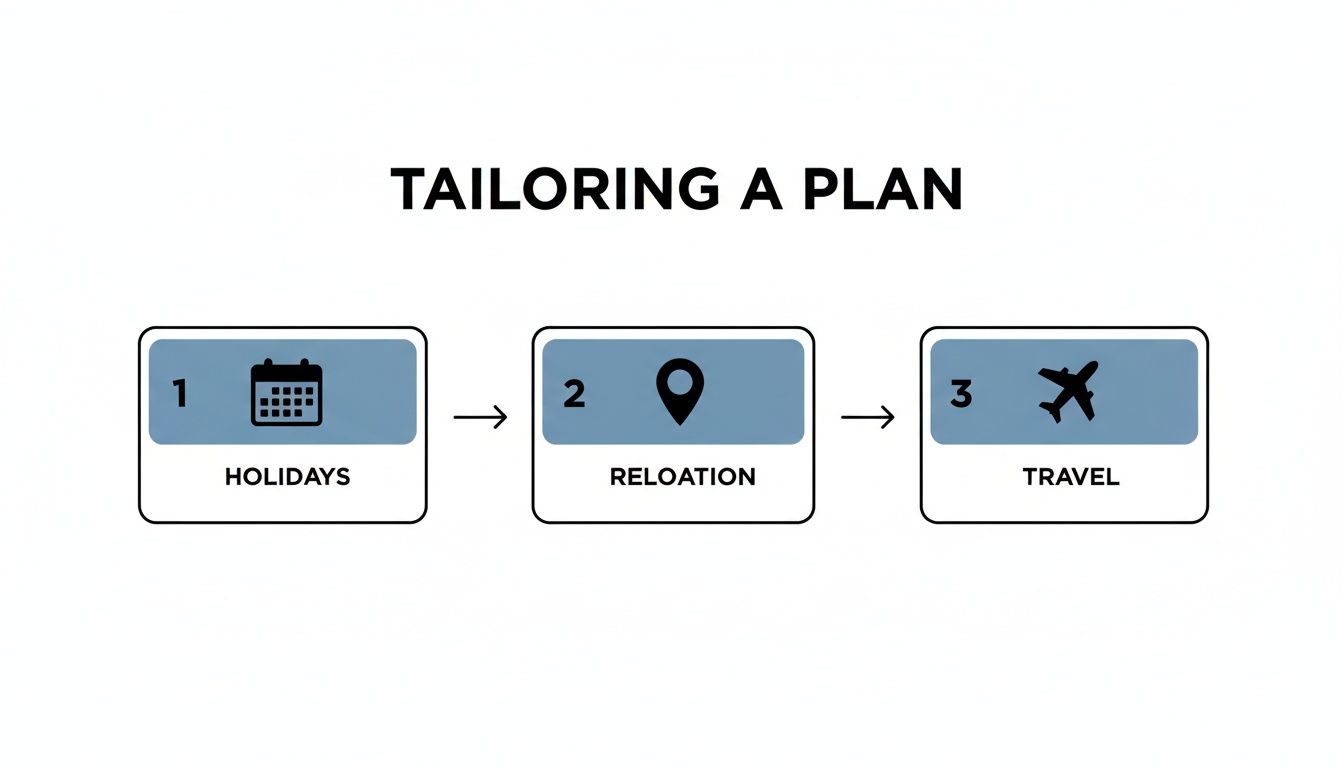
As you can see, thinking ahead about the big issues—holidays, travel, potential moves—is what gets you across the finish line smoothly. A strong agreement anticipates these problems and solves them upfront, which is exactly what a judge wants to see.
What Happens When You Cannot Agree
In a perfect world, you and your co-parent would agree on every single detail. But reality is often messier. What if you're deadlocked on the holiday schedule or can't agree on who has the final say in medical decisions? This doesn't mean you're destined for a painful, expensive trial.
This is where mediation can be a game-changer. It's a confidential process where a neutral third-party mediator helps you and your co-parent talk through the sticking points. The mediator doesn’t make decisions for you; they guide the conversation, helping you find that common ground you couldn’t reach on your own. It's a far more constructive—and usually faster—way to finalize your agreement for the court.
The whole point of this legal process is to create an enforceable order that gives your kids long-term stability. Turning your agreement into a court order isn't just paperwork; it's the single most important step you can take to protect your parenting rights and your child's routine.
Settling custody by agreement is now the standard across the country, which is why having a solid child custody agreement template is so important. Most custody arrangements are resolved without a judge having to decide the terms after a trial. For families here in the Pasco, Pinellas, and Hillsborough Counties, a properly drafted and filed agreement can prevent the chaos and uncertainty that comes with having no legal plan.
In truly urgent situations where a child's safety is at immediate risk, you can't wait for the standard process. Florida law has a mechanism for that. You can explore getting an emergency custody order in Florida to see how you can seek immediate court protection. For everyone else, the path is clear: finalize your plan, get it signed and notarized, and file it to create a binding, enforceable order.
Knowing When You Need a Family Law Attorney
A well-crafted child custody agreement template can be an incredibly powerful tool. It helps you organize your thoughts, lay out a basic schedule, and start a conversation with your co-parent about what a Parenting Plan should look like.
But let's be realistic: it's a starting point, not a magic wand. Knowing when to put the template aside and call in a professional is one of the most important decisions you'll make, especially when life gets complicated. Certain situations are just too complex and high-stakes to navigate with a fill-in-the-blank document.
For families here in Pasco, Pinellas, and Hillsborough Counties, understanding this distinction is key. It can be the difference between a solid, enforceable agreement and one that crumbles under pressure, leading to costly mistakes down the road.
Red Flags That Signal You Need Legal Counsel
While every family's situation is unique, some scenarios almost always demand a lawyer's guidance. A template simply can't anticipate the nuances of human behavior or the specific legal protections required in high-stakes situations.
Here are some clear signs that it’s time to seek professional help:
- High-Conflict Dynamics: If communication with your co-parent is constantly hostile, breaking down into arguments, or involves manipulation and bad faith, a template won't get you very far. An attorney can step in as a necessary buffer, implementing legal strategies to de-escalate the conflict while fiercely protecting your parental rights.
- Safety Concerns: Any history of domestic violence, substance abuse, or neglect changes the entire equation. A generic agreement is completely inadequate for creating the safety-focused provisions a judge would need to see to protect your child, such as supervised visitation or strict communication protocols.
- Complex Financial Situations: Is one parent a business owner, self-employed, or in possession of significant or hard-to-value assets? If so, calculating child support and other financial obligations becomes far more intricate than just plugging numbers into a formula. An experienced attorney knows how to conduct the necessary financial discovery to prevent assets from being hidden or undervalued.
A template can outline a basic schedule, but it cannot negotiate with a difficult co-parent, argue for protective measures in court, or conduct the financial discovery needed to ensure a fair outcome. Those actions require an advocate.
How an Attorney Adds Value Beyond the Template
An experienced family law attorney does so much more than just fill out forms. We provide strategic guidance tailored to your specific circumstances, ensuring your final agreement is not only compliant with Florida law but also durable enough to withstand future challenges.
A good lawyer helps you anticipate problems you might not even see coming. For example, we can draft precise language around relocation to prevent a bitter fight down the road, or create a clear deadlock-breaking provision for major decisions so you aren't constantly running back to court. This proactive approach saves you immense stress, time, and money in the long run. Before making a decision, it's wise to get an idea of typical lawyer consultation fees to help you budget accordingly.
Serving All Families With Respect And Dignity
At our firm, we are committed to providing exceptional legal support to all families throughout the Pasco, Pinellas, and Hillsborough Counties. We proudly handle gay divorce, gay custody issues, and gay or transgender name changes. We handle all LGBTQ issues, family and divorce issues, and do not discriminate. We understand that family structures are beautifully diverse, and we ensure your Parenting Plan reflects your unique reality while fully protecting your legal rights.
Recognizing the limits of a child custody agreement template is the first step toward building a truly secure future for your child. If your situation involves any of the complexities mentioned above, please don't hesitate. Seek professional guidance. A skilled advocate can help you navigate the legal system with confidence.
To learn more about how we can assist you, explore the services offered by a dedicated family law attorney near me serving Pasco, Pinellas, and Hillsborough Counties.
Common Questions About Florida Parenting Plans
Working through a child custody agreement template to create an official, court-approved Florida Parenting Plan is a process that brings up a lot of questions. It's completely normal to feel unsure about the details. We hear the same questions from parents all the time across Pasco, Pinellas, and Hillsborough Counties.
Let's clear up some of the most common points of confusion. Getting these answers straight will give you the confidence you need to build a solid agreement for your family.
Can We Modify a Parenting Plan Once It Is a Court Order?
Yes, but it's not as simple as just agreeing to a change. Once a judge signs off on your Parenting Plan, it becomes a legally binding court order. Life happens, of course—a new job, a relocation, or a child’s needs changing as they get older can make the original terms impractical.
To formally change the plan, you have to go back to court. A Florida judge will only approve a modification if you can prove there's been a "substantial, material, and unanticipated change in circumstances." On top of that, you have to show that the change you're asking for is truly in your child's best interests. This is a high legal bar to clear, which is exactly why it’s so critical to get the plan right the first time.
What Is the Difference Between a Parenting Plan and a Time-Sharing Schedule?
This is a big one, and the terms are often used interchangeably, but they are not the same thing. It's best to think of it like this:
- A time-sharing schedule is just the calendar. It’s the nitty-gritty of which parent the child is with on which days. It covers regular overnights, holidays, school breaks, and summer vacation. It's a vital piece, but it's only one piece.
- A Parenting Plan is the complete rulebook for co-parenting. It includes the time-sharing schedule, but it also covers everything else: who makes decisions about healthcare and education, how you'll communicate with each other, travel and relocation rules, and how child-related expenses will be handled.
A Florida court won't just approve a simple calendar. They require the full, detailed Parenting Plan that addresses all aspects of raising a child between two homes.
What Happens If the Other Parent Violates the Agreement?
Once your Parenting Plan is signed by a judge, it has the full force of the law behind it. It's not a suggestion. If your co-parent isn't holding up their end of the deal—maybe they're consistently late for exchanges, blocking communication with your child, or not following the holiday schedule—you have legal options.
You can take them back to court by filing a motion for enforcement or a motion for contempt.
A court order isn’t a guideline; it's an enforceable command. A judge can impose serious consequences for violations, such as ordering make-up time-sharing for the parent who was wronged, forcing the non-compliant parent to pay your attorney’s fees, or even requiring them to take a parenting course.
Courts have a number of tools to make a parent comply with the order and to protect your child's stability.
Do We Have To Go To Court To Create a Parenting Plan?
Absolutely not. You don't have to battle it out in a courtroom to get a Parenting Plan in place. In reality, the vast majority of parents in Florida work out an agreement together, either on their own, with their attorneys, or through mediation.
Once you have an agreement everyone can sign, it's submitted to the court for a judge’s review and signature. This collaborative path is what Florida courts prefer. It saves everyone time and money, lowers the stress on your kids, and lets you create a custom plan that works for your family—instead of having a judge who doesn't know you make these critical decisions for you.
Our firm is committed to serving all families with dignity, including LGBTQ+ parents navigating custody issues in Pasco, Pinellas, and Hillsborough Counties. Our goal is always to help you craft a plan that is fair, clear, and built to last.
Building a comprehensive and legally sound Parenting Plan is one of the most important things you'll do for your child's future. While a template can be a great starting point, getting professional guidance ensures your final agreement is strong, enforceable, and truly fits your family's needs. Contact Foley Family Law today to schedule a consultation and secure a stable co-parenting future.


