

What are a father's real chances of getting 50/50 custody? In Florida, the law is officially gender-neutral and starts with a simple, powerful idea: kids do best when both parents are actively involved. For dads, this means securing an equal time-sharing schedule isn’t about being a father versus a mother—it’s about proving you are a capable, essential, and consistent presence in your child's life.
Understanding A Father's Chances For 50/50 Custody

A lot of fathers walk into a custody dispute feeling like the system is stacked against them. I hear it all the time. But that’s an outdated myth, and it’s important to leave it behind. Florida courts have moved far away from the old days of automatically favoring mothers. Today, every decision is guided by a single standard: the best interests of the child.
This means that as a father, your shot at 50/50 custody—what Florida law now calls "equal time-sharing"—is directly tied to your ability to show the judge just how involved you really are. It's not enough to just be around; you have to be an active participant.
The Shift From Old Norms To Equal Footing
Let's be clear: historically, mothers were often seen as the primary caregivers, and the legal system reflected that bias. But times have changed, and so have our courts. Judges in Hillsborough, Pinellas, and Pasco Counties absolutely recognize the vital role fathers play in a child's stability, development, and overall happiness. This legal evolution puts both parents on equal footing right from the start.
Even with this progress, national statistics paint a more complicated picture. Roughly 3 million children in the U.S. live only with their fathers, a stark contrast to the over 15 million living just with their mothers. While joint custody is common, true 50/50 arrangements don't always happen, especially when cases are settled out of court where old-fashioned roles can still creep into agreements.
Key Takeaway: Your gender does not decide the outcome. The judge’s decision will hinge on the evidence you provide about your parenting skills, your bond with your child, and your ability to create a stable, loving environment.
This focus on evidence is everything. A judge isn't interested in promises; they want to see a documented history of your involvement. This includes things like:
- Daily Routines: Being part of homework, mealtimes, and bedtime stories.
- Important Appointments: Showing up for doctor's visits and parent-teacher conferences.
- Extracurricular Support: Driving to soccer practice, attending recitals, and being a cheerleader on the sidelines.
- Emotional Connection: Actively fostering a supportive, safe, and loving relationship.
To help a judge understand your role, it’s important to focus on the core factors they consider. This is what you need to build your case around.
Core Factors For 50/50 Time-Sharing In Florida
Florida law provides a list of factors the court must consider when determining what is in the child's best interests. These factors are generally applied to both parents equally. Here are some of the key themes:
- Demonstrated Capacity: This involves showing evidence that you have historically handled parenting tasks like feeding, bathing, schoolwork, and discipline.
- Moral Fitness: The court looks at your conduct and character to ensure it positively impacts the child.
- Mental and Physical Health: This factor assesses your ability to physically and emotionally care for the child without any red flags.
- Child's Preference: The wishes of a mature child may be considered, but this is never the only factor in the court's decision.
- Encouraging a Relationship with the Other Parent: The court wants to see proof that you support the child's bond with the other parent, rather than trying to undermine it.
- Geographic Viability: The court will consider how close you and the other parent live, and if a 50/50 schedule is practical for the child's schooling and activities.
- Evidence of Harm: Any history of domestic violence, substance abuse, or neglect will weigh heavily against a parent and can significantly impact the outcome.
Building your case around these factors is how you demonstrate to the court that a 50/50 schedule isn't just what you want—it's what's genuinely best for your child.
Joint Responsibility Is The Goal
You'll also notice the term "custody" itself has been updated in Florida. We don't really talk about "sole custody" or "joint custody" anymore. Instead, the court approves a Parenting Plan that spells out "time-sharing" and "parental responsibility." If you want to dig deeper, you might be interested in our guide on the differences between sole and joint custody.
Parental responsibility is about who makes the big-picture decisions for your child—things like school, healthcare, and religion. In nearly every case, Florida courts prefer shared parental responsibility, which means you and the other parent must make these calls together.
Your mission is to prove that you're not just willing but also fully capable of sharing these duties and providing a consistent, loving home for your child at least half the time. We proudly serve all families in Pasco, Pinellas, and Hillsborough Counties, including those in the LGBTQ+ community, because our core belief is that every dedicated parent deserves a fair fight for equal time with their child. We handle all LGBTQ issues, family and divorce issues, and do not discriminate.
What 'Best Interests Of The Child' Really Means

Every time-sharing decision in Florida, from Pasco to Pinellas to Hillsborough County, comes down to one guiding principle: the “best interests of the child.” But what does this legal phrase actually mean inside a courtroom? It’s not some vague, feel-good idea. It's a specific checklist a judge must use to figure out which time-sharing schedule will best promote a child’s stability, happiness, and overall well-being.
This standard is the bedrock of any father's case for 50/50 time-sharing. It forces a crucial shift in perspective—away from what you want and toward what you can prove is objectively best for your child. Think of it less like a fight against the other parent and more like a detailed presentation of your irreplaceable value in your child's life.
The court's main goal is to create an arrangement that causes the least disruption and offers the most stability. This means your track record of involvement is far more convincing than any promises you make about the future.
Deconstructing The 'Best Interests' Factors
Florida law lays out a list of factors judges are required to weigh when deciding on a time-sharing plan. While we won't get into a dry recitation of the entire legal code, grasping the core themes is essential for any father who wants to maximize his chances of getting 50/50 custody. These factors are completely gender-neutral and apply just as much to moms, dads, and parents in the LGBTQ+ community.
A judge will look closely at each parent's demonstrated ability to:
- Foster a loving relationship with the other parent: This is huge. The court heavily favors a parent who encourages a healthy bond between the child and their co-parent. Bad-mouthing your ex or trying to drive a wedge between them and your child is one of the biggest red flags a judge can see.
- Provide a stable and consistent routine: This is all about proving you can handle the day-to-day grind of parenting—getting homework done, making meals, scheduling doctor visits, and enforcing bedtimes.
- Maintain a healthy and safe environment: This goes beyond just having a clean house. It speaks to your moral fitness and your judgment in making sure the child isn't exposed to harmful situations or individuals.
At its core, the court wants to see who has been doing the hands-on parenting all along. Were you at the parent-teacher conferences? Did you take your child to their annual check-up? Can you name their best friends and favorite subjects without hesitating? These are the details that matter.
Proving Your Involvement Beyond A Paycheck
For many fathers, especially professionals, first responders, or military members with demanding schedules, there’s a real fear that long work hours will be used against them as a sign of non-involvement. This is where framing your contributions correctly becomes absolutely critical. Your hard work isn't a liability; it's proof of your responsibility and your dedication to providing for your family.
The key is to show that despite your schedule, you remain deeply engaged. A judge won’t penalize a parent for working hard, but they will look for evidence that you prioritize your child's needs when you are available. This is where you connect your actions to their best interests.
This evidence can be surprisingly simple yet incredibly powerful. A calendar showing you handled childcare while the other parent was away on work trips, emails with teachers about a science project, or even years of photos from coaching their Little League team all paint a vivid picture of a dedicated, active father. You must document everything that shows your hands-on participation. In more complex cases, it's also helpful to know how court-appointed professionals might view these facts. You can learn more about how a Guardian ad Litem works in Florida custody cases to understand how a neutral third party evaluates these very factors.
The Myth Of The "Perfect Parent"
No parent is perfect, and judges in Hillsborough, Pinellas, and Pasco Counties know this. The goal isn't to prove you're flawless. It's to show that you are fit, capable, and fundamentally important to your child’s well-being. A judge is looking for a parent who is reasonable, cooperative, and puts their child's needs ahead of their own ego or anger.
This is especially true for our firm's clients, who come from all walks of life. We handle gay divorce and custody issues with the exact same principle: the best parent is the one who shows up, provides stability, and fosters a positive co-parenting dynamic. Your ability to demonstrate these qualities through concrete actions is what truly defines the "best interests of the child" and solidifies your chances of securing a 50/50 time-sharing schedule.
Building Your Case With a Strategic Parenting Plan

When you're trying to improve your chances of a father getting 50/50 custody, your most powerful tool is a well-crafted Parenting Plan. In Florida, this document isn’t just a bureaucratic form you have to fill out. It's your story. It’s your strategy.
A generic, hastily completed plan tells a judge in Hillsborough, Pinellas, or Pasco County almost nothing about you. But a thoughtful, detailed proposal? That can completely transform your case, showing the court you’re a prepared and dedicated father.
Think of the Parenting Plan as the business plan for your co-parenting future. It’s your chance to prove you’re not just asking for equal time—you have a concrete plan to make it work successfully for your child. It demonstrates you’re committed to their well-being above all else.
Designing a Practical Time-Sharing Schedule
At its core, a Parenting Plan is all about the time-sharing schedule. This is where you get down to the brass tacks: the specific days and times the child will spend with each parent. Vague promises like "we will split time equally" just won't cut it. A judge needs to see a calendar that is practical, stable, and truly works for your child.
When mapping out your schedule, focus on these critical elements:
- Routine and Stability: Does the schedule give your child a predictable rhythm? A common and effective 50/50 schedule is a "week-on, week-off" rotation. This minimizes handoffs and lets the child genuinely settle in at each home.
- School and Activities: How does your proposed schedule accommodate school, homework, and after-school sports or clubs? A solid plan will clearly state who is responsible for transportation on any given day.
- Holidays and Vacations: Don't leave this up to chance. The plan must explicitly outline how you’ll divide holidays, school breaks, and summer vacation. Get specific—alternate major holidays each year, and define the exact start and end times to avoid future arguments.
A schedule that takes into account the child’s age, the location of their school, and their daily rhythm shows the court that your focus is exactly where it should be: on their best interests. That kind of foresight sends a powerful message.
A Parenting Plan is more than a schedule; it's a demonstration of your problem-solving skills and your commitment to a functional co-parenting relationship. The more detail you include to prevent future conflicts, the more a judge will see you as a stable and reliable parent.
Beyond the calendar, your plan also needs to cover the "who decides what" of parenting. This is legally known as parental responsibility. While Florida courts nearly always order shared parental responsibility, your plan should detail how you'll actually manage it day-to-day. If you're new to the process, getting a better handle on the ins and outs of a Parenting Plan in a divorce can give you some much-needed context.
Addressing Decision-Making and Communication
A truly strategic Parenting Plan anticipates future disagreements and builds a roadmap for solving them before they blow up. This proactive approach shows the court you are a mature, cooperative parent who can handle conflict constructively.
Here are the key areas you must define:
- Major Decisions: Specify how you and the other parent will jointly make choices about non-emergency healthcare, education (like school selection or hiring a tutor), and religious upbringing.
- Communication Rules: Set clear, firm guidelines for how you will communicate about the kids. Will you use a co-parenting app? Stick to email? Schedule weekly phone calls? A critical clause to include is a prohibition on discussing disputes in front of the children.
- Conflict Resolution: What happens when you inevitably disagree on something? Include a provision requiring mediation before either of you can run back to court. This signals your commitment to resolving issues amicably.
It’s also helpful to understand the different co-parenting models, like Parallel Parenting Vs Co Parenting, to figure out what approach is realistic for your family.
Ultimately, a detailed plan proves you've thought through the real-world challenges of raising a child in two homes. It shows a judge you’re not just fighting for time, but are genuinely planning for a peaceful and stable future for your child. That’s what significantly strengthens your case for a 50/50 time-sharing arrangement. We work with all parents in Pasco, Pinellas, and Hillsborough Counties, including those in the LGBTQ+ community, to build these critical documents with the care and foresight they deserve.
When you walk into a courtroom in Hillsborough, Pinellas, or Pasco County, the judge’s perspective wasn’t formed in a vacuum. Florida courts are part of a much larger, ongoing conversation about what modern co-parenting should actually look like. There’s a powerful movement, both here and abroad, pushing for shared parenting as the new standard—and that trend can give a father’s case for 50/50 time-sharing a serious boost.
This global shift is built on a simple, proven idea: children do better when both parents are deeply involved in their lives after a separation. Knowing these trends helps you frame your request for equal time not as some controversial demand, but as the reasonable, forward-thinking, and evidence-based approach it is. It shows your goal is in sync with where family law is already headed.
Learning From Global Shared Parenting Models
Looking outside the U.S., you'll find powerful, real-world examples of successful 50/50 arrangements. Many European countries have already embraced what’s often called joint physical custody (JPC), and the results speak for themselves. This is especially true in a place like Sweden, where new data shows an incredible 42.5% of children from separated families now live in an equal 50/50 time-sharing setup.
And other countries aren't far behind. Take Finland (23.8%) and Belgium (19.6%), where more than one in five children now gets equal time with both parents after a divorce. These aren't just numbers; they prove that a 50/50 split isn't some radical experiment. It's a stable, successful model for families. If you want to dig into the stats yourself, you can learn more about the rise of joint physical custody in Europe.
These international successes are the perfect counter-argument to any old-school, outdated belief that a 50/50 schedule is too disruptive or impractical. They prove that with the right structure and commitment from both parents, it’s a completely workable and beneficial arrangement for kids.
Key Insight: Framing your goal of 50/50 time-sharing as a global best practice strengthens your position, both in mediation and in front of a judge. It shows you’ve done your homework and are pushing for a solution that’s been proven to work for families all over the world.
This perspective can be a game-changer in negotiations. It shifts the conversation from a personal dispute to a discussion about adopting a modern, child-focused standard that has already been successfully road-tested elsewhere.
The Legislative Shift Across The United States
This push for equal time-sharing isn’t just happening overseas. A major legislative movement is gaining steam right here in the U.S., with a growing number of states rewriting their laws to better support a father’s involvement. This trend is a direct challenge to the old, default thinking where one parent was automatically named the "primary" caregiver.
More and more, states are moving toward a legal presumption of equal time-sharing. This is a huge deal. It means that instead of a father having to prove why he deserves 50/50, the court would start with the assumption that a 50/50 schedule is in the child’s best interest, unless someone proves otherwise. This simple change puts both parents on truly equal footing right from the start.
This legislative momentum is backed by a mountain of research showing the positive, lasting impact of having two highly involved parents. For fathers in Florida trying to improve their chances of getting 50/50 custody, this national trend is a powerful ally. It gives you a strong argument that your request for equal time lines up with where family law is moving across the country. We are committed to helping all parents in Pasco, Pinellas, and Hillsborough Counties, including those in the gay and transgender community, make this exact case. By understanding these bigger trends, you can advocate for your family with more confidence, knowing your goals are supported by a worldwide movement toward what’s best for children.
Choosing Your Path To 50/50 Custody
Getting to an equal time-sharing schedule means making smart, strategic choices from the very beginning. For any father aiming for this outcome, the route you take can make or break your chances of success. Broadly speaking, you'll be looking at one of three paths: cooperative mediation, necessary litigation, or a modification of a prior court order.
Each path comes with its own set of rules, risks, and potential rewards. Understanding them is the first step in working with your attorney to pick the approach that makes the most sense for your family's unique situation, whether you're starting from scratch or trying to change an old agreement. This decision tree offers a simple visual to help you figure out whether to start with mediation or brace for a court battle.
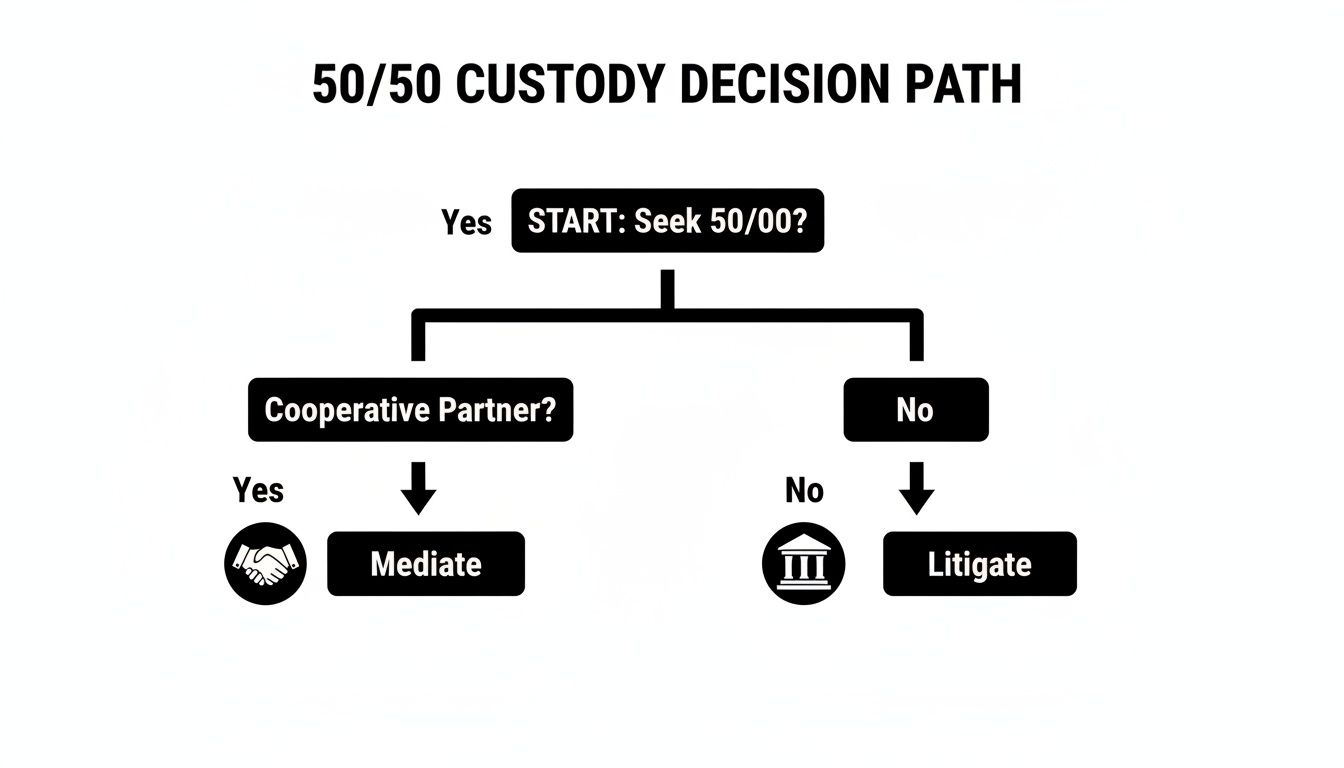
As you can see, the first critical question is a simple one: is the other parent being cooperative? Your answer to that question creates the main fork in the road, pointing you toward either a collaborative process or an adversarial one.
The Cooperative Path: Mediation
Mediation is a structured, confidential negotiation where you and the other parent sit down with a neutral third party—the mediator—to hammer out a Parenting Plan you can both live with. This is almost always the best place to start, especially if both parents are reasonable and genuinely focused on the child's well-being. The huge advantage here is that you control the outcome, rather than handing that power over to a judge.
For a father seeking a 50/50 split, mediation is your chance to present a logical, well-thought-out schedule and explain exactly why it’s in your child’s best interest. It’s a forum for creative problem-solving and flexibility that a courtroom simply can't match. You can dive deeper into how this all works in our guide on divorce mediation in Florida. The ultimate goal is to walk away with a signed agreement that can be submitted to the court, making it a legally binding order.
When Litigation Becomes Unavoidable
But sometimes, cooperation just isn't on the table. If the other parent flat-out refuses to even consider a 50/50 schedule, if there are serious allegations of harm, or if communication has completely collapsed, litigation might be your only path forward. This means you’re formally asking a judge in Hillsborough, Pinellas, or Pasco County to make the final call.
When a case goes to court, your chances of getting 50/50 custody hinge entirely on the evidence you bring. This is where all that detailed documentation of your involvement—the calendars, the school emails, the doctor visit receipts—becomes your most powerful tool. A judge won’t just take your word for it; you have to prove you are an active, consistent presence in your child’s life.
A courtroom battle isn't about winning an argument against your ex. It's about presenting a clear, compelling case to the judge that proves an equal time-sharing plan is the most stable, supportive, and beneficial setup for your child.
This adversarial process can be tough, both emotionally and financially. It is, however, a necessary step when one parent’s unreasonable stance is blocking a fair agreement and putting the child's needs at risk.
The Path to Modification: Increasing Your Time
What if you already have a time-sharing order, but it’s not 50/50? You aren't necessarily stuck with that old schedule forever. Florida law allows parents to ask the court to modify a time-sharing plan, but you have to clear a specific legal hurdle first.
To have a shot at a modification, you must prove there has been a “substantial, material, and unanticipated change in circumstances” since the last order was put in place. This is a high bar to clear. A minor scheduling conflict won't cut it. Examples of what might qualify include:
- The other parent is planning to relocate a significant distance away.
- Your work schedule has permanently changed, making you much more available.
- The child is now older and has clearly expressed a desire to spend more time with you.
- The other parent’s living situation has become unstable or unsafe.
Whether you're negotiating in mediation, presenting your case in court, or proving a substantial change has occurred, every path demands a solid strategy. Having an experienced guide in your corner helps you make these crucial decisions with sound legal advice and dedicated advocacy.
Working With The Right Attorney To Secure Your Goals
Florida's laws might be written in black and white, but getting to a 50/50 custody outcome is rarely that simple. It requires real skill and advocacy. Think of it this way: the law gives you the map, but a great attorney is the guide who’s walked the trail a hundred times. They know the shortcuts, the pitfalls, and exactly what the judge on the other side of the bench wants to see.
Hiring the right lawyer isn't about picking a bigger fight. It’s about making sure your story gets told clearly and your rights are protected at every turn. It’s an investment in your future relationship with your child.
The Advantage Of Experienced Representation
A seasoned attorney brings a crucial advantage: local knowledge. They understand the specific procedures in Hillsborough, Pinellas, and Pasco County courts because they're there day in and day out. They know the judges, their tendencies, and how to frame a case in a way that resonates. This insider perspective is huge when you’re trying to improve the chances of a father getting 50/50 custody.
Here’s what they do:
- Strategic Planning: They help you craft a Parenting Plan that's not just a wish list but a practical, detailed blueprint showing the court you’re ready for equal time-sharing.
- Evidence Gathering: They know what proof matters. They'll help you find and organize the texts, emails, photos, and witness statements that demonstrate you’re an active, involved parent.
- Skilled Negotiation: In mediation, they’ll advocate for your goals to try and lock down a fair agreement, steering you away from a costly and stressful court battle.
- Powerful Litigation: If you do have to go to court, they present your evidence persuasively, connecting everything you do back to the "best interests of the child" standard the judge must follow.
Choosing an attorney isn’t just about hiring a legal technician; it's about finding a partner who genuinely gets what’s at stake for your family. That partnership is what gets you through the legal and emotional maze of a custody case.
Finding A Firm That Understands Your Family
Every family’s story is different, and your legal team should recognize that from day one. It’s critical to find a firm that has experience with and is committed to serving all parents, including those in the LGBTQ+ community, first responders, and military families. We are proud to handle gay divorce, gay custody issues, gay or transgender name changes, and all other LGBTQ+ family law matters, making sure every parent gets the dedicated and respectful representation they deserve in Pasco, Pinellas, and Hillsborough Counties.
A good lawyer listens first. They take the time to hear your story, understand what’s most important to you, and then build a plan around those priorities. You don’t have to figure this out on your own. You can learn more about what to look for when you check out our guide on how to choose a divorce attorney.
Getting expert guidance is the single most important step you can take toward securing your rightful place in your child's life.
Common Questions About 50/50 Custody
Let’s cut to the chase. Here are some quick, direct answers to the questions we hear most often from fathers fighting for equal time with their kids in Florida.
Will a Judge Automatically Favor the Mother?
No. This is probably the most persistent myth in family law, but it’s outdated. Florida family law is crystal clear: the law is gender-neutral.
Judges in Hillsborough, Pinellas, and Pasco counties are legally required to give fathers and mothers equal consideration. The only thing that matters is the “best interests of the child.” The court’s focus is on which parent can provide a stable, loving, and consistent environment—not their gender.
Does "50/50" Mean My Child Support Is Eliminated?
Not necessarily, though it often reduces it. Child support and time-sharing are two separate calculations, even though one heavily influences the other.
Having equal overnights doesn't just magically wipe out a child support obligation. The final amount is determined by a specific formula that plugs in both parents' incomes and the exact number of overnights the child spends with each parent.
A big jump in your overnight stays from a previous schedule will almost certainly lower your child support payment. However, if there's a large income gap between you and the other parent, a 50/50 split may still result in one parent paying support to the other.
What If the Other Parent Won't Agree to 50/50?
If the other parent digs in their heels and refuses to agree, your case is headed for litigation. There's no way around it.
This means you’ll have to go before a judge and present your case. You’ll need to prove, with solid evidence, that an equal time-sharing schedule is what’s truly best for your child. Your entire argument will rest on your ability to document your history of active involvement and show the court you are a responsible, capable, and dedicated father.
Can I Get 50/50 Custody for a Very Young Child?
Yes, it’s possible, but it can be a tougher fight, especially if you have an infant who is still breastfeeding. While no Florida law forbids 50/50 for young children, some judges are hesitant.
Instead, they might lean toward a “step-up” plan. This type of plan gradually increases your time-sharing as the child gets older, eventually leading to a 50/50 split. Your success in getting 50/50 from the start will depend entirely on your ability to show the court you can meet all of that young child's specific, and often demanding, needs.
At Foley Family Law, we know that nothing is more important than your relationship with your children. If you're ready to fight for your right to equal time-sharing in Pasco, Pinellas, or Hillsborough Counties, our team is here to provide the experienced and dedicated representation you need. Contact us to build a strategic plan for your family's future at https://wfoleylaw.com.


