

When a marriage comes to an end in Florida, many people assume divorce is the only option. But there’s another, less common path: an annulment. The two are fundamentally different, and understanding that distinction is the first step for anyone in Pasco, Pinellas, or Hillsborough Counties who is facing this difficult transition.
At its core, the difference is this: an annulment says a marriage was never legally valid to begin with, essentially erasing it from a legal perspective. A divorce, on the other hand, is the legal process of ending a marriage that was valid from the start.
Annulment vs. Divorce: Understanding The Core Difference
Think of it like this. An annulment isn’t just an alternative to divorce; it’s a completely separate legal concept. To get an annulment in Florida, you have to prove that the marriage itself was defective from the moment you said “I do.” This usually involves specific grounds like fraud, bigamy (one person was already married), or duress. The bar for proving this is quite high, which is why annulments are rare.

Divorce is far more common because it addresses a legally valid marriage that has simply broken down. Florida is what’s known as a no-fault divorce state, which streamlines the process significantly. You don’t have to point fingers or prove wrongdoing. You can learn more in our detailed guide on what it means that Florida is a no-fault divorce state. This approach allows couples to dissolve their union without the added conflict of assigning blame.
It’s important to note that these legal principles apply to everyone. Residents in the LGBTQ community, from gay couples to transgender individuals, have the same rights and follow the same legal procedures for ending a marriage. At our firm, we handle all family and divorce issues with the respect and dedication every client deserves, without discrimination.
At a Glance: Comparing Annulment and Divorce in Florida
To make the differences even clearer, it helps to see them side-by-side. Here are the key distinctions between seeking an annulment versus a divorce under Florida law.
An Annulment:
- Legal Effect: Declares the marriage was never legally valid.
- Grounds Required: You must prove specific legal grounds, such as fraud or bigamy.
- Legal Standing: The parties are returned to their single status as if they were never married.
- Availability: Only available in limited circumstances with a high burden of proof.
A Divorce:
- Legal Effect: Legally ends a valid marriage.
- Grounds Required: No fault is required; only that the marriage is “irretrievably broken.”
- Legal Standing: The parties are legally recognized as formerly married.
- Availability: Available to any legally married couple meeting Florida’s residency requirements.
As you can see, the legal theory behind each action is what truly sets them apart. An annulment invalidates the marriage entirely, while a divorce simply ends it. This foundational difference has major implications for everything that follows, from property division to your future legal status.
Grounds For An Annulment In Florida
A lot of people think an annulment is just a different kind of divorce, maybe for a really short marriage you regret. That’s not how it works in Florida. Unlike a divorce, which can be granted simply because a marriage is “irretrievably broken,” an annulment isn’t about changing your mind.
To get an annulment, you have to legally prove the marriage was never valid to begin with. Think of it this way: you must show there was a fundamental, fatal flaw at the exact moment you said “I do,” which made the whole thing legally impossible from the start.
The burden of proof is entirely on the person asking for the annulment, and Florida courts have a very high bar. You need to come forward with clear and convincing evidence, which makes the process a whole lot more complicated than a standard no-fault divorce.
Common Grounds Recognized in Florida
While every situation is different, Florida law generally recognizes a few specific reasons a marriage can be declared void. Crucially, these aren’t about things that happened after the wedding—they’re about conditions that existed at the moment of the marriage ceremony.
Some of the most common grounds include:
- Bigamy: This is when one person was already legally married to someone else when they entered into the new marriage. You simply can’t be married to two people at once.
- Fraud or Misrepresentation: This is a frequent claim, but it has to be about something absolutely essential to the marriage itself. For example, if someone lied about their ability or desire to have children, concealed a serious felony conviction, or hid a sexually transmitted disease. You can find more on this complex topic by reading about overcoming deception in marriage.
- Duress or Coercion: If you were forced or threatened into getting married against your will, the marriage lacks real consent and can be annulled.
- Lack of Mental Capacity: This applies if one or both people couldn’t understand the nature of the marriage contract they were entering. This could be due to mental illness, intoxication from drugs or alcohol, or another condition that made them incapable of consent.
The key takeaway here is that the problem has to go to the very core of the marital agreement. Finding out your spouse lied about how much money they have probably isn’t grounds for an annulment. Discovering they lied about their actual identity almost certainly is.
Proving Your Case in Pasco, Pinellas, and Hillsborough Counties
To be successful, your word alone isn’t enough. You have to present solid evidence to a judge—things like documents, witness testimony, and other forms of proof that back up your claim. For anyone in Pasco, Pinellas, and Hillsborough Counties, it’s critical to understand this high evidentiary standard.
This is a far cry from the streamlined paperwork of an uncontested divorce. Because the bar is set so high, annulments are pretty rare. Divorce remains the standard legal path for ending most marriages. An experienced family law attorney can look at the facts of your situation and tell you whether you might meet the strict criteria for an annulment.
Navigating The Legal Process And Timeline
Knowing what to expect on the legal journey for either an annulment or a divorce in Florida is key to setting realistic expectations. While both start with filing a petition, the paths they take couldn’t be more different, and that has a big impact on the timeline and complexity for folks here in Pasco, Pinellas, and Hillsborough Counties.

Honestly, the divorce process in Florida is often the more straightforward route, especially when it’s uncontested and everyone agrees on the major issues. Florida is a no-fault state, so you don’t have to prove someone did something wrong—just that the marriage is irretrievably broken. That simple fact usually simplifies the entire procedure.
The Standard Florida Divorce Procedure
The path to dissolving a valid marriage is a well-worn one, with a clear set of steps. This structured approach gives you a sense of predictability, even when things get complicated.
- Filing the Petition: The whole thing kicks off when one spouse files a Petition for Dissolution of Marriage with the court.
- Serving the Other Spouse: Your spouse has to be formally notified, and they have a set amount of time to respond.
- Financial Disclosures: This is a big one. Both of you are required to swap detailed financial information—assets, debts, income, the works. It’s all about transparency for dividing property fairly.
- Reaching a Resolution: Spouses can sort out their issues through mediation or negotiation. If you just can’t agree, the case goes to trial, and a judge will make the final calls.
- Final Judgment: Once everything is settled, the court issues a Final Judgment of Dissolution of Marriage. That’s the piece of paper that legally ends the union. And before any of this can happen, you have to meet the state’s residency requirements. You can learn more about how long you have to live in Florida to get a divorce.
The Annulment Process: A Higher Burden
Getting an annulment is a totally different ballgame. It’s far more intensive and moves beyond just checking boxes on a form. You’re essentially building a legal case to argue in front of a judge. You aren’t just ending a marriage; you’re trying to prove it was never legally valid to begin with.
An annulment case is less about paperwork and more about proof. The entire process hinges on your ability to present clear and convincing evidence that specific legal grounds for invalidity existed at the moment of the ceremony.
This need for hard evidence is what makes the annulment timeline so unpredictable and potentially much longer than a divorce. It means digging up documents, getting witnesses to testify, and making a persuasive argument in a formal hearing. A religious annulment is a separate process from the legal one, and the legal journey often mirrors its intensity. It often takes many months because it’s much closer to a trial than a simple dissolution.
Financial And Parental Consequences
Choosing between an annulment and a divorce isn’t just a legal distinction—it’s a decision with massive real-world consequences. Here in Florida, that choice will dramatically shape your financial future, how your property gets divided, and the legal landscape for your kids. If you’re in Pasco, Pinellas, or Hillsborough Counties, you need to understand these differences before you act.
A divorce kicks off Florida’s equitable distribution laws. In simple terms, everything you and your spouse acquired or earned during the marriage—assets and debts—gets divided fairly. Fair doesn’t always mean a clean 50/50 split, but it covers the house, bank accounts, retirement funds, and even a family business.
On top of that, a divorce opens the door to alimony, or spousal support, which is designed to help a lower-earning spouse get back on their feet.
Property Division Annulment Versus Divorce
An annulment flips the script entirely. Since the court is saying the marriage was void from the start, the legal concept of a “marital estate” never really existed. This makes untangling the finances a lot messier.
Forget automatic equitable distribution. Instead, a Florida court has to figure out who owns what based on whose name is on the title. If property is jointly titled, the court might have to partition it, treating you more like business partners dissolving a venture than spouses ending a marriage.
For those with significant assets, understanding how to navigate the financial implications during a divorce is crucial. High-net-worth couples often face intricate situations involving business valuations and investments, a topic explored in detail by experts on finance and divorce for high net worth individuals.
Here’s the bottom line: alimony is not available in an annulment. Since the law says a valid marriage never existed, there is no legal basis to award spousal support. This is a critical distinction that can have lasting financial repercussions.
Protecting Children’s Rights In Either Scenario
One of the biggest worries for any parent is how all this affects the kids. Florida law is completely clear on this point: an annulment does not erase parental obligations. The rights and needs of your children are protected, no matter what happens with your marital status.
Whether you get a divorce or an annulment, the court will establish paternity and create orders for parental responsibility, timesharing, and child support. The process is identical, and it’s always guided by the child’s best interests.
- Child Support: A judge will calculate child support using Florida’s guidelines, which factor in both parents’ incomes and the child’s needs. You can get a rough idea using our Florida Child Support Calculator to see what potential obligations might look like.
- Parental Responsibility: You’ll get a parenting plan that spells out who makes the big decisions about healthcare, school, and other major parts of your child’s life.
- Timesharing: A schedule will be created that lays out exactly how much time the child spends with each parent.
So, while the financial fallout from an annulment versus a divorce is starkly different, the court’s mission to protect children is unwavering. Divorce is a common path, while annulments are quite rare. This reality just underscores how vital it is to understand the profound financial and parental consequences before making your choice.
Choosing The Right Path For Your Situation
Deciding between an annulment and a divorce isn’t just a legal question—it’s a deeply personal one that hinges entirely on the specific facts of your marriage. There’s no one-size-fits-all answer. My goal here is to give you a practical framework for that decision, especially if you’re in Pasco, Pinellas, or Hillsborough County.
The chart below helps visualize just how different the financial and parental outcomes are when you compare these two paths.
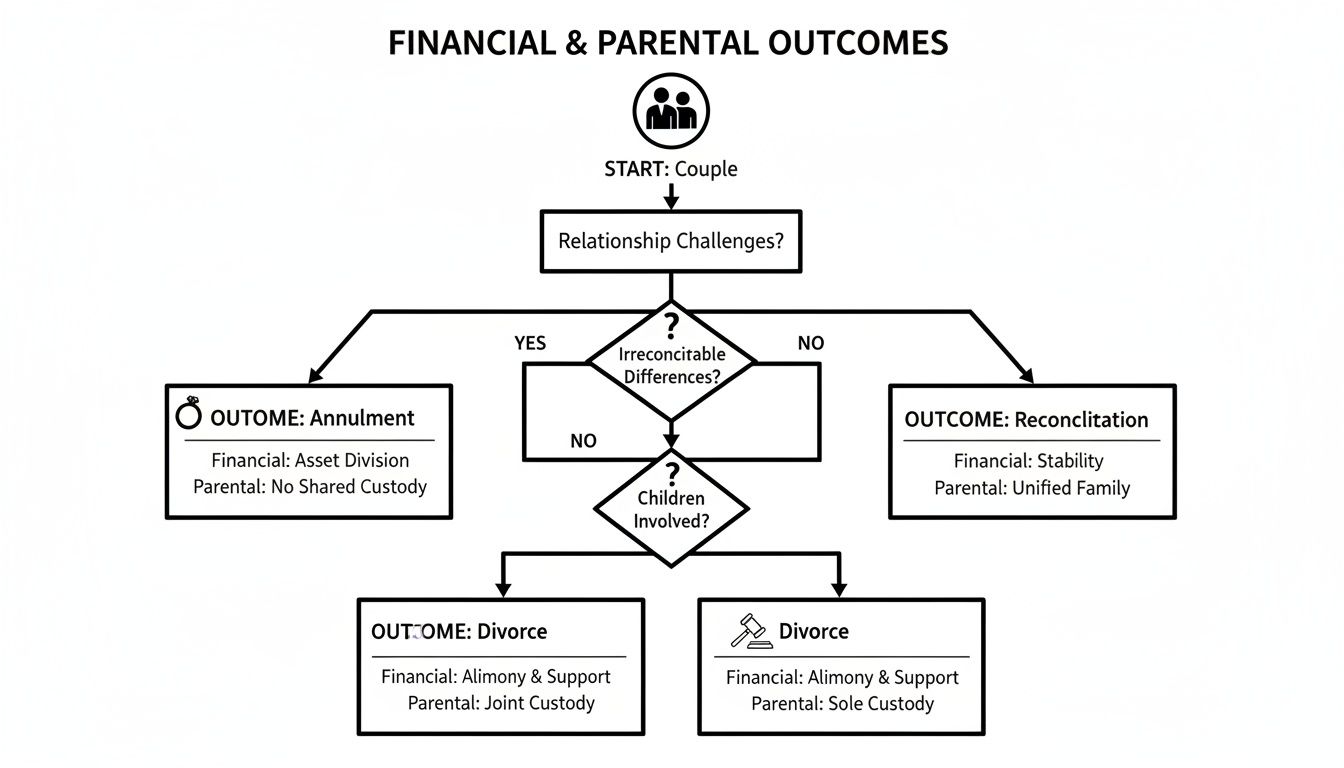
As you can see, a divorce provides a clear, structured process for dividing property and considering alimony. An annulment, on the other hand, essentially rewinds the clock, which can make financial matters much more complicated since things like equitable distribution aren’t guaranteed.
When an Annulment Might Be an Option
An annulment is a possibility, but it’s a tough road. The entire argument rests on proving the marriage was fundamentally flawed from the moment it began.
Think about these specific scenarios:
- A Marriage Based on Provable Fraud: This is more than just a simple lie. If you found out right after getting married that your spouse concealed something essential—like a secret family, a criminal history, or their inability to have children after you both agreed on starting a family—you might have a case. The deception has to go to the very heart of the marriage contract.
- Strong Religious Objections: For some people, divorce is simply not recognized by their faith. While a legal annulment is separate from a religious one, it can feel more aligned with their core beliefs, making it the only path they’re willing to consider.
Why Divorce Is Usually the Right Path
For the overwhelming majority of couples ending their marriage in Florida, divorce is the correct and necessary legal tool. This is especially true for any marriage that has lasted more than a few months, involves shared children, or has intertwined finances.
Divorce is specifically designed to untangle a valid union. It creates a legal framework to address the realities of a life built together, providing a clear way to divide assets and debts and allowing for spousal support when one person is financially dependent. If your separation involves any of these complex factors, divorce is almost certainly the way to go. For those hoping to avoid a courtroom battle, it’s worth knowing that a collaborative divorce offers a less contentious path for Tampa families.
Ultimately, the rarity of annulments in the U.S. speaks volumes. The rigorous burden of proof makes it a difficult path to pursue. Divorce, by contrast, is a straightforward legal tool designed for ending a valid marriage that has irretrievably broken down.
No matter which option seems to fit your situation, the most critical step you can take is to talk with an experienced family law attorney. It’s the only way to fully protect your interests and make a truly informed decision.
Common Questions About Annulment and Divorce
When you’re facing the end of a marriage, a thousand questions can run through your mind. The path forward feels foggy, especially when you’re trying to figure out the real difference between an annulment and a divorce here in Florida.
Let’s cut through the noise. Here are some direct answers to the questions we hear most often from our clients across Pasco, Pinellas, and Hillsborough Counties. The law applies to everyone, so this information is just as relevant for same-sex couples navigating this complex area of family law.
Does A Short Marriage Automatically Qualify For An Annulment?
No. This is probably the biggest misconception out there. The length of your marriage has zero legal bearing on whether you can get an annulment in Florida.
To get an annulment, you have to prove the marriage was invalid from the very beginning because of a specific legal defect, like fraud or duress. While it’s true that many marriages that get annulled are short, it’s the defect—not the duration—that matters.
If you got married and simply had a change of heart a few weeks later, a no-fault divorce is the proper route. For a short-term marriage without kids or a lot of shared property, an uncontested divorce can often be a surprisingly quick and simple process.
What Happens To My Children If My Marriage Is Annulled?
This is a critical point, and the law is very clear: an annulment has no effect on your children’s legitimacy or your parental rights and responsibilities. The law fully protects the parent-child relationship, no matter how the parents’ marriage ends.
A Florida court will step in to ensure the children’s well-being is the top priority. That means the judge will:
- Establish Paternity: The court makes a legal finding of who the parents are.
- Create a Parenting Plan: A detailed court order is created to outline parental responsibility and a timesharing schedule.
- Order Child Support: The court will calculate financial support using Florida’s guidelines.
The court handles these issues exactly as it would in a divorce. The focus is always on the best interests of the children.
A lot of people think an annulment just “erases” the marriage and everything that came with it. That’s not true. Florida law ensures your kids get the same legal and financial protections whether you annul or divorce. Your duties as a parent are permanent.
Is An Annulment Cheaper Than A Divorce In Florida?
Usually, no. In many cases, an annulment is actually more expensive and drawn-out than a standard uncontested divorce.
Why? Because with an annulment, you have to go to court for a formal hearing. You’ll need to present evidence and have witnesses testify to prove the marriage was invalid from the start. That takes a lot of legal prep work and attorney time.
On the other hand, a huge number of Florida divorces are settled through negotiation or mediation without ever seeing the inside of a courtroom. When both sides can agree on the key issues, an uncontested divorce is almost always the more cost-effective way to end a marriage.
Are The Rules Different For Same-Sex Couples In Florida?
No. The laws for annulment and divorce in Florida apply equally to all legally married couples. Same-sex couples use the exact same no-fault divorce process and must meet the same strict legal standards to get an annulment.
The grounds for annulment—things like fraud, duress, or bigamy—are identical for everyone. There is no distinction under the law.
Our firm is committed to providing experienced, respectful legal help to everyone in the LGBTQ community across Pasco, Pinellas, and Hillsborough Counties. We make sure all of our clients understand their rights and options, offering dedicated support for gay divorce, gay custody issues, gay or transgender name change, and all related family law issues without discrimination.
Navigating the complexities of annulment and divorce requires clear, knowledgeable guidance tailored to your unique situation. At Foley Family Law, we provide the experienced representation you need to protect your rights and secure a fair outcome. To understand your options and create a plan for moving forward, schedule a consultation with our dedicated family law team today at https://wfoleylaw.com.


