

Florida alimony law has been completely overhauled. The biggest change? Permanent alimony is gone. This marks a fundamental shift, creating a new system focused on predictability and helping both people achieve financial independence after a divorce.
What this really means is that nearly all spousal support is now temporary. The goal is to help a lower-earning spouse get back on their feet, not to create a lifelong financial obligation. Our firm handles all family and divorce issues for everyone, including the LGBTQ+ community, and we do not discriminate. We practice in Pasco, Pinellas, and Hillsborough Counties.
Understanding The New Era Of Florida Alimony

Navigating a divorce is a huge life event, and it almost always comes with financial uncertainty. If you're between the ages of 35 and 65, you’re probably asking yourself how you'll manage financially or if you'll have to support your former spouse. The recent changes to Florida law have totally reshaped the answers, moving away from long-term dependency toward clear, finite support structures.
This new era of alimony in Florida is all about purpose and duration. The law is no longer just about maintaining a certain lifestyle indefinitely. It's about providing a practical bridge to a new, self-sufficient life, which is designed to be fairer and more predictable for everyone involved.
The Purpose Of Modern Alimony
Think of the new alimony system like a toolkit. Instead of a single, one-size-fits-all solution, the law now provides several types of support, each designed for a specific job. This ensures that any assistance is directly tied to the receiving spouse's actual needs as they transition out of the marriage. Our firm is committed to making sure these laws are applied fairly for everyone, including members of the LGBTQ+ community navigating divorce and family law issues in Pasco, Pinellas, and Hillsborough Counties.
The main thing to remember is that alimony is now built with an end date in mind, reflecting the modern view that both people should eventually stand on their own two financial feet.
The core principle of Florida's updated alimony law is to provide temporary, purposeful support that empowers individuals to move forward, rather than creating a permanent financial link between former spouses.
This shift has introduced several distinct categories of alimony, which are the building blocks of any spousal support arrangement in Florida today. Let's break them down.
- Bridge-the-Gap Alimony: This is for immediate, short-term needs right after the divorce is final. Think of it as help covering the first few months of expenses while getting settled.
- Rehabilitative Alimony: This type provides funds for education or training to help a spouse become employable or increase their earning potential. It requires a specific plan.
- Durational Alimony: This offers temporary support for a set period following a short, moderate, or long-term marriage. Its length is directly tied to the length of the marriage.
Each type serves a unique purpose. A court will look at the specific facts of your case to decide which form of support, if any, is appropriate.
The Different Types of Alimony Explained

Trying to make sense of the different forms of alimony in Florida can feel like learning a new language. But it’s simpler than it looks. Each type is just a specific tool designed to solve a particular financial problem that comes up when a marriage ends.
The big picture is that Florida law has moved away from the idea of alimony as a lifelong obligation. Instead, the focus is now on targeted, temporary support to help a spouse get back on their feet financially. Think of it as a toolkit, not a single hammer, with each tool having a clear job and a firm expiration date.
Our job is to make these options clear for every client, including those in the LGBTQ+ community. We want everyone in Pasco, Pinellas, and Hillsborough Counties to know exactly what they’re facing so they can build a stable future. Let’s break down the main tools in the alimony toolkit.
Bridge-the-Gap Alimony
Imagine you've just left the marital home and need to find a new apartment. You need cash for a security deposit, first month's rent, and to get the lights turned on. That's exactly what Bridge-the-Gap alimony is for.
This is a short-term financial boost designed to cover legitimate, immediate costs associated with transitioning to single life. It's not for long-term support; it’s for specific, identifiable needs. This type of support is strictly temporary and can’t last for more than two years. Once a judge awards it, the amount and duration are set in stone—it can't be modified.
Rehabilitative Alimony
Think of Rehabilitative alimony as an investment in someone's future. It's awarded when one spouse needs time and money to gain the skills or education necessary to become self-sufficient. Maybe they need to finish a degree they put on hold or get a certification to re-enter their old career field.
To get this type of support, the requesting spouse has to present a solid, detailed rehabilitation plan to the court. This isn't just a vague idea; it's a specific roadmap outlining the school or training program, how long it will take, and what it will cost. The alimony payments are tied directly to making progress on that plan.
Durational Alimony
This has become the go-to form of spousal support in Florida. As the name implies, Durational alimony provides financial assistance for a set period of time after a divorce. It’s used when other types of alimony aren't enough to do the job.
The length of the payments is directly tied to how long the marriage lasted—it can never be longer. This is where we've seen a massive change in Florida law. In 2023, the law was changed to completely eliminate permanent alimony and put strict new caps on how long durational alimony can last.
For short-term marriages (under 10 years), the cap is 50% of the marriage length. For moderate-term marriages (10-20 years), it’s 60%. And for long-term marriages (over 20 years), the cap is 75% of the marriage’s duration.
The end of permanent alimony and the creation of these strict caps is the biggest shake-up to Florida’s alimony laws in years. It signals a clear shift toward support that is predictable and has a definite end date.
Since this is now the most common type of alimony, getting the details right is critical. You can learn more about the specifics in our detailed guide on durational alimony. This approach gives both sides a clear finish line from the start.
Lump Sum Alimony
Though it’s less common, lump sum alimony is another option. It is exactly what it sounds like: a single, one-time payment or transfer of property from one spouse to the other. This payment settles the entire alimony obligation in one shot, allowing for a clean financial break.
This can be a great solution in certain cases, like when one spouse wants to buy out the other’s share of a family business or the marital home. But it's a final deal. Once it's paid, it can't be changed, so it’s vital to make sure the amount is fair and truly covers what’s needed.
To help you keep these straight, here is a quick summary of the different alimony types in Florida.
Florida Alimony Types At A Glance
- Bridge-the-Gap: This type covers immediate, short-term costs of transitioning to single life. It has a maximum duration of 2 years and is non-modifiable.
- Rehabilitative: This type funds education or training for a spouse to become self-supporting. Its duration is tied to the length of the approved rehabilitation plan.
- Durational: This is for economic assistance for a set period after the divorce. Its duration is capped at 50-75% of the marriage length, depending on how long the marriage was.
- Lump Sum: This settles the entire alimony obligation with a one-time payment or asset transfer. It is a single transaction and is non-modifiable.
Understanding these distinctions is the first step toward figuring out what your financial future might look like after a divorce.
How Florida Courts Decide on Alimony
When a judge in Florida considers alimony, they aren't just picking a number out of a hat. The whole decision rests on a simple, two-part test: one spouse must have a genuine financial need, and the other spouse must have the ability to pay. If both aren't proven, the conversation about alimony stops before it even begins.
Think of it as a balancing act. On one side of the scale is the spouse asking for support, along with their monthly budget, real-world expenses, and lack of income. On the other side is the paying spouse's income, earning potential, and financial stability. Only when the scale clearly tips—showing a real need and a clear ability to meet it—will the court move on to the next step.
This fundamental requirement ensures alimony isn't an automatic penalty in a divorce. It's a specific remedy for a financial imbalance created during the marriage, and it’s the starting point for every single alimony case in Pasco, Pinellas, and Hillsborough Counties.
The Factors a Judge Must Consider
Once the court confirms both need and ability to pay, Florida law provides a checklist of factors a judge must analyze to make a fair decision. There's no calculator or magic formula here. A judge has a great deal of discretion to weigh these factors based on the unique story of each family, including same-sex couples.
This is where having an experienced attorney is non-negotiable. Our job is to paint a complete and accurate picture for the court, presenting compelling evidence on every relevant factor to protect your financial future.
Here are the key factors a judge will dig into:
- The Standard of Living: The court looks at the lifestyle the couple was accustomed to during the marriage. This isn't about luxury; it's about setting a realistic benchmark for the receiving spouse's needs.
- Duration of the Marriage: As we’ve covered, how long you were married is a massive factor. It directly impacts what type of alimony might be awarded and for how long.
- Age and Physical/Emotional Condition: A spouse's age or a serious health problem can dramatically affect their ability to re-enter the workforce and become self-sufficient.
- Financial Resources: This is a deep dive into everything—salary, bonuses, investments, property, and any other sources of income for both spouses (both marital and non-marital).
- Earning Capacities: The court assesses each person’s education, job skills, and employability. If one spouse stepped away from their career for years to raise a family, their immediate earning capacity is going to be viewed very differently than the spouse who was climbing the corporate ladder.
Contributions to the Marriage
A marriage is more than a financial partnership, and the court knows that. Judges are required to look beyond the bank statements and evaluate each spouse's contributions to the marriage as a whole. This is where the story of your family comes to life.
For instance, a judge will consider the sacrifices one spouse made to support the other's education or career. They also give significant weight to the contributions of a homemaker—the childcare, household management, and unpaid labor that allowed the other spouse to succeed professionally.
A judge’s final decision on alimony isn't based on one single fact. It’s a comprehensive evaluation of the entire marital partnership, blending financial realities with the personal contributions each spouse made along the way.
This holistic approach is designed to prevent a spouse who gave up their career to support the family from being left in a financial bind after divorce. But while the process aims for fairness, it’s undeniably complex. It’s no wonder many people want to know if there are ways to structure their divorce to limit or even eliminate an alimony obligation. For those interested, you can read our guide on how to avoid alimony in Florida for a deeper look at those strategies.
Ultimately, the court's goal is to reach a fair outcome that allows both people to move forward. That final decision will be built entirely on the specific evidence and arguments presented for each of these critical factors.
Calculating Alimony Payments and Duration
Figuring out the "how much" and "how long" of alimony is often the most stressful part of any divorce in Florida. While there's no magic calculator that spits out a final number, the good news is that recent changes in the law have brought a lot more predictability to the process. We now have clearer guidelines for setting a maximum possible payment and, just as importantly, a firm end date.
The process still starts with the same two pillars: one spouse’s genuine need for support and the other spouse’s ability to pay. But now, Florida provides specific guidelines that put a ceiling on potential alimony awards. This helps manage everyone's expectations right from the start and is especially helpful for people with complex finances here in Pasco, Pinellas, and Hillsborough Counties.
The New Guideline For Alimony Amounts
The biggest change is a new, precise guideline for calculating the maximum amount of durational alimony. A judge can award the lesser of the receiving spouse's reasonable need or 35% of the difference between the spouses' net incomes.
This is a huge deal for post-divorce financial planning. Net income is figured out according to state guidelines, and this cap is designed to ensure a fair outcome that addresses proven need—it’s not a blank check. The receiving spouse still has to prove their need, and the paying spouse must have the ability to pay.
It’s critical to understand that this 35% figure is a cap, not an automatic number. The final amount a judge orders can be, and often is, lower than this maximum. It all comes down to the specific factors and the evidence presented in court.
Let’s walk through a quick example to see how it works.
Example Calculation:
- Spouse A’s Net Monthly Income: $10,000
- Spouse B’s Net Monthly Income: $3,000
- Difference in Net Income: $7,000 ($10,000 – $3,000)
- Maximum Potential Alimony (35% of Difference): $2,450 ($7,000 x 0.35)
In this situation, the absolute most Spouse B could receive is $2,450 per month. But there's a catch: they must also prove their monthly need is at least that high. If Spouse B can only show a monthly need of $1,800, the alimony award would be capped at that $1,800, not the $2,450 maximum.
This simple flow chart breaks down how a court thinks through the process.
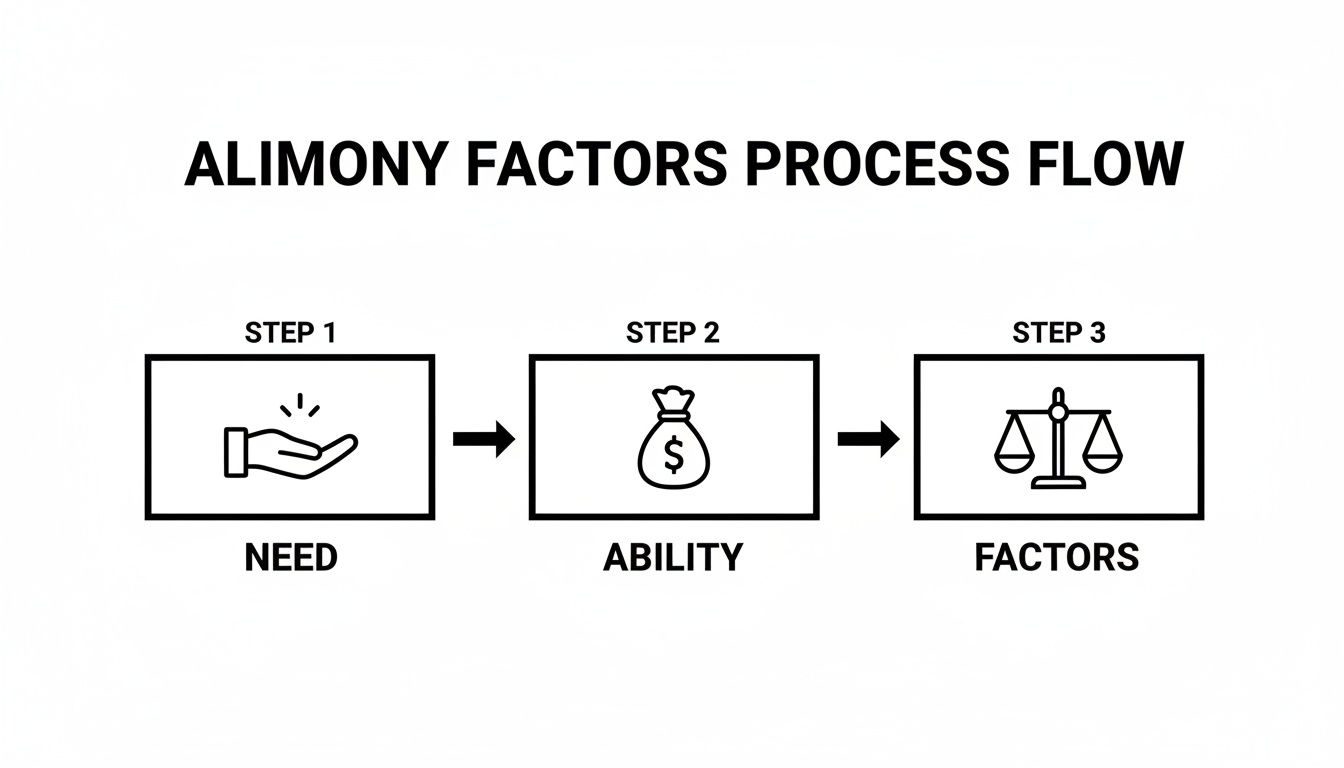
As you can see, the court has to confirm both need and ability before it even starts weighing all the other factors to land on a final, fair number.
New Time Limits Based On Marriage Length
Just as the law now caps the alimony amount, it also sets clear time limits for how long durational alimony can be paid. This is another key part of the reforms, as it provides a definite end date to the financial obligation. The timeline is tied directly to how long you were married.
Here’s how the time limits are structured:
- Short-Term Marriage (less than 10 years): Alimony cannot last for more than 50% of the length of the marriage.
- Moderate-Term Marriage (10 to 20 years): Alimony cannot last for more than 60% of the length of the marriage.
- Long-Term Marriage (over 20 years): Alimony cannot last for more than 75% of the length of the marriage.
These strict time limits, combined with the end of permanent alimony, provide a clear timeline for both parties to plan their financial futures independently.
This structure really highlights the modern legal view that spousal support should be a temporary bridge to self-sufficiency, not a permanent arrangement. Understanding these timelines is crucial, and you can get more details in our article answering the question, "How long will I pay alimony?"
Our firm guides clients through these calculations with care and precision. We serve individuals from all walks of life, including the LGBTQ+ community, making sure their financial situations are presented accurately and fairly in courts across Hillsborough, Pinellas, and Pasco Counties.
Modifying Or Terminating Alimony In Florida
A divorce decree might feel like the final word, but life doesn't freeze in place once the judge’s signature is on the paper. People get promotions, lose jobs, get sick, or find new partners. Florida law gets this, which is why it allows alimony orders to be changed—or even ended completely—when life throws a curveball.
But you can’t just go back to court because you’ve decided the original amount was unfair. The legal system sets a high bar for making these kinds of changes. You have to prove there’s been a substantial, material, and unanticipated change in circumstances since the final judgment was entered. This standard is designed to give both sides some stability while still allowing for flexibility when it's truly needed.
What Qualifies As A Substantial Change?
So, what does that legal jargon actually mean for you? It boils down to a significant life event that permanently changes the financial picture for either the person paying or the person receiving alimony. This can't be a temporary dip in income or a minor setback.
Courts in Pasco, Pinellas, and Hillsborough Counties will demand solid proof of a major shift. Here are a few common situations that might be enough to justify an alimony modification:
- An involuntary job loss or a significant, long-term pay cut for the paying spouse.
- A major promotion or salary increase for either spouse.
- The start of a serious illness or disability that affects either person's ability to work.
- The spouse receiving alimony gets a substantial inheritance.
- The paying spouse retires, as long as the retirement is reasonable and not just a way to dodge payments.
Changing an alimony order means filing a formal request with the court and building a strong case for the judge. When the goal is to stop payments altogether, it's crucial to understand the legal framework. For a different perspective on ending legal obligations, some insights on how to legally cancel an agreement can offer a useful comparison.
Events That Automatically Terminate Alimony
While most changes require a trip back to court, some life events automatically shut off the alimony tap by law. These are clear-cut situations that sever the financial ties from the divorce, giving a definite end date to the payments.
The two most definitive events that terminate durational alimony in Florida are the death of either the paying or receiving spouse, or the remarriage of the person receiving the payments.
On top of that, Florida law also allows for alimony to be reduced or terminated if the receiving spouse enters into a "supportive relationship." This essentially means they are living with someone in a marriage-like relationship that includes financial support, even if they aren't legally married. Proving this often takes some digging, but it's a powerful tool for ending alimony.
It's also worth remembering that bankruptcy can have complicated effects on these obligations. You can learn more in our article discussing if you can stop paying alimony if you file for bankruptcy.
We regularly guide clients, including those in the LGBTQ+ community, through modification and enforcement actions across Hillsborough, Pinellas, and Pasco Counties. We’re here to help you adapt your legal agreements to fit your new reality.
Why Choose Our Firm For Your Case
Navigating Florida's alimony laws isn't something you can learn from a few articles. It demands a strategic partner who understands how to protect your financial future, especially now that permanent alimony has been eliminated. This change has completely reset the landscape.
Frankly, choosing the right legal advocate is the most important decision you'll make. A good attorney doesn't just recite the law—they apply it to the unique facts of your life to build a case that makes sense and gets results.
That’s exactly what we do. We have a deep bench of experience handling a wide range of family law matters. We've managed everything from high-asset divorces with intricate financial portfolios to the very specific needs of military members and first responders. Our firm is built on a simple foundation: clear communication and practical strategies designed to secure a fair, dignified outcome for you.
A Client-Centered Approach
We believe everyone going through a divorce deserves compassionate and competent guidance. It's one of life's toughest transitions, and our commitment to serving our whole community is unwavering.
We proudly handle gay divorce, custody issues, and name changes, making sure every member of the LGBTQ+ community receives the dedicated and respectful representation they deserve. We don't discriminate. We're here to handle all family and divorce issues with the same level of focus and skill.
Our approach starts by creating a clear plan of action tailored specifically to you. We serve clients across Pasco, Pinellas, and Hillsborough Counties, bringing the local knowledge and courtroom experience you need to succeed. From our very first conversation to the final resolution, our focus is on securing a fresh start for you and your family.
Your peace of mind is our priority. We are committed to protecting your rights and your future with professionalism and a deep understanding of Florida's evolving alimony laws.
Secure And Confidential Guidance
We get it—divorce proceedings are sensitive, and we prioritize your confidentiality above all else. Our firm uses robust measures to ensure your private information is protected every step of the way. If you're interested in the technical side of how legal practices keep client data safe, this guide offers a solid overview of effective law firm data security.
If you’re facing these challenges, it’s time to take the next step. Learn more about how a dedicated Florida alimony lawyer can make a critical difference in your case. Schedule a consultation with us today. You'll walk away with a detailed action plan and the confidence that comes from having skilled representation on your side.
Frequently Asked Questions About Florida Alimony
When you’re staring down the complexities of alimony in Florida, it's natural to have a lot of questions. Getting clear, straightforward answers is the first step toward feeling in control and planning for your financial future. We've put together a few of the most common questions we hear from clients to help you get a better handle on Florida's spousal support laws.
Think of this as a starting point. While these answers are based on current law, every divorce is different, and the unique facts of your situation will always steer the final outcome. That’s precisely why having an experienced family law attorney in your corner is non-negotiable.
Does Cheating Affect Who Gets Alimony?
This is a big one for many people. While Florida is a no-fault divorce state, adultery can play a role in an alimony award. It's not a simple yes or no; cheating doesn't automatically disqualify someone from receiving support, nor does it guarantee the other spouse will have to pay. At the end of the day, the court's primary focus remains on one spouse's financial need and the other's ability to pay.
However, if marital money was spent furthering the affair—think gifts, trips, or supporting a new partner—a judge might factor that into the equation. It's just one piece of a much larger puzzle, but an important one. We can help you understand how the specific circumstances of your case might look in a Pasco, Pinellas, or Hillsborough courtroom.
How Does Alimony Impact Child Support?
Yes, alimony and child support are very much connected, and they directly influence each other's calculations. Here’s how it works: when one parent pays alimony, that amount is subtracted from their net income before child support is calculated. For the parent receiving alimony, that same amount is added to their net income.
This shift can dramatically change the final child support figure dictated by Florida's guidelines. It is absolutely essential to calculate these two financial obligations together to ensure the result is fair, accurate, and truly reflects your family's financial reality.
The interplay between alimony and child support is a critical calculation in any divorce involving children. Getting it right ensures that both parents contribute fairly and that the children’s financial needs are properly met.
What If My Ex Stops Paying Alimony?
It's a frustrating and stressful situation, but if your ex-spouse stops making court-ordered alimony payments, you have powerful legal options. The first step is to file a motion with the court, which is a formal way of asking a judge to step in and enforce the order.
If the judge finds your ex has the ability to pay but is willfully choosing not to, they can be held in contempt of court. This is a serious finding with significant consequences, which can include:
- Garnishing their wages
- Seizing funds from bank accounts
- Suspending their driver's license
- In some cases, even jail time
It’s crucial to act quickly if the payments stop. Our firm helps clients throughout Hillsborough, Pinellas, and Pasco Counties with enforcement actions to get the support they are legally owed. We are committed to serving all members of our community, including those in the LGBTQ+ community, with their family and divorce issues.
Answering these complex questions requires a skilled legal partner. We provide the clear guidance and strong advocacy you need to protect your financial future. If you are facing a divorce in the Tampa Bay area, schedule a consultation with us today by visiting https://wfoleylaw.com.


