

TL;DR:
- Florida’s 2023 law eliminated permanent alimony, replacing it with limited forms like temporary, bridge-the-gap, rehabilitative, and durational support. The amount and duration of durational alimony are now capped based on marriage length and income differences, requiring documented proof of needs and ability to pay. Courts consider several factors, including financial, marriage contributions, and personal circumstances, when setting support and its potential for modification.
Florida alimony law changed significantly in 2023. Under Florida Statutes, Section 61.08, courts may now award one or more of four forms of spousal support: temporary, bridge-the-gap, rehabilitative, and durational. Permanent alimony no longer exists. Durational awards are capped both in length (tied to how long the marriage lasted) and in amount (the lesser of 35% of the net income difference between spouses or the recipient’s reasonable need). Every award requires written findings of fact. If you are preparing for divorce in Florida, your first task is building documented proof of need or ability to pay before you ever set foot in a courtroom.
This is general legal information, not legal advice. Confirm current rules with the Florida Senate’s statute page or a qualified family law attorney before making decisions in your case.
What are the four types of alimony in Florida?
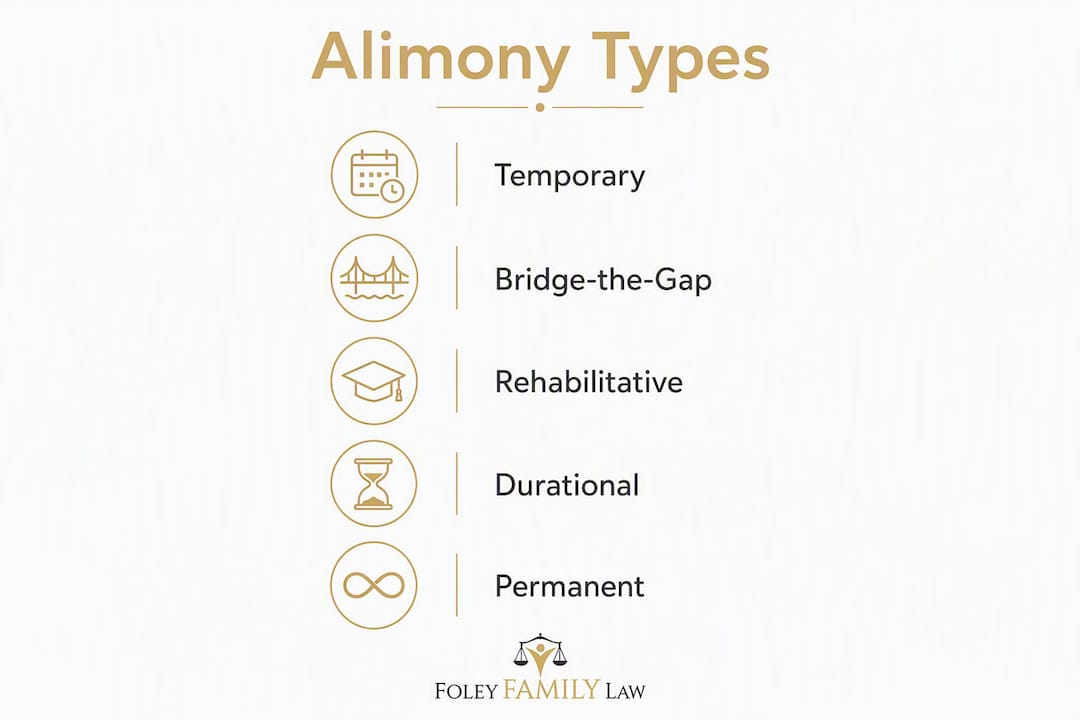
Florida courts can award any combination of the four statutory forms. Each serves a distinct purpose, carries its own time limits, and has different rules about modification.
Temporary alimony (pendente lite): Awarded during the divorce proceeding itself to maintain the status quo while the case is pending. It ends automatically when the final judgment is entered. Courts grant it to prevent one spouse from being financially stranded mid-litigation.
Bridge-the-gap alimony: Designed to help a spouse transition from married to single life by covering legitimate, identifiable short-term needs. The award may not exceed two years. Critically, bridge-the-gap alimony is not modifiable in amount or duration once entered, though it terminates on remarriage or death of either party.
Rehabilitative alimony: Intended to help a spouse redevelop skills or acquire education and training needed to become self-supporting. A specific, written rehabilitative plan is required and generally may not exceed five years. Courts can modify or terminate it if the plan is completed, abandoned, or substantially changed.
Durational alimony: Provides economic support for a set period following a marriage of any length, provided the marriage lasted at least three years. Duration is capped as a percentage of the marriage length (explained in the next section), and the amount is capped at 35% of the net income difference or the recipient’s reasonable need, whichever is less. Durational awards are generally modifiable upon a substantial change in circumstances.
One important note on form: courts may award periodic payments or a lump sum, or both. The choice affects tax planning and enforcement, so it is worth discussing with counsel before agreeing to a structure.
Who qualifies for alimony in Florida, and what factors does the court weigh?
The threshold question under F.S. 61.08 is straightforward: does the requesting spouse have an actual need, and does the other spouse have the ability to pay? The party seeking alimony carries the burden of proving both. Without that foundation, the court will not reach any of the other factors.

Once need and ability are established, the judge weighs a broader set of statutory factors. Grouped by theme, they fall into roughly three categories.
Financial picture: Each party’s income, assets, liabilities, and earning capacity. This includes the standard of living established during the marriage, the tax consequences of any award, and each spouse’s financial resources, including non-marital assets.
Marriage history and contributions: The duration of the marriage (measured from the date of marriage to the date of filing), each spouse’s contributions to the household, including homemaking and child-rearing, and any career sacrifices one spouse made to support the other’s education or advancement.
Personal circumstances: Age, physical and emotional health, and any other factor the court finds relevant to equity. The court may also consider adultery and its economic impact on the marital estate.
Consider a 12-year marriage where one spouse left the workforce for six years to care for children. That spouse re-enters the job market at a significant disadvantage in earning capacity. The court would weigh the career gap, the current income disparity, the marital standard of living, and the realistic cost of retraining. Each of those points needs documented evidence, not just testimony.
Pro Tip: Start building your financial picture before you file. Gather two to three years of tax returns, recent pay stubs, bank statements, and a detailed monthly expense budget. Courts respond to documented need, not general claims of hardship. Learn more about how Florida determines alimony to understand exactly what judges look for.
How do Florida judges set the amount and duration of an alimony award?
Marriage-length categories and duration caps
Florida law divides marriages into three categories based on length from the date of marriage to the date of filing:
| Marriage length | Category | Maximum durational award length |
|---|---|---|
| Less than 10 years | Short-term | Up to 50% of the marriage length |
| 10 to 20 years | Moderate-term | Up to 60% of the marriage length |
| 20 years or more | Long-term | Up to 75% of the marriage length |
So a 16-year marriage (moderate-term) could support a durational award of up to 9.6 years. A 24-year marriage (long-term) could support up to 18 years of durational support. Durational alimony cannot be awarded at all following a marriage of less than three years.
Extensions beyond these caps are possible only under “exceptional circumstances,” proven by clear and convincing evidence. Courts treat these deviations as rare exceptions, not routine adjustments. Qualifying factors include caregiver responsibilities for a disabled child, a disability that limits the recipient’s employability, or severely limited financial resources.
The 35% amount cap
The amount of a durational award may not exceed the lesser of two figures:
- 35% of the net income difference between the parties (net income calculated under s. 61.30(2) and (3), which excludes spousal support already paid under court orders between the parties).
- The recipient’s reasonable need as documented by their actual monthly expenses.
Whichever figure is lower becomes the ceiling.
Example A (short marriage): Payor nets $6,000/month; recipient nets $2,000/month. The difference is $4,000. Thirty-five percent of $4,000 is $1,400. If the recipient’s documented reasonable need is $1,200/month, the cap is $1,200. The marriage lasted seven years (short-term), so the maximum duration is a portion of the marriage length.
Example B (moderate marriage): Payor nets $9,000/month; recipient nets $3,000/month. The difference is $6,000. Thirty-five percent is $2,100. If the recipient’s documented need is $2,500/month, the 35% cap controls at $2,100. A 14-year marriage allows up to 8.4 years of durational support.
One additional protection for payors: an award may not leave the payor with significantly less net income than the recipient unless the court makes written findings of exceptional circumstances justifying that result.
Because the statute ties the amount to both a percentage cap and documented reasonable need, presenting a clear, itemized monthly budget alongside the income-based calculation gives the court exactly what it needs to set a supportable number.
When can alimony be modified, terminated, or enforced?
Modification triggers
Not every alimony type is modifiable. Bridge-the-gap awards cannot be changed in amount or duration once entered. Rehabilitative alimony can be modified or terminated if the plan is completed, abandoned, or if there is a substantial change in circumstances. Durational alimony is generally modifiable on a showing of a substantial, material, and unanticipated change in circumstances.
Common modification triggers include:
- A significant increase or decrease in either party’s income
- Job loss or a serious medical condition affecting earning capacity
- Completion or abandonment of a rehabilitative plan
- Cohabitation by the recipient in a supportive relationship (discussed below)
- Retirement of the payor, depending on age and circumstances
Remarriage, death, and cohabitation
Alimony terminates automatically on the death of either party or the remarriage of the recipient. Cohabitation is more nuanced. Florida courts look at whether the recipient is in a “supportive relationship” that reduces their financial need. Relevant factors include how long the couple has lived together, whether they share expenses, whether they hold themselves out as a couple, and the financial interdependence of the relationship. Courts do not terminate alimony simply because a recipient has a new partner; they look for evidence that the relationship actually changes the recipient’s financial picture.
Enforcement options
When a payor stops paying, the recipient has several remedies:
- Contempt of court: The most direct route. A court finding of willful non-payment can result in fines or incarceration.
- Wage garnishment: Courts can order income deduction directly from the payor’s employer.
- State depository: Many alimony orders require payments through the state depository, which creates a payment record useful in enforcement proceedings.
- Security for the award: Under F.S. 61.08(4), courts may order life insurance or a bond to protect the recipient if the payor’s circumstances suggest a risk of non-payment.
Pro Tip: If you are the recipient and payments stop, document every missed payment with bank records and depository statements before filing for contempt. Courts expect a clear payment history, not a general claim that “he hasn’t paid in months.”
How does alimony differ from property division, and what happens to a 401(k)?
Alimony and equitable distribution are separate legal concepts that serve different purposes. Alimony is ongoing support based on one spouse’s need and the other’s ability to pay. Equitable distribution is a one-time division of marital assets and liabilities. A court can award both, and the size of the property settlement can influence whether alimony is appropriate, but neither automatically replaces the other.
Florida is an equitable distribution state, meaning marital assets are divided fairly, though not necessarily equally. Retirement accounts, including 401(k) plans, are marital property to the extent contributions were made during the marriage. The portion accumulated before the marriage or after the date of filing is typically treated as separate property.
Do you automatically get half of your spouse’s 401(k)? Not necessarily. The court divides the marital portion equitably, which often means an equal split but can vary based on the overall asset picture. The process requires:
- Identifying the plan and obtaining a current statement
- Determining the marital portion (contributions and growth from the date of marriage to the filing date)
- Obtaining a Qualified Domestic Relations Order (QDRO) or, for government plans, an equivalent order
- Submitting the QDRO to the plan administrator for approval before distributions are made
A QDRO is a separate legal document from the divorce decree. Many people finalize their divorce and then discover the retirement account was never actually divided because the QDRO was never drafted or submitted. That oversight can take months and significant legal fees to correct.
Alimony does not reach into a retirement account directly. If one spouse needs ongoing support and the other’s primary asset is a retirement account, the court balances alimony against the property settlement to reach an equitable overall result.
What are the practical steps to request alimony in a Florida divorce?
Requesting alimony starts with the pleadings. If you are the petitioner, include an alimony claim in your Petition for Dissolution of Marriage. If you are the respondent, raise it in your Answer and Counter-Petition. Failing to plead for alimony in the initial filing can waive your right to seek it later.
Document checklist:
- Last two to three years of federal and state tax returns (both parties)
- Recent pay stubs (at least three months)
- Bank and investment account statements (at least six months)
- Signed financial affidavit (Florida Family Law Form 12.902)
- Monthly expense budget with supporting receipts or statements
- Proof of health insurance costs and medical expenses
- For rehabilitative claims: a written plan with specific goals, timelines, cost estimates, and measurable outcomes
- Medical records if health affects earning capacity
- Evidence of cohabitation if relevant to modification
Typical timeline:
- Filing and service: Petition filed; respondent served and has 20 days to respond.
- Mandatory disclosure: Both parties exchange financial documents within 45 days of service.
- Temporary relief hearing: You can request temporary spousal support early in the case to cover living expenses while the divorce is pending.
- Discovery: Depositions, subpoenas for bank records, and interrogatories to verify income and assets.
- Mediation: Required in most Florida circuits before trial.
- Trial: If no settlement, the judge hears testimony and reviews evidence.
- Post-judgment: Enforcement or modification proceedings if circumstances change.
Pro Tip: Hire counsel before the mandatory disclosure deadline, not after. An attorney can subpoena employer records, depose the other party, and issue third-party subpoenas for bank and business records. Once discovery closes, that window is gone.
What records and testimony actually move the needle with a judge?
Judges in alimony cases are looking for consistency between what you claim and what the documents show. A spouse who testifies to $4,000 in monthly expenses but submits bank statements showing $2,200 in withdrawals loses credibility on everything else.
Core documents every case needs:
- Federal tax returns (W-2s, 1099s, Schedule C if self-employed)
- Pay stubs or profit-and-loss statements for the past 12 months
- Bank and brokerage account statements
- Retirement account statements with a clear valuation date
- Signed expense declaration with line-item support
When expert witnesses add value:
In a straightforward case (salaried payor, short marriage, clear income disparity), the financial affidavits and tax returns usually tell the story without expert help. Complex cases are different. A self-employed payor who runs personal expenses through a business, a high-net-worth case with multiple income streams, or a long marriage where one spouse’s earning capacity is genuinely disputed can all benefit from a forensic accountant or vocational expert.
A vocational expert evaluates what a spouse could realistically earn given their education, work history, and the local job market. Courts give these opinions real weight when the recipient claims they cannot return to work and the payor disputes that claim.
Witness testimony: Parties should testify to specific facts, not general grievances. Third-party witnesses (employers, doctors, financial advisors) are most useful when they can corroborate a specific documented claim, such as confirming a medical condition limits employment or that a business’s reported income matches its actual deposits.
Recent statutory changes and what they mean for your case
The most significant change to Florida alimony law in decades took effect in 2023: permanent alimony was eliminated. Before that amendment, courts could award open-ended support with no termination date. Under the current version of F.S. 61.08, every award has a defined end point or terminates on a specific event (remarriage, death, or cohabitation in a supportive relationship).
| Change | Statutory basis | Practical effect |
|---|---|---|
| Permanent alimony eliminated | F.S. 61.08 (2023 amendment) | All awards now have a defined duration or termination trigger |
| Durational caps by marriage length | F.S. 61.08(7) | Short: 50%, moderate: 60%, long: 75% of marriage length |
| 35% net-income cap on durational amounts | F.S. 61.08(8) | Amount ceiling tied to income difference, not just need |
| Written findings required | F.S. 61.08(1)(b) | Judges must explain every award or denial in writing |
| Exceptional circumstances standard | F.S. 61.08 | Extensions beyond caps require clear and convincing evidence |
Foley Family Law’s perspective on the 2023 changes: The elimination of permanent alimony shifts the strategic focus toward documenting the recipient’s realistic path to self-sufficiency and the payor’s actual net income. Under the old framework, a long-term homemaker could receive indefinite support. Under the current law, the same person needs a credible plan for financial independence, even if that plan spans many years. Cases that used to settle around “how much per month forever” now require both sides to think carefully about income projections, rehabilitation timelines, and the 35% cap. Getting those numbers right at the outset is far more important than it was before 2023.
For the current statute text, see the Florida Senate’s statute page. Laws can change; confirm effective dates with the statute directly or with a licensed Florida attorney.
Key Takeaways
Florida alimony law now limits every award to one of four statutory forms, caps durational amounts at 35% of the net income difference or the recipient’s reasonable need (whichever is less), and ties duration to marriage length categories.
| Point | Details |
|---|---|
| Four alimony types only | Florida courts award temporary, bridge-the-gap, rehabilitative, or durational alimony; permanent alimony no longer exists. |
| Durational amount cap | Awards may be capped relative to the net income difference between spouses or the recipient’s reasonable need. |
| Duration tied to marriage length | Short marriages (under 10 years): 50% cap; moderate (10 to 20 years): 60% cap; long (20+ years): 75% cap. |
| Burden of proof on the claimant | The spouse seeking alimony must prove both actual need and the other party’s ability to pay before any other factors are weighed. |
| Foley Family Law | Foley Family Law helps clients in Hillsborough, Pinellas, and Pasco counties build documented alimony claims or defenses under the current statutory framework. |
What Foley Family Law tells clients about alimony
The biggest mistake people make going into an alimony case is assuming the outcome is obvious. A long marriage does not automatically produce a large award. A significant income gap does not guarantee support. What courts actually respond to is documented evidence tied to the specific statutory factors, presented clearly and consistently.
Foley Family Law’s approach starts with the financial picture before anything else. That means gathering tax returns, building a realistic monthly budget, and identifying any income the other party may be underreporting. Self-employed spouses, business owners, and anyone with variable income require closer scrutiny, and that scrutiny needs to happen during discovery, not at trial.
Common pitfalls the firm sees repeatedly:
- Overlooking hidden income: Business owners who run personal expenses through a company or report artificially low draws. A forensic accountant can reconstruct actual income from bank deposits.
- Failing to document expenses: Claiming $5,000 in monthly expenses without receipts or bank statements to back it up. Judges discount undocumented claims.
- Assuming alimony is automatic: Especially in long marriages. The threshold test still applies, and a spouse with significant separate assets or earning capacity may not qualify regardless of marriage length.
- Neglecting the rehabilitative plan: Vague promises of “going back to school” without a specific program, timeline, and cost estimate often result in denial or a shorter award than the facts would otherwise support.
When you come in for an initial consultation, bring your last two years of tax returns, recent pay stubs or business financials, a list of monthly expenses, and any financial documents you have already gathered. That starting point lets the firm assess your position quickly and focus the strategy where it matters most.
Foley Family Law is ready to help with your alimony case
Alimony cases under Florida’s current statute require precise financial documentation, a clear understanding of the 35% cap and duration limits, and early strategic decisions about temporary relief, discovery, and settlement structure. That is exactly the work Foley Family Law does every day for clients across Hillsborough, Pinellas, and Pasco counties.

The firm handles the full range of alimony-related services: temporary relief motions to protect your finances while the case is pending, discovery and forensic accounting for complex income situations, QDRO coordination for retirement account division, and enforcement or modification proceedings after judgment. For high-asset divorces where alimony intersects with significant property division, the firm’s experience with high net worth divorce in Florida means you get counsel who understands both sides of the financial equation.
Initial consultations are available for a fee and give you a direct assessment of your position under the current statute. If you want to understand what an alimony claim or defense realistically looks like in your case, schedule a consultation with Foley Family Law and come prepared with your financial documents.
Useful sources
Verify the current statute text and confirm effective dates directly from these primary sources before relying on any summary, including this one:
- F.S. 61.08 — 2025 Florida Statutes (Florida Senate): Current alimony statute with the 2023 amendments in effect.
- F.S. 61.08 — 2024 Florida Statutes (Florida Senate): Prior year version for comparison.
- F.S. 61.08 — 2023 Florida Statutes (Florida Senate): The version reflecting the initial elimination of permanent alimony.
- Online Sunshine — F.S. 61.08 (Florida Legislature): The legislature’s own searchable statute database.
- Florida Statutes — general statutes page (Florida Senate): Full Florida Statutes index for cross-referencing related sections.
- The Florida Bar maintains a lawyer referral service and publishes consumer guides on family law topics, including spousal support.
Laws change. Confirm the effective date of any provision with the statute text directly, and consult a licensed Florida attorney for advice specific to your situation.
FAQ
Who qualifies for alimony in Florida?
Either spouse may qualify. The court must first find that the requesting spouse has an actual financial need and that the other spouse has the ability to pay; the requesting party bears the burden of proving both under F.S. 61.08.
How much alimony can a spouse receive in a Florida divorce?
For durational alimony, the amount may not exceed 35% of the net income difference between the parties or the recipient’s reasonable need, whichever is less. The total amount depends on documented income, expenses, and the specific statutory factors the court weighs.
How long does alimony last after a 20-year marriage in Florida?
A 20-year marriage qualifies as long-term, so a durational award may last up to 75% of the marriage length. The court sets the actual duration based on the circumstances; the statutory ceiling is a portion of the marriage length, not a guarantee.
Does a spouse automatically get half of the other’s 401(k) in a Florida divorce?
Not automatically. Florida divides the marital portion of a 401(k) equitably, which often means an equal split but is not required. The marital portion covers contributions and growth from the date of marriage to the date of filing, and the division requires a Qualified Domestic Relations Order (QDRO) submitted to and approved by the plan administrator.
Can alimony be modified after the divorce is final?
Durational and rehabilitative alimony can generally be modified on a showing of a substantial, material, and unanticipated change in circumstances. Bridge-the-gap alimony cannot be modified in amount or duration once entered. Foley Family Law handles post-judgment modification proceedings for clients in Hillsborough, Pinellas, and Pasco counties.


