

Adding your new spouse to the deed on a home you owned before marriage might feel like the natural next step. It’s a common move here in Florida, and for many couples, it’s a powerful symbol of their new life together. We handle all family and divorce issues, including for LGBTQ+ clients, and we do not discriminate.
But this isn't just a sentimental gesture. It's a significant legal and financial decision. The most common way to do this is with a quitclaim deed, a document that officially transforms your separate property into a shared, marital asset.
Should You Add Your Spouse To Your Home's Deed?
When you get married, it’s natural to want to combine your lives—and your assets. For homeowners in Pasco, Pinellas, and Hillsborough Counties, the question of adding a spouse to the deed comes up frequently. The decision is usually driven by a mix of emotional and practical considerations. Our audience for this guidance is typically between 35 and 65, male or female.
Emotionally, sharing legal ownership makes the house feel like our home, aligning your legal status with your personal commitment. Practically, holding property jointly can simplify things down the road, especially when it comes to estate planning. It can allow the home to pass directly to the surviving spouse, bypassing the often-lengthy probate process.
The Realities Of Shared Ownership
While the process of signing a quitclaim deed seems simple, its effects are profound and permanent. This isn't just about adding a name to a piece of paper; you're fundamentally changing the legal status of your single largest asset.
Here’s what really happens under Florida law when you add your spouse to the deed:
- Creation of a Marital Asset: The moment the deed is signed and recorded, your once-separate, pre-marital property becomes a marital asset. This is a critical legal shift.
- Impact on Divorce: If the marriage ends, the home is now subject to equitable distribution. By adding your spouse, you are making a legal "gift" to the marriage, which changes who has a claim to the property's value.
- Creditor Protection: Titling the property as a married couple can offer robust protection against certain creditors, but it has to be done correctly to be effective.
This isn't just a piece of paper; it’s a decision that permanently redefines property ownership and your financial future. It's a gesture of commitment that intertwines your legal and financial lives in a way that requires careful consideration.
For all couples, including the LGBTQ+ families we proudly work with, it's crucial to understand these legal changes. It's also smart to think about how this move fits with other legal tools. Some couples use prenuptial agreements to outline how pre-marital assets are handled, and you can learn more about what a prenup protects in our guide.
Before you move forward, you have to weigh the symbolic and practical benefits against the very real legal and financial risks.
The Legal And Financial Impact Of Sharing Your Deed
Before you sign anything, it’s absolutely critical to understand what really happens when you add a second name to your property deed. From a family law perspective, this is a massive and often immediate change. It’s not just a simple administrative update; you're making a fundamental shift in ownership that carries significant legal weight.
The most profound impact? You're likely turning your separate, pre-marital property into a marital asset. Under Florida law, assets you owned before the marriage are generally considered your separate property, meaning they aren't on the table for division in a divorce. But the moment you add your spouse to that deed, the law sees it as you making a "gift" of the property to the marital union.
That single act has a direct and serious effect on your financial standing if the marriage ever ends. The home and all its equity are no longer solely yours.
Equitable Distribution And The Loss Of Separate Property
Florida is an equitable distribution state. This means that in a divorce, marital assets are divided fairly—though not always a perfect 50/50 split. Once you retitle your home in both names, it goes straight into the marital pot. If you divorce, the court now has jurisdiction to divide the home's value between you and your spouse.
Consider this all-too-common scenario: You owned your home in Hillsborough County for five years before getting married, building up $100,000 in equity on your own. A year after the wedding, you decide to add your spouse to the deed. If you divorce down the road, your spouse now has a legal claim to a share of the home's entire value, and that includes the $100,000 you built up by yourself. By making that "gift," you have almost certainly forfeited your claim to that pre-marital equity.
This is a point that cannot be overstated: Adding a spouse to a deed is often an irreversible financial decision. The law may presume you intended to make a gift to the marriage, and proving otherwise later can be incredibly difficult, if not impossible.
To get a clearer picture of how assets are divided in a Florida divorce, you can find more detail in our guide to equitable distribution vs. community property. This is essential reading for anyone thinking about merging significant assets.
Impact On Florida Homestead And Creditor Protection
Another vital piece of the puzzle is Florida's valuable Homestead protection. When a home is your primary residence here in Florida, it gets significant protection from being sold off by most creditors. Adding a spouse can actually strengthen this shield, especially if you title the property as "tenants by the entireties"—a special ownership status reserved for married couples.
This form of ownership creates a powerful defense. If a creditor has a judgment against only one of you, they generally can't force the sale of the home to satisfy that debt. For families in Pasco, Pinellas, and Hillsborough Counties, this is a major benefit.
But there's a flip side. If you add a spouse who comes into the marriage with existing debt—or who later racks up significant debt—you could be exposing your once-protected home to new risks. The protection only works for one spouse's individual debts; if you both share a debt, the Homestead protection against that specific creditor is gone. For all couples, including the many LGBTQ+ families we serve, understanding how this decision fits into your complete financial picture is the key to protecting your future. An informed choice now prevents unforeseen hardship later.
How To Prepare And File A New Deed Correctly
Alright, you’ve decided to move forward and add your spouse to your deed. Now for the practical part: getting the paperwork right. This process is all about precision—a single mistake can cause serious problems later on.
While the exact steps for preparing a new deed can differ, the core principles are the same. A good overview like this one on How to Change a Deed on a House can be helpful, but here's what you need to know for Florida.
The most common way to do this is with a quitclaim deed. This legal document transfers your ownership interest (as the grantor) to the new owners—you and your spouse together (the grantees).
This is more than just paperwork. It’s a formal legal procedure, and for the deed to be valid in counties like Pasco, Pinellas, and Hillsborough, every detail must be perfect.
Gathering The Essential Information
Before you start drafting anything, you need to have your facts straight. Accuracy here is non-negotiable.
You will absolutely need:
- The Full Legal Description of the Property: This is critical. It's not the mailing address. You'll find this detailed description on your current deed, and it precisely identifies the property's boundaries.
- The Grantor's Information: That’s you, the current owner. Your full legal name must be written exactly as it appears on the existing deed.
- The Grantees' Information: This will be both you and your spouse. List both of your full legal names and decide on the form of ownership.
- The Parcel ID Number: Every property has a unique ID number assigned by the county property appraiser. This is essential for the county to record the deed correctly.
Once you have this information assembled and double-checked, you’re ready to prepare the quitclaim deed itself.
Specifying The Right Ownership Language
This is arguably the most important part of the entire process. You must clearly state how you and your spouse will own the property together. For married couples in Florida, the gold standard is "tenancy by the entireties."
To establish this powerful form of ownership, the deed needs very specific wording. It has to explicitly say that the grantees are married and are taking title as tenants by the entireties with rights of survivorship.
A common way to phrase this is: "…to [Spouse 1's Name] and [Spouse 2's Name], husband and wife, as tenants by the entireties with full rights of survivorship." If you leave this language out, the law might default to a different, less-protective form of ownership.
This transaction legally transforms your separate property into a marital asset through a gift, as shown in the graphic below.
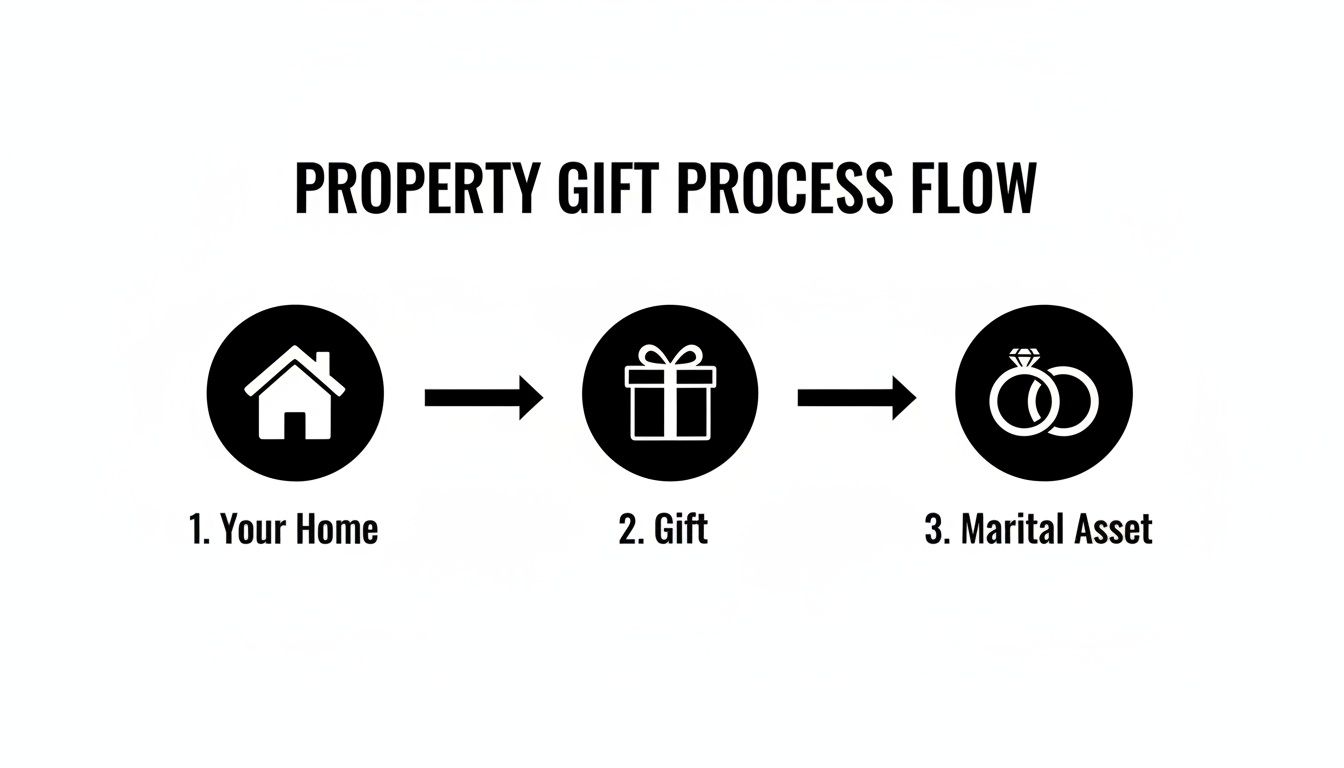
Understanding this legal transformation is key, as it affects everything from how the asset is treated by creditors to what happens in a divorce. If a marriage does end, knowing how assets are divided is critical, which we cover in our overview of what a marital settlement agreement involves.
Executing And Recording The Deed
After the deed is prepared and you've reviewed it for complete accuracy, it's time to sign and record it. "Executing" is the legal term for signing the document according to Florida's strict rules.
Here’s what’s required for a valid signature in Florida:
- The Grantor's Signature: As the one transferring the interest, you must sign the deed. Your spouse, as a grantee, does not need to sign.
- Two Witnesses: You must sign in the presence of two adult witnesses, who will then also sign the deed.
- Notarization: A Notary Public has to witness you signing and then notarize the document, which verifies your identity and that you signed willingly.
But you're not done yet. The final, crucial step is to record the deed with the Clerk of the Circuit Court in the county where the property is located, whether that's Hillsborough, Pasco, or Pinellas. Recording the deed makes the ownership change official public record.
You’ll also have to pay any required documentary stamp taxes. In Florida, if the property has a mortgage, the state will calculate this tax based on half of the outstanding mortgage balance. Don't skip this—an unrecorded deed has no legal effect against future buyers or creditors.
Choosing The Right Type of Spousal Property Ownership

When you decide to add your spouse to your property deed, you’re doing more than just putting a name on a piece of paper. You have to specify how the two of you will own the home together. This single decision has massive ripple effects on everything from estate planning to what happens if the marriage ends.
Fortunately, Florida law provides a clear front-runner for married couples. It’s called Tenancy by the Entireties (TBE), and for homeowners in Pasco, Pinellas, and Hillsborough Counties, it’s the gold standard for spousal property ownership. Think of it as a legal fortress built around your family home, available exclusively to married partners.
The law sees a couple holding title this way not as two individuals, but as one single, indivisible entity.
Understanding Tenancy By The Entireties
The real power of TBE comes from a couple of key features that other ownership forms just can't offer a married couple. Grasping these benefits is crucial to understanding why it's almost always the right call.
The first, and most well-known, is the automatic right of survivorship. If one spouse passes away, the surviving spouse immediately and automatically becomes the sole owner of the property. The home bypasses the probate court process entirely, which saves an immense amount of time, money, and public scrutiny. It's a clean and seamless transfer of ownership by operation of law.
The second huge advantage is TBE’s incredible creditor protection. If a creditor gets a judgment against only one spouse, they generally can't force the sale of the home to pay off that individual's debt. Because the couple is seen as a single unit, a debt belonging to just one "half" can't be used to break the whole.
This is a powerful shield for your family’s single most important asset, protecting it from things like one spouse's individual business debts or personal loans.
Comparing Florida Property Ownership Options For Spouses
To really see why TBE is so valuable, it helps to put it side-by-side with the other ways people hold title. Choosing one of these by mistake when adding a spouse can leave your family financially exposed. When preparing a new deed, it's essential to compare all your options.
Tenancy by the Entireties
- Best For: Married couples seeking maximum asset protection and seamless estate transfer.
- Availability: Married couples only.
- Right of Survivorship: Yes, automatic. The surviving spouse inherits the whole property outside of probate.
- Creditor Protection: Strong. It protects against creditors of only one spouse.
- Transferability: Neither spouse can sell or transfer their interest without the other's consent.
Joint Tenancy with Right of Survivorship
- Best For: Unmarried partners or family members who want automatic inheritance.
- Availability: Any two or more people.
- Right of Survivorship: Yes. The surviving owner(s) inherit the deceased's share.
- Creditor Protection: Weak. A creditor of one owner can force the sale of that owner's share.
- Transferability: Each owner can sell or transfer their share without the other's consent.
Tenancy in Common
- Best For: Co-investors or individuals who want their share to pass to their own heirs.
- Availability: Any two or more people.
- Right of Survivorship: No. The deceased's share goes to their heirs via probate.
- Creditor Protection: None. Each share is vulnerable to the individual owner's creditors.
- Transferability: Each owner can sell or transfer their share independently.
As the comparison makes clear, the other common forms just don't measure up for a married couple in Florida.
Choosing the correct vesting language on the deed is not a small detail; it is the core of the protection you're trying to create. Without explicitly stating you are taking title as "tenants by the entireties," you may default to a less protective ownership structure, negating the very benefits you seek.
For married couples, including the many LGBTQ+ families we serve, Tenancy by the Entireties is specifically designed to provide maximum stability and security. It directly reflects the legal and financial partnership of a marriage.
Of course, thinking about property and marriage also means thinking about what happens if things don't work out. Our firm has resources to help families navigate these complexities. You may find it useful to read our guide on Florida no-fault divorces for more insight into how the state handles marital property division.
The decision to add a spouse to your deed is a big one. But it's choosing the right type of ownership that gives that decision its true power and protective value, ensuring your home remains a sanctuary, both emotionally and legally.
Risks And Alternatives To Consider Before You Act
Adding a spouse to the deed on your home feels like a natural step in a marriage. It’s a gesture of commitment, but it’s also a permanent legal decision with serious consequences you need to understand, especially if the marriage doesn’t last.
The biggest risk? You’re converting your separate property into a marital asset. The moment your spouse’s name is on that deed, you have legally gifted them a share of your home. If you divorce, that home's value is now on the table for equitable distribution under Florida law. You could lose the equity you worked hard to build on your own before you ever said, "I do."
The Divorce Dilemma: Turning Separate Property Marital
This is where good intentions can lead to a financial nightmare. The desire to share everything is understandable, but it can create enormous headaches down the road.
We see this scenario play out often with clients across Hillsborough, Pinellas, and Pasco Counties. Imagine this:
- You own a home outright before getting married, maybe one you inherited.
- To show your new spouse they are part of your life and to simplify things if you pass away, you add them to the deed.
- But you also have children from a previous marriage, and you want them to inherit the value of that home.
By adding your new spouse to the deed, the home's value could be split in a future divorce. That directly reduces the inheritance you planned for your children. With many remarriages involving children from prior relationships, keeping separate property separate is often the wisest way to protect their future.
Exploring Smarter Alternatives
Fortunately, a quitclaim deed isn't your only choice. There are far more strategic ways to accomplish your goals without exposing your pre-marital assets to such risk. These alternatives offer protection while still allowing you to plan for the future together.
Before you sign anything, consider these powerful strategies instead:
- Prenuptial or Postnuptial Agreements: This is the most direct route. A legal contract can allow you to add your spouse to the deed while explicitly stating the home (or its pre-marital value) remains your separate property if you divorce.
- Creating a Trust: Placing your home into a trust is another excellent option. A trust can be designed to let both you and your spouse use the property, while clearly defining that your children are the ultimate beneficiaries.
- Life Estate Deeds: This tool grants your spouse the right to live in the home for the rest of their life. After they pass, ownership automatically transfers to whomever you designate—like your child—without going through probate.
A simple gesture of love requires serious legal planning to avoid unintended financial pain. What seems like a straightforward signature on a deed has permanent consequences that a well-drafted legal agreement can help control.
Disputes over asset division in divorces often arise because a pre-marital home was retitled during the marriage. You can explore insights on how marriage changes property rights to better protect yourself.
A carefully drafted Florida post-nuptial agreement is an especially effective tool if you're already married. It lets you formalize your intentions and protect your assets without ambiguity. Our firm proudly handles all LGBTQ+ family and divorce issues, ensuring every couple gets the clear guidance they need to secure their future.
Common Questions About Changing a Florida Property Deed
Even after deciding to add a spouse to a property deed, many Florida homeowners still have practical questions. Here in the Tampa Bay area, we see the same concerns pop up again and again from clients in Hillsborough, Pinellas, and Pasco counties.
Let’s tackle some of the most common questions we hear to help you navigate this important step with confidence.
Will Adding My Spouse to the Deed Affect My Mortgage?
This is a big one. Putting your spouse’s name on the deed does not automatically add them to the mortgage. The deed is about ownership, while the mortgage is about the debt. They are two separate legal instruments.
However, you need to check your loan documents for a “due-on-sale” clause. This standard provision gives your lender the right to call the entire loan due if you transfer any ownership interest in the property.
Fortunately, a federal law generally stops lenders from enforcing this clause when you add a spouse to the title. While the law is on your side, it’s always good practice to notify your lender of the change as a courtesy.
Do I Have to Pay Taxes When I Add My Spouse to the Deed?
When it comes to federal taxes, the answer is usually no. The IRS allows for unlimited tax-free transfers between spouses, so you won’t trigger a federal gift tax.
Florida’s own transfer tax, called the documentary stamp tax, is another story. This is where it gets a little tricky. If there is an existing mortgage on the property, you will almost certainly owe this tax.
The state sees this as your spouse taking on responsibility for half of the mortgage balance. The tax is calculated on that amount, which is called "consideration." For example, if you have a $200,000 mortgage balance, the tax is based on $100,000 (your spouse's half). At a rate of $0.70 per $100 of consideration, that would be a $700 tax bill. It's always smart to understand and resolve potential home title problems beforehand to ensure the transfer goes smoothly.
Can I Reverse the Process if We Get Divorced?
No, this is not a simple reversal. Once your spouse is on the deed, they are a legal co-owner. You cannot just take their name off the title, even if you owned the house by yourself before the marriage.
To remove them, your spouse must willingly sign a new deed that transfers their ownership interest back to you. If they don’t agree, you’ll need a court order.
This process typically happens as part of a divorce settlement or judgment, where a judge orders one spouse to sign over their interest in the home. This reality highlights the permanent nature of adding a spouse to a deed and why it should never be taken lightly.
This is a critical point many people miss. The act of adding your spouse to the deed is a gift to the marriage that can't be taken back without their consent or a judge's intervention.
Should We Get a Postnuptial Agreement Before Changing the Deed?
This is a very smart move, especially for couples in second marriages or where one partner brought the house into the marriage. A postnuptial agreement is a legal contract you create after getting married.
A "postnup" allows you to add your spouse to the deed for estate planning benefits while legally clarifying that the home's pre-marital value remains your separate property in a divorce.
This strategy offers the best of both worlds. You gain shared legal ownership and the powerful protections of tenancy by the entireties, all while contractually protecting the equity you built before the marriage. It’s a great way to provide clarity and peace of mind for both of you. Our firm is proud to help all couples, including those in the LGBTQ+ community, build legal structures that protect their assets and their futures.
At Foley Family Law, we understand that decisions about marital property are deeply personal and have lasting consequences. We handle family and divorce issues in Pasco, Pinellas, and Hillsborough Counties. If you are considering adding a spouse to your deed or have questions about how to protect your assets, contact us for a consultation. Let us help you find the right path forward for your family. Visit us at https://wfoleylaw.com to learn more.


